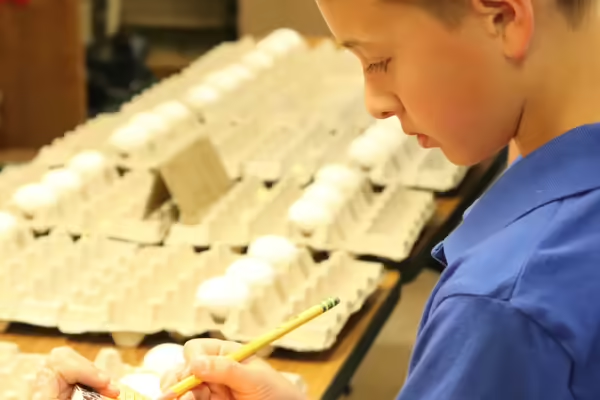
URBANA, Ill. — Illinois 4-H members demonstrated their poultry evaluation skills during the 2026 Illinois 4-H Poultry Judging Contest held April 28 on the University of Illinois Urbana-Champaign campus.
The annual contest provides youth with hands-on experience evaluating poultry and eggs using industry standards. Participants build knowledge in quality, safety, and nutrition — key components of a safe and reliable food system — while strengthening skills in observation and decision-making.
“This contest gives youth the opportunity to apply what they’ve learned in a real-world setting,” said Myla Munro, 4-H youth development educator and contest coordinator. “They’re not only evaluating poultry and eggs, but they’re also building confidence, sharpening critical thinking, and gaining a deeper understanding of the food systems they’re part of.”
The four highest-scoring senior 4-H members will be selected to represent Illinois on the state team. Senior 4-H members are youth ages 14 to 18 as of Jan. 1 of the current year. These individuals are invited to compete at the National 4-H Poultry and Egg Conference, held in November in Louisville, Kentucky.
The results of the 2026 Illinois 4-H Poultry Judging Contest include:
Senior Individual Placings: Lydia Worsham of DeWitt County in first, Weston Goebel of Jasper County in second, Kylie Kocher of Richland County in third, Arabella Baumann of McLean County in fourth, and Owen Kocher of Richland County in fifth.
Junior Individual Placings: Brandon Wier of DuPage County in first, Gavin Grenier of DuPage County in second, Titan Clark of Washington County in third, Ciara Schlenz of Bureau County in fourth, and Brennan Walsh of Kankakee County in fifth.
In Senior Team Placings, Richland County swept the top with their Richland 1 and Richland 2 teams taking first and second place, respectively. The Jasper County 2 team finished out the top three.
“This contest continues to grow thanks to the dedication of our county programs and the support youth receive at the local level,” said Myla Munro, 4-H youth development educator and contest coordinator. “We’re especially grateful to Dr. Ken Koelkebeck for his long-standing commitment to this event and the meaningful role he plays in creating a high-quality experience for our youth.”
Source: Myla Munro, 4-H Youth Development Educator
Writer: Carissa Nelson, 4-H Media Communications Manager, carissa7@illinois.edu
About Illinois 4-H: About Illinois 4-H:
Illinois 4-H is the flagship youth development program of University of Illinois Extension, administered through the College of Agricultural, Consumer and Environmental Sciences. Through hands-on learning and life-changing experiences, Illinois 4-H prepares youth to be Beyond Ready — ready for college, career, military service, entrepreneurship, and more. Young people build confidence, leadership, and resilience as they explore interests from agriculture to computer science. Independent research and national surveys confirm the powerful outcomes of 4-H: participants are 40% more likely to pursue a college degree, twice as likely to obtain technical training, and two times more likely to serve in the military. With a legacy of cultivating leaders, Illinois 4-H continues to grow the next generation who are equipped to thrive in life and work today and beyond.
University of Illinois Extension develops educational programs, extends knowledge, and builds partnerships to support people, communities, and their environments as part of the state's land-grant institution. Extension serves as the leading public outreach effort for University of Illinois Urbana-Champaign and the College of Agricultural, Consumer and Environmental Sciences in all 102 Illinois counties through a network of 27 multi-county units and over 500 staff statewide. Extension’s mission is responsive to eight strategic priorities — community, economy, environment, food and agriculture, health, partnerships, technology and discovery, and workforce excellence — that are served through five program areas — 4-H youth development, agriculture and agribusiness, community and economic development, health and community wellness, and natural resources, environment, and energy.