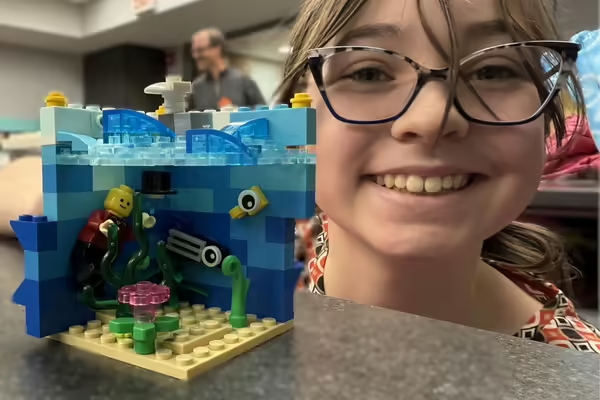
URBANA, Ill. — Tiny spaces sparked big creativity for Illinois 4-H youth during the December Creating with Building Bricks Challenge, where participants were tasked with designing detailed mini scenes for the theme “Habitats.” Youth created small diorama-style builds for a minifigure, roughly 2.5 inches wide and deep.
In the 8–10-year-old division, Lauren Oslawski, 10, of the Coles County All-Stars 4-H Club, earned top honors with a peaceful garden scene. Her build features a young girl watering plants surrounded by a cherry tree, purple flowers by a fence, an orchid growing from the back wall, and mosses and flowering vines climbing the structure, all packed into a carefully detailed miniature space.
The 11–13-year-old division winner, Isabella Roth, 13, of the Lego Club of DuPage in DuPage County, created a striking half-and-half habitat scene. Her build depicts a figure in the ocean below, with the waves visible above, using contrast and balance to tell two stories within one compact design.
In the 14–18-year-old division, Anna Rutherford, 14, of the Pin Oak Progressors 4-H Club in Madison County, impressed judges with a cozy castle kitchen habitat. Her build includes an abundance of food and cooking supplies, with a minifigure in the middle of preparing food, bringing warmth and storytelling to a medieval-inspired space.
“It was really neat seeing how much detail our 4-Hers could fit into such small builds,” said Amy Henschen, University of Illinois Extension 4-H senior program lead. “We limited them to building on an 8-stud by 8-stud plate, which is only about 2.5 inches wide and deep. In that tiny space, our winners packed in a ton of clever storytelling.”
The monthly challenge series was created to promote Illinois 4-H’s new Creating with Building Bricks project, which helps youth develop creativity, problem-solving, and design skills using popular plastic building bricks such as LEGO and MEGABLOKS.
“This has been such a fun series of monthly building challenges for us and our members,” Henschen said. “We hope it inspires Illinois youth to join 4-H and sign up for our new Creating with Building Bricks project. Youth in that project will have the opportunity to improve their building skills and create original builds to enter at their local county fairs and shows this summer.”
Winners receive a build-it-yourself building brick medal along with a small keepsake.
To learn more about the Creating with Building Bricks project and future opportunities, visit https://go.illinois.edu/4Hbricks or contact your local county Extension office.
About Illinois 4-H:
Illinois 4-H is the flagship youth development program of University of Illinois Extension, administered through the College of Agricultural, Consumer and Environmental Sciences. Through hands-on learning and life-changing experiences, Illinois 4-H prepares youth to be Beyond Ready — ready for college, career, military service, entrepreneurship, and more. Young people build confidence, leadership, and resilience as they explore interests from agriculture to computer science. Independent research and national surveys confirm the powerful outcomes of 4-H: participants are 40% more likely to pursue a college degree, twice as likely to obtain technical training, and two times more likely to serve in the military. With a legacy of cultivating leaders, Illinois 4-H continues to grow the next generation who are equipped to thrive in life and work today and beyond.
University of Illinois Extension develops educational programs, extends knowledge, and builds partnerships to support people, communities, and their environments as part of the state's land-grant institution. Extension serves as the leading public outreach effort for University of Illinois Urbana-Champaign and the College of Agricultural, Consumer and Environmental Sciences in all 102 Illinois counties through a network of 27 multi-county units and over 700 staff statewide. Extension’s mission is responsive to eight strategic priorities — community, economy, environment, food and agriculture, health, partnerships, technology and discovery, and workforce excellence — that are served through six program areas — 4-H youth development, agriculture and agribusiness, community and economic development, family and consumer science, integrated health disparities, and natural resources, environment, and energy.