Title
2026 Illinois Extension Master Naturalist state conference
October 15-16
Join us in Springfield, Illinois, on October 15th and 16th for the 2026 Illinois Master Naturalist Conference. This statewide event brings together Master Naturalist volunteers and Extension staff from across the state to learn, grow, and connect.
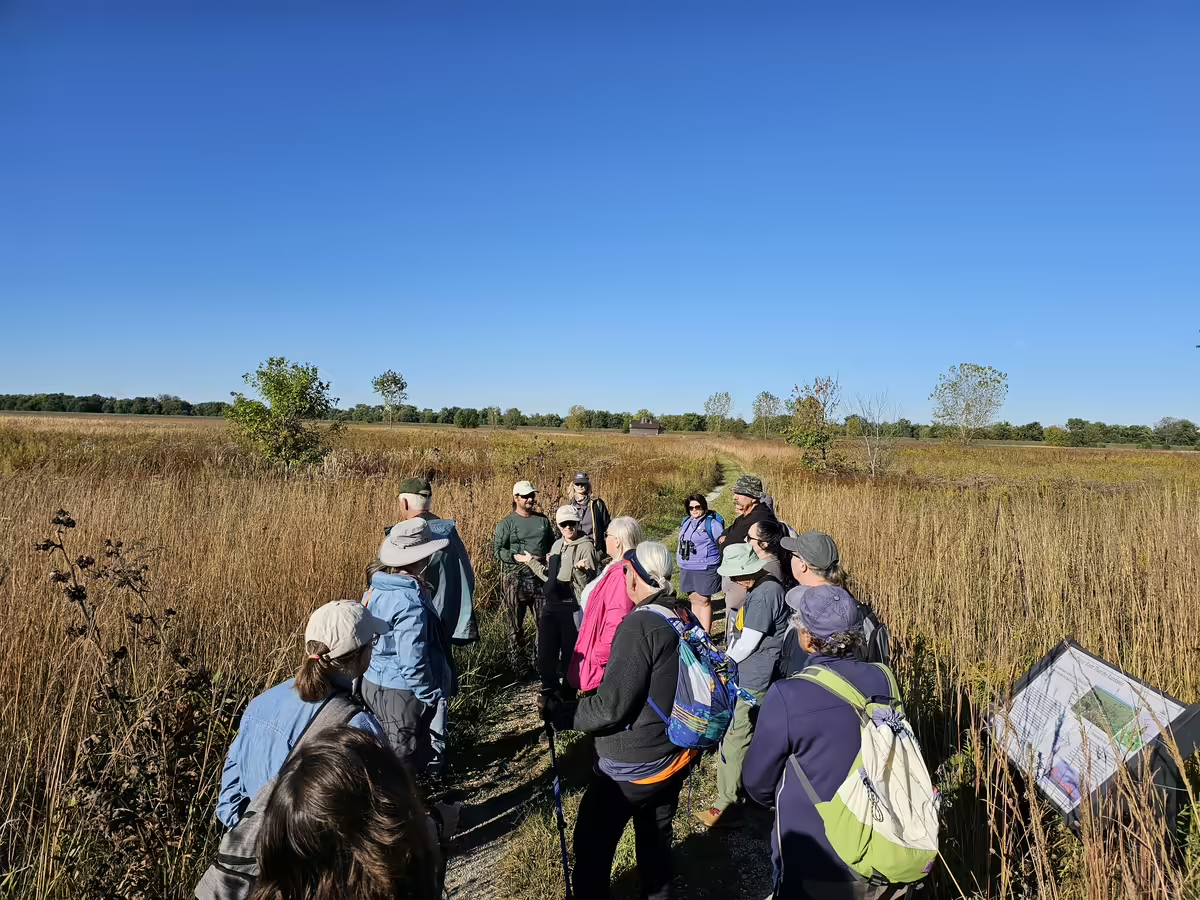
This year’s conference theme, “Rooted in Prairie: Deep Connections, Lasting Impacts,” highlights the ecological, cultural, and scientific importance of prairie systems and the enduring relationships that connect people, land, and science.
2026 Illinois Master Naturalist State Conference
Rooted in the Prairie, Deep Connections, Lasting Impact
Location: University of Illinois Springfield Public Affairs Center, 2200 Ernest Hemingway Drive. Springfield, IL
Keynote:
Michael D. Wiant
PhD; Director Emeritus, Illinois State Museum - Dickson Mounds
Looking Back to See Forward: Exploring Indigenous History in Illinois.
For more than 150 years, both avocational and professional archaeologists have explored the material record of the Indigenous peoples of Illinois, who comprise many distinct cultures and groups. Although they have uncovered only a small fraction of this record, they have learned much about Indigenous history, a dynamic narrative that continues to be refined. When their work is coupled with that of allied scientists, such as archaeobotanists, archaeozoologists, and geomorphologists, the research reveals an increasingly detailed narrative that is both historical and insightful for the future. Dr. Wiant draws on a portfolio of archaeological research and more than 50 years of personal exploration to encourage you to consider why knowing the past should inform today’s decision-making and tomorrow’s future.
Quick Schedule:
October 15, 2026
Tours: 9:00 a.m. - 3:00 p.m.
Various Locations- See conference website for details
Tours to local sites.
Evening Mixer: 6:00 p.m. - 9:00 p.m.
Camp Illinek, Chatham, IL (6610 Iron Bridge Rd.)
Evening mixer for night tours, socializing, and yummy food at a campsite.
October 16, 2025
Classroom Sessions: 8:00 a.m. - 4:00 p.m.
UIS Public Affairs Center, Springfield, IL (2200 Ernest Hemingway Dr.)
8:00 - 9:00 am Registration
9:00 - 9:10 am Welcome
9:10 -10: 30am Keynote speaker
10:30- 10:45 am Break
10:45 -11:35 am Breakout 1: Climate Change
11:40 -12:30 pm Breakout 2: Identification
12:30 -1:45 pm Lunch
1:45 -2:40 pm Breakout 3: Storytelling
2:45 -3:45 pm Conference Book Club: Eager
3:45 - 4:00 pm Closing
Things to Know:
Book Exchange Table
Bring a book, take a book
Attendees are invited to participate in a book exchange table throughout the conference. Bring one or more books you’d like to share and exchange them for new reads. The table will feature nature-focused, science, and environmental titles, providing a casual way to connect with others through shared interests and expand your library.
Conference Book Club
Read Together, Talk Together, Listen Together
This year, we’re bringing the reading experience to life with a dedicated conference book club. Join a lively, facilitated discussion around a featured book and explore its ideas with fellow naturalists in an engaging, small-group setting.
Let’s take your experience one step further by attending a live recording of the Everyday Environment podcast. Watch as the book is reviewed, hear expert insights, and be a part of a real-time conversation that connects literature, science, and the environment.
Eager: the surprising secret life of beavers and why they matter by Ben Goldfarb
Eager is the powerful story of how one of the world’s most influential species can help us fight drought, flooding, wildfire, extinction, and climate change — and how we can learn to coexist with our fellow travelers on this planet.
Conference Merchandise
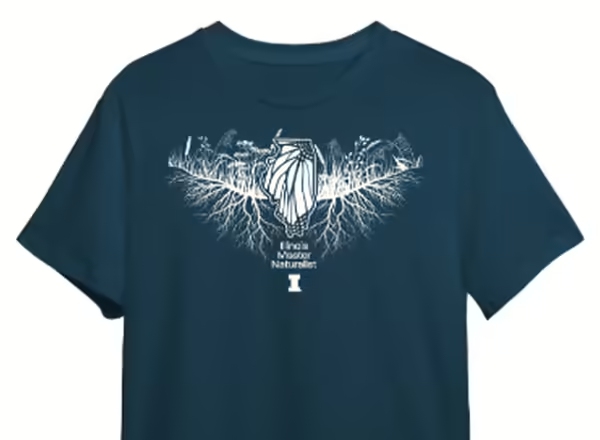
T-shirt
The conference shirt is available for purchase by conference attendees and any Master Naturalist whose local coordinator is attending.
If you are attending the conference, order your shirt through the conference registration. If you are NOT attending the conference, contact your local coordinator to arrange shirt pickup and order your t-shirt here: 2026 T-shirt and bag order for non-conference attendees.
Breakout Sessions
Choose one course to attend during each breakout session and gain insights on topics like drought, prairie grass identification, and Sandhill cranes.
Breakout 1: Climate Change
10:45 -11:35 am
Climate Stewards: Turning climate conversations into local action
Linda Derhak, Energy and Climate Outreach Associate, Illinois Extension
Public concern about climate change is high in Illinois, yet few people report regularly having conversations about it. This session bridges the gap by exploring best practices for effective climate communication, including research-backed strategies such as storytelling, hope-inspired messaging, and meaningful metaphors. Participants will have the opportunity to engage with content from our Climate Stewards course, which will explore community perceptions of climate change, communication strategies, and climate resilience at the local level. By the end of this session, attendees will have an understanding of how to have engaging conversations around climate change and ideas of how to integrate climate action into their volunteer work.
Exploring Nature's Timing and Climate Change
Lorna Shuman, Education Division Head, IDNR
When does spring start? When do the flowers bloom? How does nature know when to start at different times of year? It's all about the phenology or timing. Learn about this concept and how you can bring it into your classroom. Phenology is a great way for students to explore the changes happening in nature due to climate change. Explore different ways to collect data with students of all ages, connect it to common core math you are already doing in your classroom, and help students understand nature in new ways. Explore how this is affecting the native species of Illinois.
From Drought to Flood and Back Again
Trent Ford, Illinois State Climatologist, Illinois State Water Survey
Illinois is thought to be a water-rich state, and yet we never seem to have the right amount. As the state swings from flood to drought, or in some cases experiences both simultaneously, strategies for managing water are paramount. We'll discuss the problems of flooding and drought, changes in these risks across our state, and the important role of healthy prairie ecosystems for managing flooding and drought now and into the future.
Breakout 2: Identification
11:40 -12:30 pm
The Buzz on Bees: Illinois Native Bees
Sarah Davis, IDNR ENTICE Coordinator, IDNR
What is all the buzz about? Native bees are where it's at, and there are lots of them in Illinois. Almost 500, to be exact. From small, metallic sweat bees to large, fluffy bumble bees, learn all about the amazing bees that call Illinois home. Explore bees versus other pollinators, native versus nonnative bees, and their unique behaviors. Discuss the challenges they face and discover ways to help native bees with human-enhanced nesting structures, pollinator gardens, and more.
Birding for Master Naturalists
Brodie Dunn. Extension Outreach Associate, Illinois Extension
This session will focus on leveraging tools and experiences to improve your bird identification skills as a master naturalist. Explore practical identification using sight and sound, the eBird and Merlin birding applications, and other tips and tricks that will help you cultivate and apply your birding skills. This session will be relevant for beginner and intermediate birders.
Which Grass is Which: Prairie Grass Identification
Erin Garrett, Natural Resources, Energy, and Environment Educator, Illinois Extension
When looking at green blades of grass, it can often be difficult to tell which grass is which. While identifying grasses can be tricky, it doesn’t always have to be. Learn the basics of grass identification and how to identify prairie grasses of Illinois.
Breakout 3: Storytelling
1:45 -2:40 pm
A Brief History of Bird Banding and Its Importance
Matthew Hayes, Director of Conservation Science, Illinois Audubon Society
How many times have you watched birds in your yard and thought, "Oh, my pair is back. Wonder if they will nest this year?" How do you know you're looking at the same birds year after year? Unless they have natural markings that you can identify, it is difficult to know for sure. By applying bands to a bird's leg, we can identify that individual. Why is that important? Once we can identify individuals, we can start to understand basic population parameters such as birth rate, death rate, movement out of a population, and movement into a population. These are critical factors for scientists to measure to aid in species conservation and long-term persistence. This talk is a discussion on bird banding, including history, regulations, and changes in banding technology.
Connecting People to the Prairie Through Interpretation
Jenny Garver, Volunteer Coordinator, Macon County Conservation District
Explore creative ways to interpret prairie ecosystems for audiences of all ages using plants, wildlife, geography, seasonal change, and the sky above. This session highlights how meaningful interpretation can inspire curiosity, create memorable “ah-ha” moments, and strengthen connections to prairie stewardship, habitat management, and volunteer engagement. Drawing from a botanist’s perspective, participants will leave with practical, adaptable ideas for parks, preserves, nature centers, and educational programs.
Origins of the Tallgrass Prairie
Fred Delcomyn, Professor Emeritus, University of Illinois Urbana-Champaign
The first Europeans to see the tallgrass prairie of Illinois were overwhelmed by its majesty. They likely thought the prairie had existed for hundreds of thousands of years, if they thought about it at all. They would have been wrong.
The tallgrass prairie they encountered was only about 10,000 to 12,000 years old, shaped by environment, climate, and human activity. This presentation will lay out the events that led to the formation of tallgrass prairie and brought us to today. It will cover the last glaciation of Illinois, the Wisconsinan, and its immediate aftermath. The dry period that followed the retreat of the glaciers, the Hyspithermal, created conditions favorable for drought-tolerant plants from the southern parts of North America. Then, after the climate had become wet enough to support forests again, the indigenous people living there used fire periodically, suppressing tree growth across much of the landscape, resulting in the prairie encountered by Marquette and Joliet in 1673.
After Illinois became a state in 1818, and accelerated by John Deere's invention of the steel plow in 1837, settlers began pouring into Illinois to exploit the rich, fertile soil of the prairie. The presentation will conclude with the stark fact that of the 60% or so of the state that was covered by prairie when Europeans first visited, only about 0.01% of the original, unplowed prairie remains.
Field Excursions
Field excursions and tours take place on October 15th at various locations and times. See details below:
Morning Excursions (10:00 am start)
Habitat Restoration Tour
10:00 am to 2:00 pm
Maximum registration: 20
Bring your own lunch (no lunch provided)
Morning: Rexroat Prairie, Virginia, IL
The Rexroat Prairie is a historical prairie restoration, founded 50 years ago in 1976. It was planted with the intention of being a living showcase of native Midwestern Prairie plants. Join a Rexroat Prairie Board member for a walk through the prairie and a tour of the restored log cabins on site. This tour also includes an opportunity to gather seed from the prairie.
To learn more about this site: https://rexroatprairie.wixsite.com/rexroatprairie
Afternoon: Tyner-Lael Wetland & Prairie Restoration, Ashland, IL
Explore the Tyner-Lael habitat project in rural Ashland, IL, and learn about this privately built, grant-funded project that began in 2015. The project consists of a 6-pool wetland and currently has about 20 acres of prairie planting. An additional 11 acres have just been enrolled in the CRP pollinator project and were seeded in November 2025.
Invasive Species Management field tour
Unit 18 Extension Office, Hillsboro
10:00 am to 2:00 pm
Maximum registration: 20
Lunch Provided
Join Extension Horticulture Educator Andrew Holsinger to learn about invasive species in Illinois, identify plants on a walking tour, review commonly used management tools, and view demonstrations of management techniques.
Nipper Wildlife Sanctuary, Loami, IL
10:00 am to 1:00 pm
Maximum registration: 25
The Nipper Wildlife Sanctuary is a private wildlife Sanctuary located south of Loami, Illinois. Nipper features both wetland and prairie habitats. Guided tour of the property.
Join Jon Henn, Extension Faculty Specialist and Assistant Professor, Grassland Ecology and Restoration, for a short presentation about the value of natural history observations. Learn about iNaturalist and how it contributes to conservation and ecology, the strengths and weaknesses of iNaturalist, and a quick demonstration of how to submit observations. Followed by a tour of the Nipper Wildlife Sanctuary and the chance to use iNaturalist in the field.
Afternoon Tours (1:30 pm start)
Behind-the-Scenes Tour of the Illinois State Museum Research & Collections Center
1:30 pm start time
Maximum registration: 10
The Research and Collections Center is a 97,000 square-foot facility dedicated to collections care, research, and education. This collection bank holds over 11.8 million objects as an investment for the future. The RCC houses vast collections ranging in size from microscopic pollen grains to colossal mastodon fossils. Within its walls, the Illinois State Museum fulfills its mission of collecting, studying, and interpreting objects that represent the natural history, anthropology, and art of Illinois. It provides state-of-the-art space for the care and study of collections, as well as laboratories and special program spaces for Museum scientists, artists, and educators.
To learn more about this site: https://www.illinoisstatemuseum.org/welcome-ism-research-collections-center.html
Dana-Thomas House, Springfield, IL
1:30 pm start time
Maximum registration: 60
Note: This tour has a 15-person minimum; if the minimum registration is not achieved, we will contact you.
Description from website: Take a guided tour of the Dana-Thomas House, a State Historic Site, and experience an exquisite example of Prairie School architecture, the first American style of architecture, which originated in the Midwest.
In the heart of a Springfield community, forward-thinking heiress Susan Lawrence Dana hired architect Frank Lloyd Wright to design a home in which she could advance ideas about education and democracy.
This home is one of the best-preserved examples of Wright’s “organic architecture,” containing more than 100 pieces of custom furniture and over 250 works of original art glass.
To learn more about this site: https://dana-thomas.org/
Accommodations:
Where to stay:
Springfield has plenty of hotel options and a few camping options. Check out and book your accommodations below. Note: There is no room block for this conference.
Hotel Options: Comfort Inn and Suites, Fairfield Inn & Suites Springfield, La Quinta Inn & Suites, Country Inn & Suites, Holiday Inn Express.
Camping Options: Double J Campground, Hickory Point Campground
Extra things to see:
Lincoln Memorial Garden and Nature Center, Washington Park Botanical Gardens, Abraham Lincoln Presidential Museum, Lincoln Home National Historic Site, Old State Capitol, Lincoln Tomb