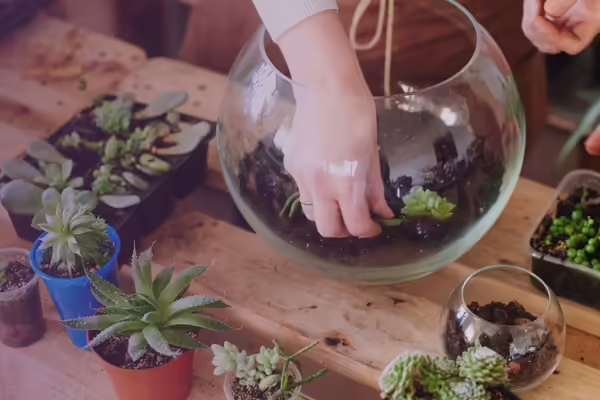
HENRY, Ill. – Get creative and connect with nature at our Terrarium Workshop, a hands-on program taking place Friday, March 27, from 2:00 to 4:00 p.m. at the Marshall-Putnam Extension Office, 509 Front Street, Suite 4, Henry, IL 61537.
This interactive workshop will guide participants through the process of creating their own terrarium—a small, enclosed garden featuring plants and moss. Terrariums are a fun and approachable way to bring greenery indoors, and they make great decorative pieces or gifts. During the program, participants will learn basic principles of terrarium design, plant selection, and care while assembling a unique miniature ecosystem to take home.
The workshop is designed for beginners and plant enthusiasts alike. No prior experience is necessary, and all materials needed to create a terrarium are provided. This program is made possible in part through support from a Thrivent grant, which covers a portion of participants’ registration costs.
Registration cost is $20. Space is limited, and pre-registration is required. Register online at go.illinois.edu/terrariumworkshop.
For questions or if you need an accommodation to participate, please contact Emily Hansen at emhansen@illinois.edu or 815-224-0896. Early requests are strongly encouraged to allow sufficient time to meet your access needs.
University of Illinois Extension develops educational programs, extends knowledge, and builds partnerships to support people, communities, and their environments as part of the state's land-grant institution. Extension serves as the leading public outreach effort for University of Illinois Urbana-Champaign and the College of Agricultural, Consumer and Environmental Sciences in all 102 Illinois counties through a network of 27 multi-county units and over 700 staff statewide. Extension’s mission is responsive to eight strategic priorities — community, economy, environment, food and agriculture, health, partnerships, technology and discovery, and workforce excellence — that are served through five program areas — 4-H youth development, agriculture and agribusiness, community and economic development, health and community wellness, and natural resources, environment, and energy.