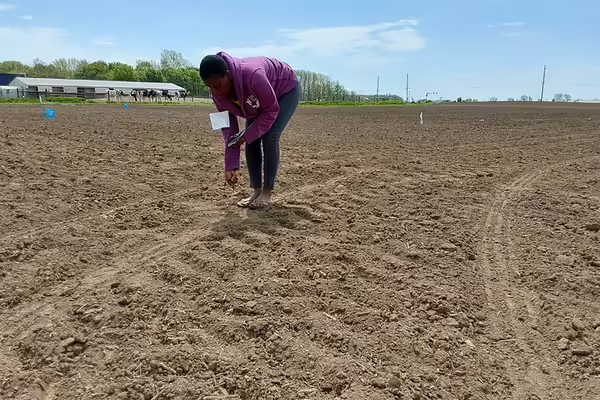
Tile drainage is common in U.S. Midwest agricultural fields, helping to remove excess water and aerate the soil. While the practice enhances crop productivity, it can cause phosphorus to leak into nearby waterways, where it contributes to harmful algal blooms. Directing tile-drain runoff through a structure filled with biochar – a form of charcoal produced from organic waste – provides a potential remedy for phosphorus pollution, but the method is novel and not fully explored.
In a new study, University of Illinois Urbana-Champaign researchers examined the capacity of specially designed biochar pellets to absorb and release phosphorus under real-world conditions, finding they don’t perform as well as they do in laboratory settings.
“The idea was to find out if we can use designer biochar pellets to capture phosphorus from tile drains and later add the pellets to the field as a phosphorus nutrient amendment that reduces subsequent phosphate application,” said lead author Agnes Millimouno, a doctoral candidate in the Department of Agricultural and Biological Engineering, part of the College of Agricultural, Consumer and Environmental Sciences and The Grainger College of Engineering at the University of Illinois Urbana-Champaign.
The designer biochar pellets were made by mixing sawdust with bentonite clay and lime sludge, then heating and drying them to create a dense, carbon-rich material with a large surface area.
Read the full article from College of ACES.
University of Illinois Extension develops educational programs, extends knowledge, and builds partnerships to support people, communities, and their environments as part of the state's land-grant institution. Extension serves as the leading public outreach effort for University of Illinois Urbana-Champaign and the College of Agricultural, Consumer and Environmental Sciences in all 102 Illinois counties through a network of 27 multi-county units and over 500 staff statewide. Extension’s mission is responsive to eight strategic priorities — community, economy, environment, food and agriculture, health, partnerships, technology and discovery, and workforce excellence — that are served through five program areas — 4-H youth development, agriculture and agribusiness, community and economic development, health and community wellness, and natural resources, environment, and energy.