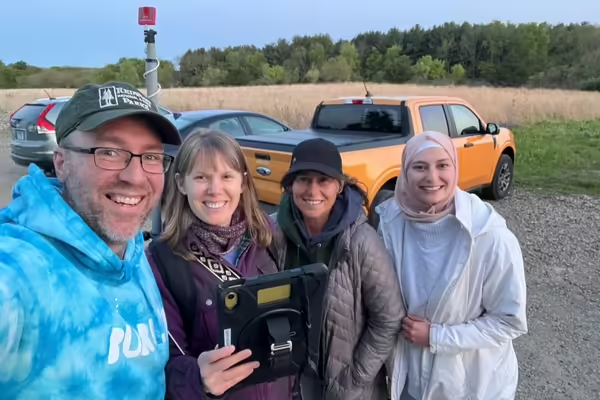
As bat conservation efforts continue across Illinois, Master Naturalist volunteers in LaSalle County are helping researchers better understand local bat populations through acoustic monitoring surveys and public education programs.
Since 2025, the University of Illinois Extension has partnered with the Illinois Bat Conservation Program to conduct volunteer-led walking acoustic transect surveys in LaSalle County. During these surveys, trained volunteers use specialized acoustic recording equipment to detect and identify bats by recording their echolocation calls. The data contributes to statewide efforts to monitor bat populations and track species distribution over time.
A key leader in the local effort has been Master Naturalist Chris Woeltje, who has conducted surveys at locations including Dayton Bluffs Preserve, Belrose Farm, and Harper's Farm. In 2025 alone, Woeltje completed seven surveys, documenting multiple bat species and recording more than 200 bat passes. The most commonly detected species was the big brown bat, while surveys also detected eastern red bats, hoary bats, silver-haired bats, and evening bats. The highest level of activity occurred during an August survey at Dayton Bluffs Preserve, when 70 bat calls were recorded.
The monitoring program continues to expand. In 2026, a new survey route was added at Dixon Waterfowl Refuge, led by Master Naturalist Hannah Safiran. The addition of a second survey route broadens the area's monitoring efforts and provides valuable information on bat activity across different habitats.
Survey work for the 2026 season will continue through the end of September, with volunteers collecting data that will be analyzed through the Illinois Bat Conservation Program. The long-term goal is to build a dataset that helps scientists identify population trends and guide conservation efforts for Illinois bats.
To complement the monitoring program, University of Illinois Extension has also been offering Bat Acoustic Walks, giving community members a chance to learn about bat ecology and conservation while testing the same acoustic monitoring equipment used during the surveys. Participants can experience firsthand how researchers detect bats in real time, even when the animals are not visible.
One more Bat Acoustic Walk is scheduled for September 19. Additional opportunities to learn about bats will be available this fall through the Creatures of the Night program on October 24 and National Bat Week - Bats & Snacks on October 29, both of which will feature bat-focused hikes and educational activities.
"Bats play an important role in our ecosystems by helping control insect populations, yet many species face ongoing conservation challenges," said Emily Hansen, natural resources educator. "Dedicated volunteers like Chris and Hannah are helping us better understand and protect these important animals while also engaging the public in conservation science."
For more information about upcoming bat programs or the University of Illinois Extension Master Naturalist program, visit our website.
University of Illinois Extension develops educational programs, extends knowledge, and builds partnerships to support people, communities, and their environments as part of the state's land-grant institution. Extension serves as the leading public outreach effort for University of Illinois Urbana-Champaign and the College of Agricultural, Consumer and Environmental Sciences in all 102 Illinois counties through a network of 27 multi-county units and over 500 staff statewide. Extension’s mission is responsive to eight strategic priorities — community, economy, environment, food and agriculture, health, partnerships, technology and discovery, and workforce excellence — that are served through five program areas — 4-H youth development, agriculture and agribusiness, community and economic development, health and community wellness, and natural resources, environment, and energy.