OTTAWA, Ill. – While many people spend summer days searching for treasures at garage sales or flea markets, a group of local University of Illinois Extension Master Naturalist volunteers went looking for something far older: fossils more than 300 million years old.
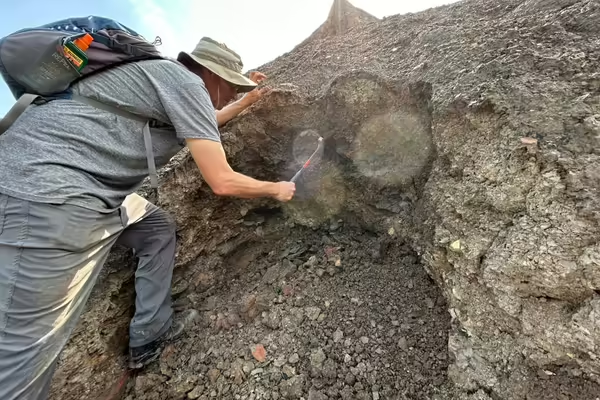
In June, Illinois Extension Master Naturalist volunteers joined Extension Educator Emily Hansen for a field trip to a site known as the Braceville Spoil Pile near Braceville, Illinois. The privately owned site is closely tied to the famous Mazon Creek fossil beds. Many of the fossils that brought international attention to the area were discovered during the region's coal mining era. The "spoil piles" explored by fossil hunters today were created when layers of rock and soil were removed during strip mining operations in the mid-1900s, uncovering fossil-bearing concretions that had remained buried for millions of years.
During the outing, volunteers searched for ironstone concretions, round rock formations that can preserve ancient plants and animals in remarkable detail. These fossils date back roughly 300 million years, when Illinois was a tropical coastal environment of swamps, rivers, and shallow seas. The Mazon Creek fossil record provides one of the most complete windows into life from that period anywhere in the world.
"Fossil hunting at Mazon Creek is a little like a treasure hunt," Hansen said. "You can spend hours searching and collecting concretions without knowing what's inside. The anticipation is part of the fun."
That anticipation continues long after the field trip ends. Rather than breaking concretions open with tools, collectors often use a freeze-thaw method that allows the rock to naturally split along its midline. Volunteers are currently cycling their finds through repeated freezing and thawing in home freezers, a process that can take weeks or even months before the concretions open.
The lengthy process adds to the excitement because not every concretion contains a fossil. In fact, only about 10 to 15 percent of collected concretions reveal fossilized plants or animals when opened.
For many volunteers, the field trip built on a growing interest in fossils, geology, and Illinois' prehistoric past. Fossils have been a popular topic among local Master Naturalist volunteers this year, and Hansen has presented several programs for the public exploring the ancient environments, plants, and animals that once existed across the Illinois Valley.
"Field experiences like this help our volunteers connect classroom learning with real-world discovery," Hansen said. "Searching for fossils gives participants a hands-on opportunity to explore Illinois' natural history and gain a deeper appreciation for the landscapes and ecosystems that existed here millions of years ago."
Although the group's fossil-hunting results remain a mystery for now, volunteers are eagerly awaiting the outcome of their freeze-thaw experiments. Whether the concretions reveal ancient fern leaves, marine animals, or no fossil at all, the experience provided an opportunity to connect with Illinois' deep natural history while learning hands-on scientific techniques.
Community members interested in learning more about Mazon Creek fossils and seeing authentic fossil specimens will have an opportunity this fall when Hansen presents “Fossils of the Illinois Valley" at the Utica Public Library on November 12, 2026 from 4:30 p.m. – 5:30 p.m. The program explores the region's prehistoric history and showcases examples of fossils found in northern Illinois. Register online at go.illinois.edu/FossilUtica
University of Illinois Extension's Master Naturalist program trains volunteers to serve their communities through natural resource stewardship, education, and citizen science. Through field experiences such as fossil collecting, volunteers expand their knowledge while helping connect others to the natural history of Illinois.
For more information about upcoming natural resource programs or the Illinois Extension Master Naturalist program, visit go.illinois.edu/BLMPMN
University of Illinois Extension develops educational programs, extends knowledge, and builds partnerships to support people, communities, and their environments as part of the state's land-grant institution. Extension serves as the leading public outreach effort for University of Illinois Urbana-Champaign and the College of Agricultural, Consumer and Environmental Sciences in all 102 Illinois counties through a network of 27 multi-county units and over 500 staff statewide. Extension’s mission is responsive to eight strategic priorities — community, economy, environment, food and agriculture, health, partnerships, technology and discovery, and workforce excellence — that are served through five program areas — 4-H youth development, agriculture and agribusiness, community and economic development, health and community wellness, and natural resources, environment, and energy.