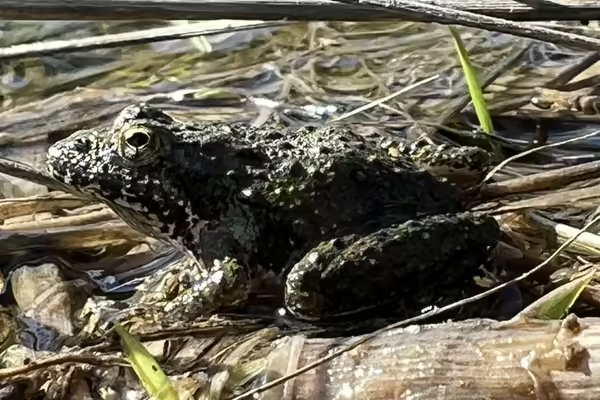
OTTAWA, Ill. – The Calling Frog Survey is a citizen science project that invites community members to learn how to identify frog calls and contribute valuable data to amphibian conservation efforts. Before the Calling Frog Survey began, little was known about the distribution and status of amphibians in our region. Now the survey is providing important information to scientists and land managers who can use the data to conduct management and research that benefits amphibian populations.
In 2025, the Calling Frog Survey in LaSalle County grew significantly, expanding from 2 routes in 2024 to 7 routes this year. The data collected provides critical insights into amphibian abundance and distribution, supporting conservation planning and land management decisions. In 2025, 9 volunteers from LaSalle county participated in the survey, recording over 50 volunteer hours. They observed many of the 13 species of toads and frogs found in Northern Illinois, including Wood Frogs, Spring Peepers, Northern Leopard Frogs, Gray Treefrogs, and Cricket Frogs.
Chris Woeltje, Master Naturalist volunteer, began the first Calling Frog Survey routes in LaSalle County in 2024: “For me, the most rewarding part of the frog surveys was discovering the unknown out in LaSalle County. Knowing we had a large population of the cricket frogs out here was huge for me personally. Knowing that those frogs are all but gone from the Chicagoland area but they are thriving at multiple sites is just the best.”
This expansion reflects both the growing interest in environmental stewardship and the dedication of our volunteers. By participating, volunteers not only contribute valuable data but also deepen their connection to local ecosystems.
Master Naturalist volunteer Joann Bowman brought her 11-year-old grandson with her on her monitoring routes in Bureau County, stating “We found it fun and rewarding to identify so many frogs in a 1-2 mile stretch of the I&M Canal. It was a great learning experience and I’m planning on participating again next year.”
The Calling Frog Survey demonstrates how community involvement can drive meaningful scientific outcomes. Each observation helps scientists track changes in amphibian populations, which are key indicators of ecosystem health. Through this project, volunteers become partners in conservation, ensuring that future generations can continue to enjoy the rich biodiversity of our region.
For those interested in participating in the Calling Frog Survey, a watch party for the next virtual training will be held on January 31, 2026 from 1:00 p.m. – 5:00 p.m. at the LaSalle County Extension Office (1689 N. 31st Rd, Ottawa, IL 61350). Register online at go.illinois.edu/CallingFrogSurvey.
If you are unable to attend the in-person watch party on January 31 but would still like to be involved in surveys in Bureau, LaSalle, Marshall, or Putnam Counties, online training options are available on January 31, February 2, February 7, and February 12. For more information about online options visit frogsurvey.org. After completing the online training, please reach out to Emily Hansen at emhansen@illinois.edu to discuss route options.
The Master Naturalist program leverages the expertise of university scientists and environmental partners to train adult volunteers to be environmental advocates by putting research into action. Our goal is to empower nature enthusiasts to put their unique skills to use through local conservation and restoration activities. Becoming a volunteer through the Extension Master Naturalist program provides opportunities to explore and expand your understanding of the natural world, to provide educational outreach, and to assist with environmental stewardship projects with local University of Illinois Extension partners. Learn more at go.illinois.edu/BLMPMN
University of Illinois Extension develops educational programs, extends knowledge, and builds partnerships to support people, communities, and their environments as part of the state's land-grant institution. Extension serves as the leading public outreach effort for University of Illinois Urbana-Champaign and the College of Agricultural, Consumer and Environmental Sciences in all 102 Illinois counties through a network of 27 multi-county units and over 700 staff statewide. Extension’s mission is responsive to eight strategic priorities — community, economy, environment, food and agriculture, health, partnerships, technology and discovery, and workforce excellence — that are served through six program areas — 4-H youth development, agriculture and agribusiness, community and economic development, family and consumer science, integrated health disparities, and natural resources, environment, and energy.