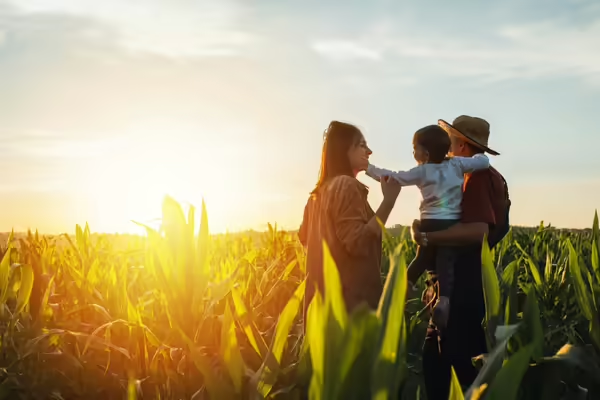
OTTAWA, Ill. – Farm succession planning is more than just passing down land—it’s about protecting your family’s legacy, ensuring financial security, and maintaining harmony across generations. Without a clear plan, farms can face legal challenges, tax burdens, and family disputes that jeopardize years of hard work.
This free educational session will provide practical guidance for farm families who want to prepare for the future. You’ll learn strategies to keep your land in the family, reduce uncertainty, and create a roadmap for smooth transitions. Whether you’re just starting to think about succession or already have a plan in place, this program will help you identify key steps and avoid common pitfalls.
This program will be co-hosted by Illinois Extension Commercial Agriculture Educators Emily Hansen and Reagen Tibbs on March 3, 2026, from 11:00 a.m. – 12:00 p.m. at the LaSalle County Farm Bureau (1691 N 31st Rd, Ottawa, IL 61350). Farm owners, family members involved in farm operations, and anyone interested in securing the long-term future of their agricultural business are encouraged to attend this informative program.
There is no cost to attend, but registration is required. Register online at go.illinois.edu/FarmSuccession
University of Illinois Extension develops educational programs, extends knowledge, and builds partnerships to support people, communities, and their environments as part of the state's land-grant institution. Extension serves as the leading public outreach effort for University of Illinois Urbana-Champaign and the College of Agricultural, Consumer and Environmental Sciences in all 102 Illinois counties through a network of 27 multi-county units and over 700 staff statewide. Extension’s mission is responsive to eight strategic priorities — community, economy, environment, food and agriculture, health, partnerships, technology and discovery, and workforce excellence — that are served through six program areas — 4-H youth development, agriculture and agribusiness, community and economic development, family and consumer science, integrated health disparities, and natural resources, environment, and energy.