
Strategic Plan Year 1 Impact
Major Milestones
Established eight workgroups
Each signature initiative workgroup, led by a dedicated champion, meets monthly and is aligned with one of the eight strategic priorities.
Finalized action profiles
Clear, actionable strategies have been developed for all eight strategic priorities, setting the foundation for measurable progress.
Launch a strategic plan web hub
A new hub for transparency, updates, and engagement with the strategic plan was launched to inform and connect internal and external stakeholders.
Engaged staff through strategic plan integration workshops
Held in fall 2024, these interactive workshops fostered awareness, ownership, and alignment across all Extension units.
Held the Values in Action webinar series
Delivered in spring 2025, this series explored Extension’s core values of collaboration, credibility, inclusivity, and learning in practice, inspiring staff to lead with purpose.
Released the strategic plan messaging toolkit
A comprehensive communications toolkit was developed and shared statewide, equipping staff with consistent messaging and assets to support engagement.
Held a champions orientation and quarterly cohort meetings
Each champion was onboarded through a collaborative orientation and continues participating in quarterly learning and alignment meetings, fostering shared leadership and peer support across the eight strategic priorities.
Increased cross-unit collaboration
Implementation has ignited new collaborative efforts across program areas, counties, and disciplines, breaking down silos and strengthening interdisciplinary approaches.
Embedded a focus on equity and inclusion
Equity principles have been intentionally woven into action profiles, workgroup deliberations, and program planning to ensure that the strategic plan reflects Extension’s commitment to inclusive excellence.
Conducted gap analyses
The eight workgroups launched efforts to identify statewide programming gaps through comprehensive gap analyses, laying the foundation for targeted action planning.
Held action profile roundtables
The workgroups engaged Extension staff through two feedback roundtables, one in-person and one virtual, to gather insights and refine their action profile work.
Workgroup Highlights
Title
Environment Workgroup
Signature Initiative: Bolstering climate resilience through education and outreach for a sustainable future.
In its first year, the environment workgroup has built strong momentum around climate education and environmental quality. Key achievements include:
- Assessed Climate Stewards programming and trained five more educators as instructors to enhance internal capacity to strengthen the program offerings.
- Planned an Illinois-specific climate symposium with campus faculty collaboration; continued enhancing the network for the Midwest and North Central Region climate-focused research collaborations and conferences.
- Formed five sub-groups that worked on: climate change action, standard institutional language regarding climate change, assessing climate steward’s program accessibility, assessing existing partnerships, and assessing current programming.
- Hired key specialists:
- Ashley Belle, Ph.D., environmental quality specialist. Belle brings expertise in solid waste reduction, environmental cleanup, and conservation planning. Her work empowers communities to adopt sustainable practices, reduce waste, and improve environmental health in urban and rural areas.
- Jessica Rudnick, Ph.D., climate resilience specialist. With a background in agricultural science and environmental policy, Rudnick leads efforts to address climate risks and enhance community resilience. Her programming focuses on water systems, ecological restoration, and outreach strategies that connect local action to global sustainability goals.
Title
Economy Workgroup
Signature Initiative: Fostering a resilient and future-ready workforce through delivering educational programs and promoting lifelong learning.
While not directly led by the workgroup, the following accomplishments demonstrate strong alignment with Extension’s Strategic Plan and highlight the broader organizational impact in advancing workforce development and educational innovation.
- Launched the Certified Food Protection Manager Course and the Food Handler Course for 4-H youth, expanding access to essential workforce credentials.
- Launched the first University of Illinois dual-credit course in the fall of 2025 within the College of Agricultural, Consumer and Environmental Sciences.
- Added a Family and Consumer Sciences teacher certification program to the Agricultural Leadership, Education and Communications degrees. The first student in the program will soon be placed for student teaching, helping to address statewide educator pipeline needs.
- Examined current workforce development trends and are working on the addition of graduate-level courses focused on industry credentialing and entrepreneurship to enhance workforce readiness in Agriculture and Family and Consumer Sciences teacher preparation programs.
- Developed a dual instructor and proctor professional development program for current Agriculture and Family and Consumer Sciences teachers. This program is designed for teachers to be able to certify their students with Food Protection Manager and Food Handler Certifications.
- Exploring alternative models for college credit, such as dual enrollment, to meet workforce needs and increase pathways to both college and careers.
Strategic Priority Champion Spotlight
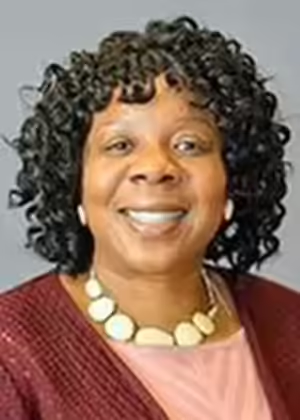
Michelle Cox, Ph.D.
Champion for Partnerships
Cox, county director for the unit serving Lake and McHenry counties, is a passionate advocate for reciprocal, community-based partnerships. Her career has focused on creating solutions in collaboration with communities, nonprofits, and civic agencies to drive equity-centered impact. She has designed partnership frameworks that are now models for integrated outreach across the state of Illinois.
Cox brings extensive experience in both academic community engagement and public sector collaboration. She is known for translating research into action through coalition building and cultivating long-term relationships. Under her leadership, the partnerships workgroup has focused on building trust, mutual benefit, and accountability, defining what it means to partner with purpose in today’s Extension landscape.
Her ability to build bridges across sectors, align stakeholders, and foster sustained engagement makes her a natural leader in guiding Extension’s partnership strategy.

Talon Becker, Ph.D.
Champion for Food and Agriculture
Becker, a commercial agriculture specialist, has spent his career supporting the agricultural community with science-based, real-world solutions. He specializes in variety trials, on-farm research, and sustainable practices that directly impact producer profitability and resource conservation.
Becker is respected not only for his agronomic expertise but for his commitment to farmer engagement and knowledge transfer. He has facilitated collaborative networks that include producers, researchers, and agency partners, ensuring local voices guide program development. His responsiveness to emerging agricultural challenges such as climate variability, soil health, and input efficiency has positioned him as a trusted resource in the field.
As champion, Becker brings a practical, systems-thinking approach that reflects both the complexity and the promise of Illinois agriculture. He is a tireless advocate for using Extension's agricultural platform to innovate, adapt, and sustain the farming communities we serve.
ACES Faculty Involvement Spotlight
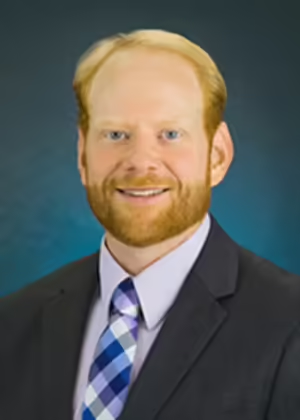
Nick Paulson, Ph.D.
Member of Food and Agriculture Workgroup
Paulson, a professor in the Department of Agricultural and Consumer Economics, is widely recognized for his expertise in agricultural risk management, farm policy, and decision analysis. He has co-authored national reports on crop insurance and commodity programs and works closely with Extension staff to interpret complex policy shifts for local stakeholders.
His collaboration with producers, farm managers, and policy institutions brings real-world insight to the food and agriculture workgroup’s planning and implementation efforts. Paulson’s contributions help ensure that the strategic actions developed by the workgroup are both evidence-based and grounded in the realities of the agricultural economy.
His ability to communicate economic trends in ways that inform smart on-the-ground decisions makes him an invaluable voice

Allen Barton, Ph.D.
Member of Health Workgroup
Barton, an associate professor in the Department of Human Development and Family Studies and an Extension specialist, brings his expertise in prevention science and family science to the health workgroup. His research focuses on advancing the health and well-being of individuals and families across Illinois, with a particular emphasis on substance use and family stability.
Through longitudinal cohort studies, randomized prevention trials, and quasi-experimental designs, Barton investigates family processes that serve as risk or protective factors and develops family-centered prevention programs to support healthier outcomes. His work is interdisciplinary, drawing from prevention science, public health, health psychology, and human development, and has been featured in leading journals.
Barton’s expertise in identifying evidence-based strategies and designing effective prevention programs brings critical insight to the health workgroup, ensuring the group’s efforts are grounded in science and focused on strengthening families and communities across Illinois.
Workgroup Member Spotlight

Veronica Aranda, M.P.H.
Member of Health Workgroup
Aranda, a community health educator, is known for her culturally responsive and community-rooted approach to health education. She has led programs in chronic disease prevention, nutrition education, and mental well-being, particularly in bilingual communities.
With a strong background in public health and a passion for social determinants of health, Aranda brings both empathy and rigor to her work. She has built trusted relationships in communities often underserved by traditional health systems, ensuring that Extension programs meet real needs in accessible ways.
As a member of the health workgroup, she advocates for strategies that address not only individual health behaviors but also the broader systems and inequities that influence health outcomes. Her voice has helped shape a more inclusive, holistic vision of Extension’s health impact statewide.

Cindy Ogwal, M.S.
Member of Workforce Excellence Workgroup
Ogwal, a 4-H youth development specialist, brings a deep commitment to equity, empowerment, and lifelong learning. With a background in community engagement and workforce readiness, she has developed and led programs that prepare youth and adults for meaningful career pathways, especially in underserved communities.
Ogwal’s work emphasizes skill-building, leadership development, and access to economic opportunity. She partners with schools, workforce boards, and community-based organizations to connect individuals with the tools, networks, and confidence needed to succeed in today’s dynamic job market.
As a member of the workforce excellence workgroup, she plays a vital role in advancing strategies that strengthen Illinois’ talent pipeline. Her focus on inclusive workforce development ensures that Extension remains a catalyst for opportunity, upward mobility, and economic resilience across the state.