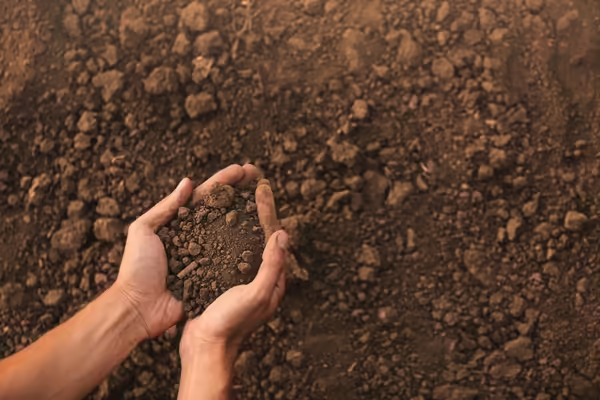
GRANVILLE, Ill. – Ever wonder how our soil has changed over the last 100 years? Discover the incredible story behind the University of Illinois Soil Lab's Centennial Soil Archive Project. A key piece of Illinois' agricultural heritage is a world-class, one-of-a-kind soil sample archive collected when local soils were first surveyed. As early as 1899, soil types across the state were mapped by sampling fields to three-foot depth and characterizing the distinct soil layers. Predecessors had the foresight to keep records of sampling locations and to store these soil samples on the University of Illinois’ Urbana-Champaign campus.
Join us at the Putnam County Library - Granville Branch (214 S. McCoy St., Granville, IL 61326) on January 13, 2026, from 6:00 p.m. – 7:00 p.m. to learn how this historical treasure helps us understand everything from the impact of farming practices to the effects of climate change. Participants will also learn about the resampling efforts going on across the state and how you can get involved. Register online at go.illinois.edu/CentennialSoils.
If you need an accommodation to participate, please contact Emily Hansen at emhansen@illinois.edu or 815-224-0896. Early requests are strongly encouraged to allow sufficient time to meet your access needs.
University of Illinois Extension develops educational programs, extends knowledge, and builds partnerships to support people, communities, and their environments as part of the state's land-grant institution. Extension serves as the leading public outreach effort for University of Illinois Urbana-Champaign and the College of Agricultural, Consumer and Environmental Sciences in all 102 Illinois counties through a network of 27 multi-county units and over 700 staff statewide. Extension’s mission is responsive to eight strategic priorities — community, economy, environment, food and agriculture, health, partnerships, technology and discovery, and workforce excellence — that are served through six program areas — 4-H youth development, agriculture and agribusiness, community and economic development, family and consumer science, integrated health disparities, and natural resources, environment, and energy.