Crop Management Guides
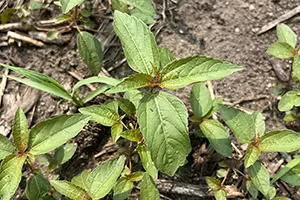
Asian Copperleaf
Asian copperleaf (Acalypha australis L.) is a new species to the Midwest, found in crop fields and urban settings. It spreads readily via seed and moves across landscapes with water. The concern is due to Asian copperleaf’s rapid spread by unknown means, its persistence in crop fields, and possible future herbicide resistance development. Download the guide to learn more about identification, management, and reporting.
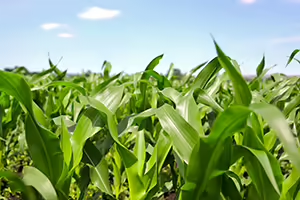
Illinois Corn Management
Corn is an important commodity crop in Illinois, with annual plantings ranging between 10.8 and 11.7 million acres over the past decade. Illinois Corn Management (2025) is a quick reference for hybrid selection, planting practices, and fertilizer and pest management. The guide offers advice to assist corn producers and crop consultants and should be adapted to suit specific conditions in their cropping system.
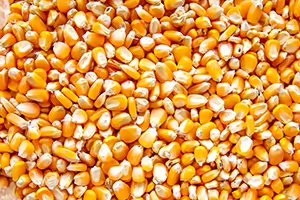
Corn Seeding Rate in Illinois
Corn yield has significantly increased in the hybrid era thanks to improved genetic yield potential and the ability of planted seeds to emerge and establish productive plants. Read how optimizing seeding rate is how to maximize return on the investment in seed.
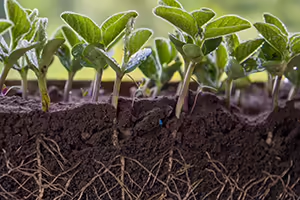
Illinois Soybean Management
Illinois is one of the largest soybean producers in the United States. In 2024, Illinois produced approximately 688 million bushels of soybean across 10.75 million acres. Illinois Soybean Management (2025) is a quick reference covering variety selection, planting practices, and fertilizer and pest management. The guide offers advice to assist soybean producers and crop consultants and should be adapted to suit specific conditions in their cropping system.
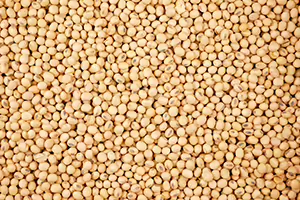
Soybean Seeding Rate in Illinois
Soybean seed has become more costly in recent years due to advances in biotechnology, higher-yielding germplasm, and a variety of available seed treatments. Read how optimizing seeding rate is therefore an important strategy for improving profitability.
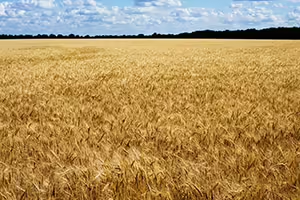
Wheat Maturity Time and Double-Crop Profitability
In the wheat-double-crop soybean system, soybean is planted immediately after wheat is harvested. Thus, the timing of wheat harvest directly affects the soybean planting date, which in turn affects the soybean yield. Read how to avoid these losses through harvesting the wheat crop in a timely manner and selecting an earlier-maturing wheat variety.
Extreme Weather: What Illinois Farmers Need to Know
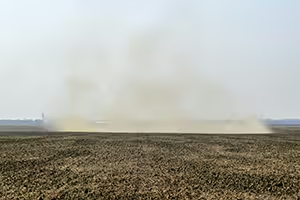
Dust Storms
A dust storm occurs when strong winds lift large amounts of loose sand, silt, and other soil components from dry surfaces into the air, creating a dense cloud that can travel long distances. A dust storm severely reduces visibility and can result in topsoil and nutrient loss, negatively impacting farms, surrounding communities, and the environment. Get the guide to learn more about the impact, the areas of greatest risk, farm management recommendations, and how to be part of the solution.
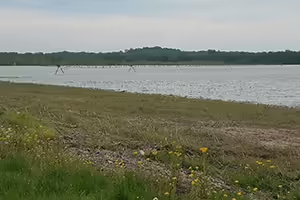
Heavy Rainfall Events
A heavy rainfall event occurs when intense amounts of rain falls in a short amount of time (at more than 0.3 inches per hour), and substantially exceeds what is normal for that location or season. These events can cause significant economic, agronomic, or infrastructure damage from runoff, erosion, inundation, and flooding. Get the guide to learn more about the impact, the areas of greatest risk, farm management recommendations, and how to be part of the solution.
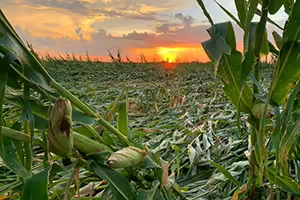
High Winds and Derechos
The National Weather Service (NWS) characterizes a high wind event as sustained winds of approximately 40 mph (64 km/h) or greater for one hour or longer. It also includes events with gusts of 58 mph (93 km/h) or greater for any duration, which are strong enough to cause infrastructure and crop damage. A derecho is a particular kind of severe convective windstorm that is a long-lived, fast-moving band of thunderstorms that produces widespread, straight-line wind damage. Get the guide to learn more about the impact, the areas of greatest risk, farm management recommendations, and how to be part of the solution.
Farm Safety Guides
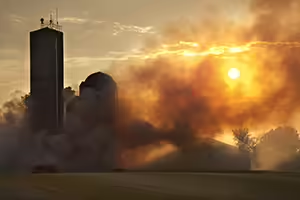
Farm Fire Risks and Prevention
A variety of factors, including the environment, can increase the risk of farm fires around a farm operation. Get the guide to increase awareness, get tips for preparation, and learn how to make time for safety checks to assist with farm fire risk and prevention.
Pesticide Safety Guides
Pesticide Resources
- How to Handle Pesticide Drift Complaints
- Pesticide Lookalikes: Avoid Accidental Pesticide Poisoning: University of Illinois Extension (Revised 2021)
- Making Pesticide Applications in School/Community Gardens: University of Illinois Extension (Revised 2021)
- Pesticide Applicator Certification & Training Brochure: Certification and Training Assessment Group
- Temperature Inversions: North Dakota State University (Revised 2019)
- Top 12 Lawn and Garden Pests: University of Illinois Extension
- NPDES Summary: University of Illinois Extension (2021)
- NPDES FAQ: University of Illinois Extension (2021)