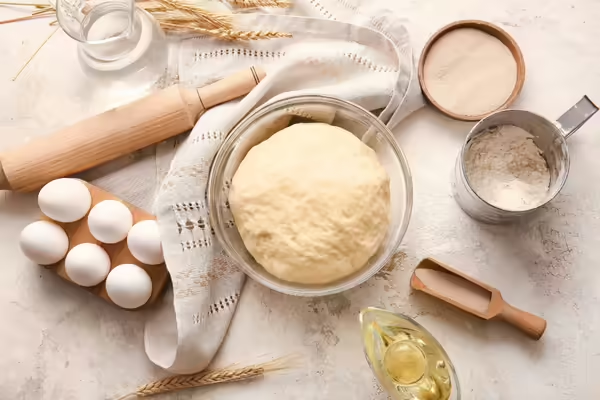
OGLESBY, Ill. - Join Illinois Extension Food and Nutrition Educator Susan Glassman and learn the art of breadmaking. Proof the yeast, mix the dough, knead, let rise, and bake till done in our annual bread workshop. Participants will learn to make and bake a classic coffee cake and a lower-sugar quick bread during the workshop. Everyone will take the breads they make home to share with family and friends on a cold winter night, or eat yourself!
Let it Dough, Make and Take Bread Workshop will be offered at:
- January 24, 2026, from 9:00 a.m. to 1:00 p.m. at Illinois Valley Community College, Room CTC-123 (815 N. Orlando Smith Road, Oglesby, Ill. 61348).
Program fees are $20.00 per person and include all the materials to make the breads, and recipes and resources. Please bring a hat or hair tie (for longer hair), an apron, and a beverage. A light snack will be served. The class size is limited to 16 adults.
Register by January 21, 2026, at go.illinois.edu/makebread or by calling Susan Glassman at Illinois Extension’s Main Office on the IVCC Campus at 815-224- 0894.
If you need accommodation to participate, please contact Susan Glassman at susang@illinois.edu or 815-224-0889. Early requests are strongly encouraged to allow sufficient time to meet your access needs. Extension offices are located in Princeton, Ottawa, Henry, and in Oglesby on the IVCC campus.
University of Illinois Extension develops educational programs, extends knowledge, and builds partnerships to support people, communities, and their environments as part of the state's land-grant institution. Extension serves as the leading public outreach effort for University of Illinois Urbana-Champaign and the College of Agricultural, Consumer and Environmental Sciences in all 102 Illinois counties through a network of 27 multi-county units and over 700 staff statewide. Extension’s mission is responsive to eight strategic priorities — community, economy, environment, food and agriculture, health, partnerships, technology and discovery, and workforce excellence — that are served through six program areas — 4-H youth development, agriculture and agribusiness, community and economic development, family and consumer science, integrated health disparities, and natural resources, environment, and energy.