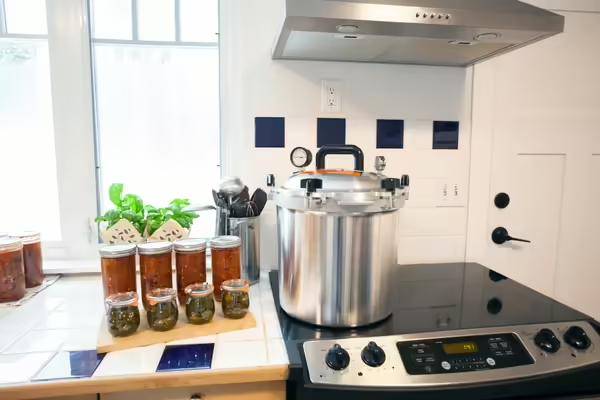
ALBION, Ill. – Did you know that Illinois Extension will test your dial-gauge pressure canner for free? Testing is recommended annually, so make plans to stop by your local Extension office before you begin canning this year.
Testers are available at the Edwards, Richland, and Wayne County Extension offices. Dial gauges can be dropped off, or an appointment may be made in advance. Gauges may also be dropped off at the Lawrence and Wabash County Extension offices, and arrangements will be made to have them tested as soon as possible.
A walk-in testing day will be available at the Richland County Extension Office on Wednesday, July 15, from 8 a.m. to 4:30 p.m. (closed from 12-1 p.m. for lunch). Gauges may also be dropped off during business hours the week prior for pickup on July 15; please include your name and contact information on the lid. For questions, contact the Richland County Extension Office at 618-395-2191 or visit the office at 306 S. Fair St. in Olney.
For questions or to schedule a testing appointment, please contact your local Extension office. Contact information can be found at go.illinois.edu/ELRWWoffices. For more information about canning, pressure canner testing, preserving food safely, recipes, and more, visit go.illinois.edu/foodpreservation.
If you need a reasonable accommodation to participate, please contact your local Extension office. Early requests are strongly encouraged to allow sufficient time to meet access needs.
University of Illinois Extension develops educational programs, extends knowledge, and builds partnerships to support people, communities, and their environments as part of the state's land-grant institution. Extension serves as the leading public outreach effort for University of Illinois Urbana-Champaign and the College of Agricultural, Consumer and Environmental Sciences in all 102 Illinois counties through a network of 27 multi-county units and over 500 staff statewide. Extension’s mission is responsive to eight strategic priorities — community, economy, environment, food and agriculture, health, partnerships, technology and discovery, and workforce excellence — that are served through five program areas — 4-H youth development, agriculture and agribusiness, community and economic development, health and community wellness, and natural resources, environment, and energy.