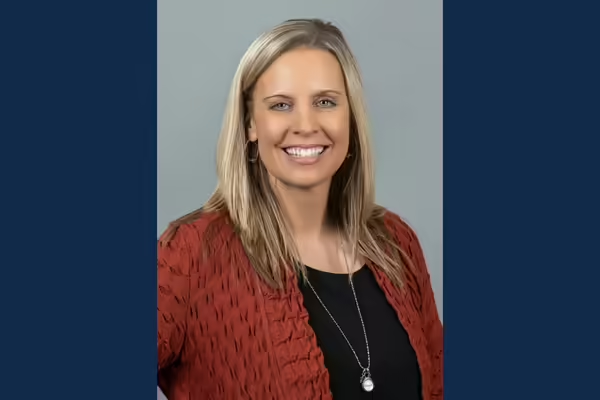
ALBION, Ill. — Tara Buerster, county director for University of Illinois Extension serving Edwards, Lawrence, Richland, Wabash, and Wayne counties, has been elected to the National Epsilon Sigma Phi board of directors as the north central region vice president.
In this national leadership role, Buerster will represent Extension professionals across 11 states, including Illinois, Indiana, Iowa, Kansas, Michigan, Minnesota, Missouri, Nebraska, North Dakota, Ohio, and Wisconsin. As north central region vice president, she will serve on the organization's executive leadership team, helping advance professional development, leadership opportunities, scholarship, recognition, and service for Extension professionals throughout the region and across the nation.
Founded in 1927, ESP is the oldest and largest professional organization for Cooperative Extension professionals in the United States. The organization is dedicated to fostering excellence in Extension educational work through professional growth, recognition, and leadership while strengthening the impact of Extension programs in communities nationwide.
Locally, as county director, Buerster oversees all Illinois Extension and 4-H youth development programs across Edwards, Lawrence, Richland, Wabash, and Wayne counties and leads a team of 18 staff members. She works closely with county governments, community organizations, volunteers, and local stakeholders to ensure Extension programs address the unique needs and priorities of the communities they serve.
Buerster earned a master's degree in human resource development from University of Illinois and a bachelor's degree in health services from the University of Southern Indiana. Before joining Illinois Extension, she served for 20 years as director of human resources for Illinois Eastern Community Colleges, bringing extensive experience in leadership, organizational development, and workforce management.
She is actively involved in her community, serving on the Edwards County Health Office board, as chair and member of the board of directors for Stopping Woman Abuse Now, as president of the Illinois Alpha Nu Chapter of ESP, and on the worship team at West Village Christian Church.
A lifelong resident of Edwards County, Buerster's connection to Extension began as a youth member of the Bone Gap Cardinals 4-H Club. She credits those early experiences with helping shape her appreciation for the positive impact Extension has on individuals, families, and communities.
"As I begin my role as north central region vice president, I am excited for the opportunity to connect with Extension professionals from across the nation and learn from their experiences," said Buerster. "I look forward to helping foster professional growth, leadership development, and recognition for our members. Serving on the National ESP board is an honor, and I am eager to contribute to the continued success and impact of our organization."
Buerster's election reflects both her commitment to strengthening Extension at the local level and her dedication to advancing the Cooperative Extension System nationwide. Through her service on the National ESP board, she will help represent the interests of Extension professionals while bringing new perspectives, ideas, and opportunities back to the communities served by Illinois Extension.
For more information about Illinois Extension programs in Edwards, Lawrence, Richland, Wabash, and Wayne counties, contact your local Extension office or visit extension.illinois.edu.
University of Illinois Extension develops educational programs, extends knowledge, and builds partnerships to support people, communities, and their environments as part of the state's land-grant institution. Extension serves as the leading public outreach effort for University of Illinois Urbana-Champaign and the College of Agricultural, Consumer and Environmental Sciences in all 102 Illinois counties through a network of 27 multi-county units and over 500 staff statewide. Extension’s mission is responsive to eight strategic priorities — community, economy, environment, food and agriculture, health, partnerships, technology and discovery, and workforce excellence — that are served through five program areas — 4-H youth development, agriculture and agribusiness, community and economic development, health and community wellness, and natural resources, environment, and energy.