It can sometimes be confusing to understand who is responsible for what within state and local government. With information coming from many different sources, it can be difficult to determine what is accurate and who is responsible for specific issues. To help provide clarity, Illinois Extension is launching an educational effort focused on common questions and concerns shared by community members. Each month, we will take a closer look at a topic and provide clear, reliable information to help residents better understand how responsibilities are divided across different levels of government.
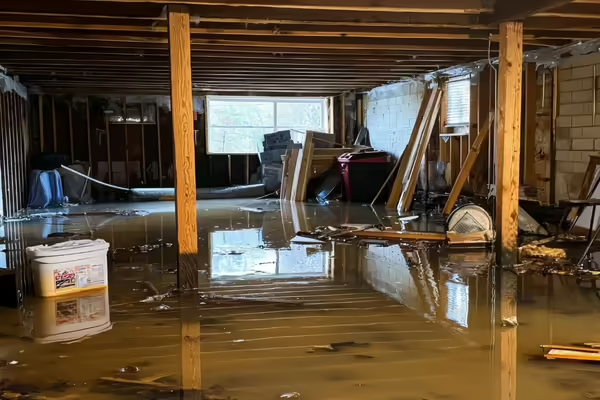
Recent heavy rainfall across Christian, Jersey, Macoupin, and Montgomery Counties has caused flooded roads, water-filled basements, and saturated yards. While the rain has helped ease drought conditions, many residents are frustrated by the damage and cleanup. This frustration often spills onto social media, creating blame and mistrust between local governments and community members.
Flooding: Who Is Responsible?
If a road is flooded, drivers are responsible for avoiding it and finding an alternate route. Do not assume a road is safe simply because a sign is not posted. It is the driver’s responsibility to make safe and proactive decisions to protect themselves, their property, and emergency workers. (To learn more, search for 625 ILCS 5/11-601 and 625 ILCS 5/11‑503.)
When large amounts of rain fall in a short time, water can enter basements or crawl spaces due to hydrostatic pressure, when saturated soil forces water through small cracks and gaps. Homeowners can take steps to reduce this risk: keep downspouts clear, ensure they drain away from the home, and maintain a proper slope (5–10%) so water flows away from the foundation. Many homes need “reverse grading” after years of erosion or settling.
Trees provide many benefits, but homeowners must ensure roots do not damage pipes. Roots seek moisture, often entering pipes and causing cracks or blockages that overwhelm drainage systems. Slow drains, gurgling toilets, or foul odors may indicate clogged sewer lines. Homeowners are responsible for the care and maintenance of sewer pipes on their property. (To learn more, visit the Illinois Administrative Code (Plumbing Code) 77 Ill. Adm. Code §890.170 and check local ordinances that define legal responsibility).
Homes with basements often rely on sump pumps. Homeowners should ensure pumps are properly sized, have alarms, and include battery backups or spare pumps, especially in areas prone to flooding. If your basement has a floor drain, talk with your insurance provider or a plumbing professional before installing backwater valves or drain plugs. In areas with extremely high rainfall, these devices can sometimes increase pressure and damage pipes.
Dry weather can also contribute to flooding issues. During drought, soil contracts and pulls away from foundations and pipes, creating gaps that allow water to enter. It also reduces soil support around sewer lines, which can lead to cracks or collapses.
Insurance matters. Check your homeowners or renters’ policy to ensure you have flood coverage. Consider the up‑front cost versus the long‑term cost of cleanup and repairs. Many people regret not investing in coverage once they experience how expensive and time‑consuming flood cleanup can be.
Key things to understand:
Under Illinois law, municipalities are often protected from liability for sewer backups by the Local Governmental and Governmental Employees Tort Immunity Act (745 ILCS 10). In addition, courts recognize an “Act of God” defense, meaning that when extraordinary rainfall overwhelms a sewer system, a city may not be held responsible unless negligence can be shown.
During heavy rainfall there are changes you can make to avoid overtaxing your sewer system, one of the easiest ways is to limit high‑usage water sources such as dishwashers, washing machines, and long showers.
If you believe the municipality is at fault, document conditions before, during, and after the event, including rainfall amounts, timing, and temperatures. Be prepared to show that you took steps to protect your home. Notify the city immediately and call a plumber to check for blockages in your private line.
While flooding is frustrating, homeowners need to take proactive and responsible measures to protect themselves and their property from changing weather and soil conditions, so they are less negatively impacted by future events.
To learn more, check out these Extension websites:
Photo Credit: Water Damage in Basement - © [Tanin] Adobe Stock
University of Illinois Extension develops educational programs, extends knowledge, and builds partnerships to support people, communities, and their environments as part of the state's land-grant institution. Extension serves as the leading public outreach effort for University of Illinois Urbana-Champaign and the College of Agricultural, Consumer and Environmental Sciences in all 102 Illinois counties through a network of 27 multi-county units and over 500 staff statewide. Extension’s mission is responsive to eight strategic priorities — community, economy, environment, food and agriculture, health, partnerships, technology and discovery, and workforce excellence — that are served through five program areas — 4-H youth development, agriculture and agribusiness, community and economic development, health and community wellness, and natural resources, environment, and energy.