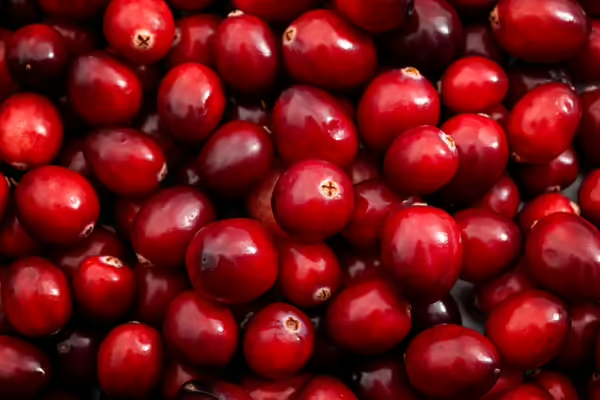
Cranberries, possibly served at the first fall harvest celebration in 1621, continue to be part of today’s holiday menus. The North American cranberry, Vaccinium macrocarpon, is a native plant to the United States. The settlers called the fruit “crane berry” because the pink flower blossom and the small stem resembled the head, beak, and neck of a crane. Eventually, the word was shortened to cranberry.
Wisconsin, the national leader of cranberry production, produces more than 60 percent of the cranberries that Americans consume each year. The 2025 Wisconsin cranberry yield was 4.6 million barrels of fruit (100 pounds per barrel). Other major cranberry producing states include Massachusetts, Oregon, and New Jersey. In total, the United States produced over 7.5 million barrels of cranberries in 2025.
The cranberry plant is a low-growing, trailing, woody evergreen vine. Cranberry plants grow and survive under special conditions. The plants prefer a sandy or organic, acid soil with a soil pH between 4.0 and 5.5. While plants need an adequate supply of water for frost protection, harvest, and winter flooding, they do not grow under water or in standing water.
It takes about four years to produce a crop of fruit from a new plant. Fruits are borne on short vertical upright branches. Flower buds are formed in late summer the season before they open. The plants produce a pink flower in late June and early July. After pollination by native honey bees, a berry begins to develop. The green berry takes about 75 to 100 days to mature to the dark red color.
Cranberries are harvested between September and early November. Most beds are wet harvested by flooding the fields, while approximately 5 to 10 percent are dry harvested.
In the winter, cranberry plants must be protected against fluctuating temperatures and drying winds. In December, dormant vines are flooded with water that freezes into a solid covering of ice. In the spring, water is pumped out of the bogs.
Traditionally, cranberries are served during the holidays; today, they have become a year-round favorite. It is a good idea to stock up now on fresh or frozen cranberries because they are only available at supermarkets from September to December. To enjoy them year-round, fresh cranberries can be sealed in an airtight container and frozen. They can be kept in the freezer for up to one year.
Scientific research has pointed to several important health benefits. Cranberries are a low-calorie, fiber-rich fruit, packed with nutrients like antioxidants and Vitamin C. They are also low in saturated fats, sodium, and cholesterol. Because of their tartness, cranberries are seldom eaten raw. Cranberries can be used in a variety of recipes, including gelatin salads, sauces, breads, desserts, beverages, and served with pork. Cranberry recipes and facts can be found on the Wisconsin State Cranberries Growers Association website.
University of Illinois Extension develops educational programs, extends knowledge, and builds partnerships to support people, communities, and their environments as part of the state's land-grant institution. Extension serves as the leading public outreach effort for University of Illinois Urbana-Champaign and the College of Agricultural, Consumer and Environmental Sciences in all 102 Illinois counties through a network of 27 multi-county units and over 500 staff statewide. Extension’s mission is responsive to eight strategic priorities — community, economy, environment, food and agriculture, health, partnerships, technology and discovery, and workforce excellence — that are served through five program areas — 4-H youth development, agriculture and agribusiness, community and economic development, health and community wellness, and natural resources, environment, and energy.