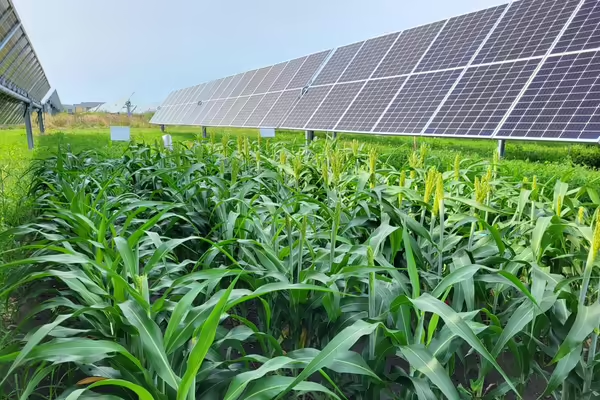
CHAMPAIGN, Ill. — In a world where increasing demands for food security and energy strain existing resources, scientists are looking for new ways to maximize both. One potential option, agrivoltaics, integrates solar photovoltaics with crops. A new study examines the agricultural and economic trade-offs that come with installing solar arrays on working farms across the Midwest.
The study found that agrivoltaics can increase or reduce yields and profits, depending on the crop and where such agrivoltaic systems are deployed.
The new findings are reported in the Proceedings of the National Academy of Sciences.
Led by scientists at the University of Illinois Urbana-Champaign, the team first developed a process-driven model to quantify the impacts of agrivoltaics on energy, water, and plant-soil dynamics. The model was first validated and published in the Journal of Advances in Modeling Earth Systems.
The team integrated an economic model to estimate annual net profits per acre from crop production and energy generation for agrivoltaics, conventional agriculture, and stand-alone solar energy systems.
The researchers ran 15-year simulations involving different climate conditions and agrivoltaic systems across the Midwest. In the agrivoltaic simulations, solar arrays covered 33% of each site.
These analyses revealed that average aridity or humidity was a key driver of crop yields and the economic viability of agrivoltaic systems.
Read the full article from the News Bureau.
University of Illinois Extension develops educational programs, extends knowledge, and builds partnerships to support people, communities, and their environments as part of the state's land-grant institution. Extension serves as the leading public outreach effort for University of Illinois Urbana-Champaign and the College of Agricultural, Consumer and Environmental Sciences in all 102 Illinois counties through a network of 27 multi-county units and over 500 staff statewide. Extension’s mission is responsive to eight strategic priorities — community, economy, environment, food and agriculture, health, partnerships, technology and discovery, and workforce excellence — that are served through five program areas — 4-H youth development, agriculture and agribusiness, community and economic development, health and community wellness, and natural resources, environment, and energy.