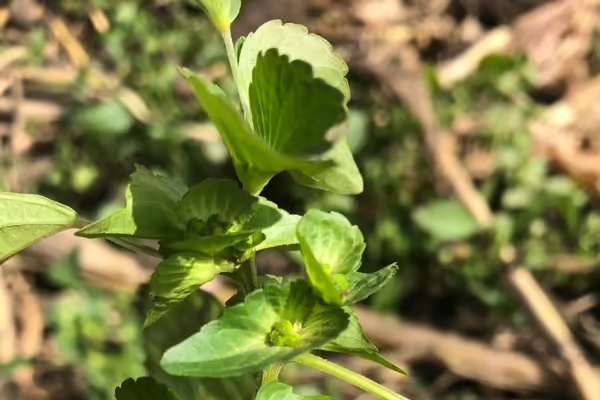
Corn and soybean farmers should be scouting for a new weed this upcoming growing season. Asian copperleaf (Acalypha australis) was identified in a field in Stephenson County following corn harvest this fall. This is the first confirmed Asian copperleaf population in Illinois.
Asian copperleaf is non-native to the United States. The first confirmed populations of this species were documented in New York in 1990. The next time Asian copperleaf was positively identified in the U.S. was in an Iowa seed corn field in 2016. Since then, it has been confirmed in ten counties across central and western Iowa. Illinois is the third state with a confirmed population of Asian copperleaf.
“Our goal is to give Illinois farmers and weed management practitioners the information necessary for them to scout and identify populations of Asian copperleaf,” says Aaron Hager, weed science professor and University of Illinois Extension faculty specialist in the Department of Crop Sciences. “We hope this will allow any additional populations to be identified so that management can be implemented to reduce the movement of seed to additional fields. It’s more advantageous to remain in front of a new weed challenge rather than allow it to get in front of us.”
Asian copperleaf is a summer annual species that reproduces exclusively by seed, but its emergence timing and duration are not known. Weed scientists at Iowa State University have received reports indicating that populations are frequently found at corn harvest but there have also been reports of emerged seedlings at the time of soybean planting.
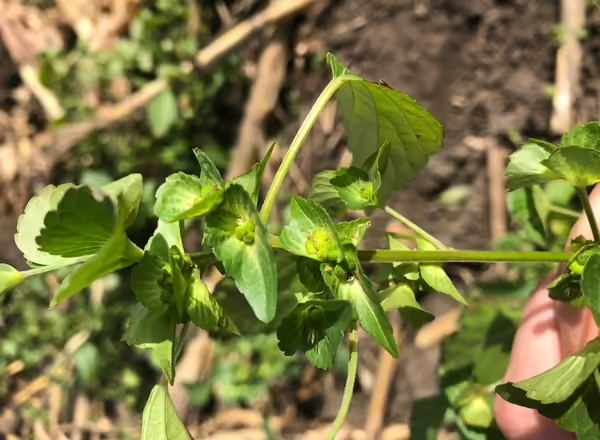
Identification of Asian copperleaf before reproductive structures are present can be difficult. Like its relatives in Illinois, leaves are alternately arranged on the stem and have serrated margins, pointed tips, and slightly to very rounded bases. Stems are erect, and flowers are not showy. Leafy tissues, called bracts, grow beneath the female flowers. These bracts are important for distinguishing Asian copperleaf from native Acalypha species such as Virginia copperleaf (Acalypha virginica), rhomboid mercury (Acalypha rhomboidea), and the rarer Deam’s mercury (Acalypha deamii).
“Asian copperleaf’s relatives are native to Illinois, growing in grassy areas, woods, and sometimes as yard weeds,” says David Zaya, botanist with the Illinois Natural History Survey. “The best way to tell Asian copperleaf apart is the leafy tissue under the flowers. If it looks like a small hand or lopsided star with long ‘fingers’, it is one of the native species. If it looks like a heart or egg with a pointed tip, you are probably looking at Asian copperleaf. The other clue would be if you see hundreds of thousands of them in an ag field, then it is probably Asian copperleaf.”
Asian copperleaf is most easily identified after harvest. The Asian copperleaf plants observed in Stephenson County were mostly between one and two feet tall, though many were smaller. The bracts at the base of the female flowers and fruits are larger than in any other Acalypha species in Illinois, with some more than one-half inch long. The bracts in other Acalypha species known in Illinois are smaller (typically a quarter of an inch long, unlikely to exceed one-half inch long). The bracts in Asian copperleaf also have a much different shape, as described above.
Farmers are encouraged to keep an eye out for this species while scouting during the upcoming growing season. While initial reports of this weed in Iowa were made during harvest, it is advised to scout for it prior to planting and throughout the growing season.
If you suspect you might have Asian copperleaf in a corn or soybean field, Illinois Extension can assist in verifying its identification. Kathryn Seebruck is a Commercial Agriculture Educator with Illinois Extension who covers Jo Daviess, Stephenson, and Winnebago Counties. She is willing to assist growers should they encounter additional populations. Kathryn can be contacted via email or telephone at seebruck@illinois.edu or 815-986-4357. More information on this Asian copperleaf population in Illinois can be found on Farmdoc.
Photo below: An Asian copperleaf plant in the reproductive stage with bracts at the base of its flowers. Photo by: Meaghan Anderson, Iowa State University Extension.
University of Illinois Extension develops educational programs, extends knowledge, and builds partnerships to support people, communities, and their environments as part of the state's land-grant institution. Extension serves as the leading public outreach effort for University of Illinois Urbana-Champaign and the College of Agricultural, Consumer and Environmental Sciences in all 102 Illinois counties through a network of 27 multi-county units and over 700 staff statewide. Extension’s mission is responsive to eight strategic priorities — community, economy, environment, food and agriculture, health, partnerships, technology and discovery, and workforce excellence — that are served through six program areas — 4-H youth development, agriculture and agribusiness, community and economic development, family and consumer science, integrated health disparities, and natural resources, environment, and energy.