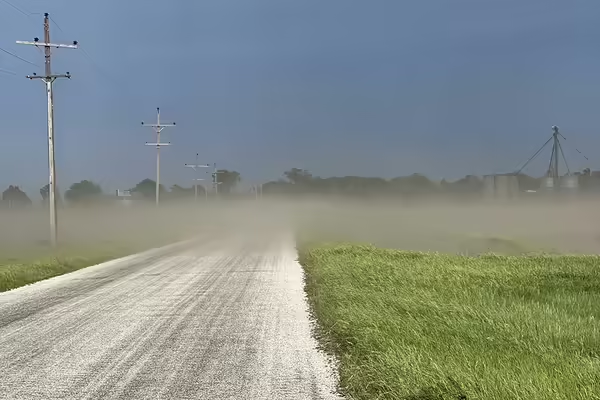
LINCOLN, Ill. — Over the recent days, the National Weather Service has issued several dust storm warnings and advisories for portions of central Illinois. This has been due to high winds from fronts and other weather patterns that have moved through the area. While there have been no reports of injuries or damage, dust storms still pose a threat to the health and safety of the communities impacted by them.
According to Reagen Tibbs, commercial agriculture educator with University of Illinois Extension, loose topsoil from agriculture fields is the primary source of these dust storms. There are many factors that impact the likelihood of erosion and dust storms. These include soil type, moisture, ground cover, and more.
“No one can control the wind,” Tibbs said, “but there are practices and strategies that producers and landowners can implement that reduce the impacts of soil erosion and the possibility of dust storms.” These practices and strategies include:
- Maintain residue cover: Leaving crop residue on the soil surface lowers wind speeds at the soil level and helps anchor soil particles, reducing the amount of dust generated.
- Limit intensive or repeated tillage: Excessive tillage breaks down soil aggregates and buries protective residue, increasing susceptibility to wind erosion.
- Use cover crops where feasible: Cover crops—particularly grass species such as winter rye or triticale—produce biomass that protects soil during high‑risk periods for wind erosion.
- Consider windbreaks or vegetative barriers: Tree rows and other windbreaks can significantly reduce wind speeds across a field and limit soil movement, particularly in flat or sandy areas.
“These practices not only protect long‑term soil productivity,” Tibbs said, “they can also reduce the risk of dangerous visibility conditions for motorists on nearby roads.”
To learn more about topics impacting local farmers, visit Tibbs’ Farm Focus blog. Information about wind erosion and dust storms can be found in a two-part series from July and August 2024.
Photo Caption: Photo taken by Reagen Tibbs in May 2025 between Elkhart and Broadwell in Logan County.
University of Illinois Extension develops educational programs, extends knowledge, and builds partnerships to support people, communities, and their environments as part of the state's land-grant institution. Extension serves as the leading public outreach effort for University of Illinois Urbana-Champaign and the College of Agricultural, Consumer and Environmental Sciences in all 102 Illinois counties through a network of 27 multi-county units and over 500 staff statewide. Extension’s mission is responsive to eight strategic priorities — community, economy, environment, food and agriculture, health, partnerships, technology and discovery, and workforce excellence — that are served through five program areas — 4-H youth development, agriculture and agribusiness, community and economic development, health and community wellness, and natural resources, environment, and energy.