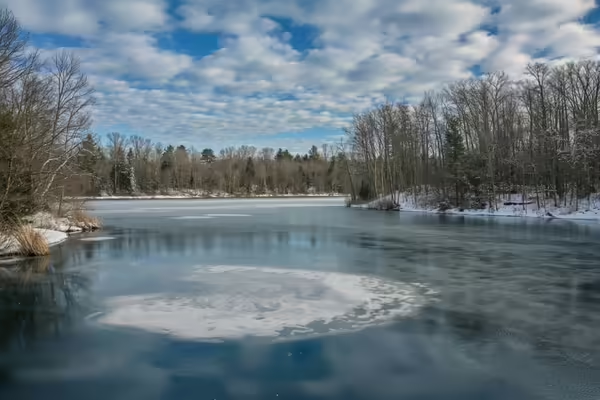
The cold of winter has settled in, and the plants and wildlife in your pond are quietly adjusting to the season’s challenges. Beneath the surface, your pond is undergoing two major physical changes: shifting temperatures and fluctuating oxygen levels. These changes play a crucial role in how aquatic life survives and thrives through the winter months. Fortunately, there are practical steps landowners can take to help their pond stay healthy and support its ecosystem.
Oxygen levels
Dissolved oxygen is the amount of oxygen gas that is held in water at the molecular level. Fish and other aquatic life use this oxygen to breathe just like terrestrial organisms use oxygen in the atmosphere. Dissolved oxygen, or DO, makes its way into the pond water column through two pathways – from the air by diffusion and through photosynthesis by aquatic plants and algae. It is reported that as much as 70-90% of a pond's DO is a result of plant and algae photosynthesis. Snow and ice on top of the pond limit the light that reaches the water surface. This lack of light halts photosynthesis ceasing oxygen production by any remaining plant life. Therefore, less oxygen is available for fish and aquatic life.
In addition, when ice and snow cover the pond’s surface, oxygen from the atmosphere can no longer easily diffuse into the water. The oxygen remaining in the water column is used up by both decaying plant and animal matter and respiration by aquatic life. If you have a large population of fish in your pond, more oxygen is needed, even though activity slows down. These natural processes all lead to low dissolved oxygen levels during winter. Fish within your pond become stressed at DO levels of 5 parts per million (ppm). Fish also will congregate in areas with higher oxygen levels making it easier for predators to find prey. As winter progresses, oxygen levels in the pond steadily decline, often dropping to very low or even zero levels in the deeper waters. Oftentimes, winter fish kill events are due to low DO levels.
Temperature changes
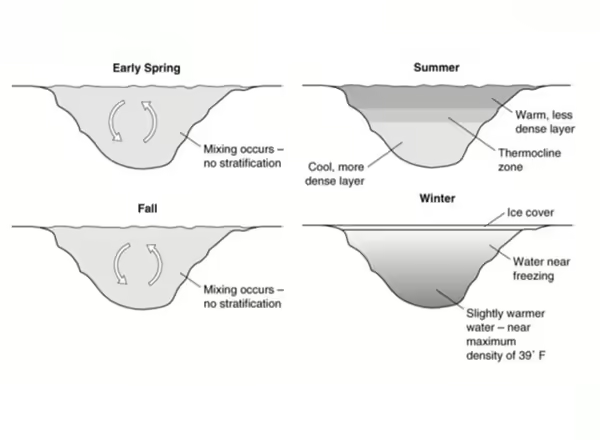
Along with oxygen level changes, the water temperature of ponds is changing and separating into layers. Water becomes most dense at 39 degrees F and begins to move downward in the water column. A layer of colder (near 32 degrees), less dense water begins to form above the 39-degree layer, so the pond now has a layer of warmer water down deep and a layer of colder water near the surface. The frozen state of water (ice) is less dense than cold water - this is why we see ice on top of our ponds rather than sinking to the bottom. The ice forms a protective barrier, insulating the water below from the freezing air above. Ice and snow act as an insulator, keeping water warmer deeper. This process of layering warm water below cold water in winter is called inverse stratification. Early in winter, fish can be found deep in the water column where it is warmer. However, as winter progresses, oxygen levels begin to decrease in deep water, and fish begin moving up the water column to more oxygenated water.
How does pond life survive in winter?
When water becomes colder and oxygen levels decrease, aquatic life begins to slow down and a variety of survival tactics kick in.
- Aquatic turtles enter a state called brumation where they bury themselves in the mud and stay mostly stationary. Their metabolism slows down and they utilize small fat reserves for nutrition – some can last 100 days without food or oxygen. Painted turtles turn to cloacal breathing which is the diffusion of oxygen through blood vessels in the cloacal opening, a multipurpose opening that serves as the exit for the digestive, urinary and reproductive systems.
- The body temperature of fish determines their rate of metabolism – during winter, fish use less energy and congregate in areas that are warmer and contain more oxygen. The water near the surface is colder, so fish will school in deeper, warmer water until oxygen levels decrease moving them up the water column.
- Oxygen levels are higher near the surface and shallow areas during winter in a pond. The young aquatic nymphs of dragonflies, a good food source for fish and other wildlife up the food chain, tend to congregate in the more oxygen-rich areas near the shore. Research has shown that, in order to survive, dragonflies will resort to eating other dragonfly nymphs in order to survive winter conditions in midwestern ponds (Clark, Hossie & Beresford, 2021).
- Insects like diving beetles and water boatmen carry a bubble of air with them as they survive under the water surface. They use their wing covers or specialized hairs to trap the bubble against the body. Scientists call this a “physical gill,” and they find these oxygen bubbles just under the ice (Meyer & Orr, 2015).
What can you do to help keep your pond healthy during winter?
- Larger ponds with greater volume hold more dissolved oxygen. To decrease the risk of winter kill of fish and other aquatic organisms, 25% of your pond should have an ideal depth of 8 feet or more.
- Maintaining a good ratio (10-20%) of aquatic vegetation during the growing season can help during winter to keep oxygen levels up. Ponds with too much summer vegetation or that is treated late in summer, however, can be susceptible to winter kill.
- Incorporating fish habitat structure allows for small fish to hide from predators. Consider constructing habitat during winter to install in spring.
- If safe, remove long-standing snow cover on 30% of your pond to allow for light penetration.
- When ice forms on the pond surface, consider running a surface water aeration system that keeps an area of open water. This allows for diffusion of oxygen from the air and creates oxygen when the water is agitated. During spring, summer, and fall, a bottom diffuser system can improve resistance to winter kill. However, this system should be moved to the surface or a shallow area during winter.
- Take a walk around your pond to inspect the water quality, dam structure, bank condition, overflow pipe condition, and depth.
References
- Bockelman, K., Elgin, E. and Filice, P. 2022. A look below the ice at fish behavior. MSU Extension Natural Resources. https://www.canr.msu.edu/news/a-look-below-the-ice-at-fish-behavior
- Braig, E.C. 2014. Your Pond (and Fish) Emerging from a Potent Winter. Ohio State University Extension, Columbus, OH.
- Clark C, Hossie TJ, Beresford DV. Density-Dependent Cannibalism in Dragonfly Nymphs (Odonata: Anisoptera) Overwintering in Temperate Freshwater Ponds. Environ Entomol. 2021 Dec 17;50(6):1483-1489. doi: 10.1093/ee/nvab097. PMID: 34492102.
- Friend, D. and Shiley, D. 2021. Pond dynamics fact sheet. University of Illinois Extension, Champaign-Urbana, IL.
- Jackson DC, Ultsch GRy. 2010. Physiology of hibernation under the ice by turtles and frogs. J. Exp. Zool. 313A:311–327. https://onlinelibrary.wiley.com/doi/pdf/10.1002/jez.603
- Meyer, J. R., & Orr, D. B. 2015. Respiration in aquatic insects. ENT 425 - General Entomology. https://genent.cals.ncsu.edu/
- Wulfhorst, P. and Oleson, D. 2025. Winterkill in Ponds. Penn State Extension, University Park, PA.
University of Illinois Extension develops educational programs, extends knowledge, and builds partnerships to support people, communities, and their environments as part of the state's land-grant institution. Extension serves as the leading public outreach effort for University of Illinois Urbana-Champaign and the College of Agricultural, Consumer and Environmental Sciences in all 102 Illinois counties through a network of 27 multi-county units and over 700 staff statewide. Extension’s mission is responsive to eight strategic priorities — community, economy, environment, food and agriculture, health, partnerships, technology and discovery, and workforce excellence — that are served through six program areas — 4-H youth development, agriculture and agribusiness, community and economic development, family and consumer science, integrated health disparities, and natural resources, environment, and energy.