
BELVIDERE, Ill. — Big Thunder Pavilion is a monument site in Belvidere, Boone County, IL, which was donated to the Boone County Conservation District (BCCD) by the late Belvidere resident and businessman, Jack Wolf. It is located at Big Thunder Blvd. and Wolf Rd., across from Rock Valley College Advanced Technology Center and adjacent to Culver's. The site consists of an irregularly shaped area covering approximately ½ acre, with a paver area surrounding a twelve-foot statue of a Native American, and the outer perimeter planted with various trees, shrubs, grasses, and plants. The bronze statue, entitled He Is They Are, is the work of sculptor Glenna Goodacre, a noted artist whose work can be seen in most of the fifty states. The late Jack Wolf, the site’s benefactor, has said that the statue represents Big Thunder, the chief of the Potawatomi tribe. Big Thunder Park, across from the Courthouse, is the burial place of the chief. Mr. Wolf hopes the Pavilion brings an “appreciation of the Boone County Native Americans [who established themselves here in the first half of the 19th century], and an understanding of what they added to our local heritage”.
In 2009 BCCD accepted the donated land based on the expressed desire and commitment that the Boone County Extension Master Gardeners (MGs) would oversee the design and maintenance of the plantings.
The pavilion tends to be wet and contains many aggressive wetland plants that were not introduced during its creation. Some of these plants were utilized by the Potawatomi, and the MGs would like to keep and control them. In this setting, the MGs sought to develop avenues to educate the public about the use of native plants and their value in our daily lives.
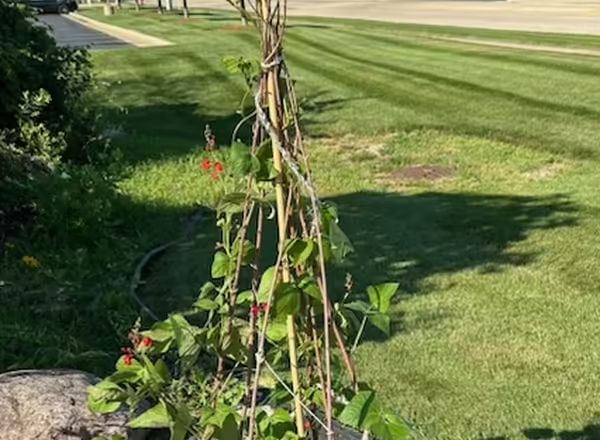
One such project is to build a structure for growing scarlet runner beans, a highly nutritious heirloom bean. These beans were observed growing at the Abraham Lincoln Demonstration Garden during the 2025 Master Garden Conference held in Springfield, IL. The MGs decided to use Sandbar Willow, one of the aggressive plants native to Big Thunder Pavilion. Per the Illinois Wildflower website concerning the Sandbar Willow: “Without the assistance of a beaver colony, it is difficult to control, and its use is not recommended for wetland restorations.” The MGs were not deterred and harvested some of the canes last fall, allowing them to dry over winter so they would not resprout. The Potawatomi made cordage, or rope, out of many different materials; Common Milkweed, Common Dogbane, and Stinging Nettle, to name a few. After the frost, the MGs harvested some of these materials from the pavilion and, over the winter, learned how to make cordage.
This spring, the MGs made obelisks from dried sandbar willow branches and tied them together with man-made cordage. The MGs planted the runner beans, and they are climbing the obelisks just as desired. The orange flowers are stunning and attractive to the pollinators. Please come and check out Big Thunder Pavilion.
WRITTEN BY: Barb Wych, Boone County Master Gardener
University of Illinois Extension develops educational programs, extends knowledge, and builds partnerships to support people, communities, and their environments as part of the state's land-grant institution. Extension serves as the leading public outreach effort for University of Illinois Urbana-Champaign and the College of Agricultural, Consumer and Environmental Sciences in all 102 Illinois counties through a network of 27 multi-county units and over 500 staff statewide. Extension’s mission is responsive to eight strategic priorities — community, economy, environment, food and agriculture, health, partnerships, technology and discovery, and workforce excellence — that are served through five program areas — 4-H youth development, agriculture and agribusiness, community and economic development, health and community wellness, and natural resources, environment, and energy.