OREGON, Ill. — Two beloved northern Illinois fall Master Gardener traditions are returning this October as University of Illinois Extension announces the annual Boone County Farm Stroll and the Ogle County Farm Stroll. Both events offer families, residents, and visitors the opportunity to explore diversified family farms, meet local producers, and learn more about agriculture in their communities.
Sunday, October 4 • 10 a.m.–4 p.m. The Boone County Farm Stroll invites participants to visit multiple family-owned farms throughout the county at their own pace. There is no official starting point—visitors choose which farms to explore and create their own route. Many farms offer demonstrations, educational activities, and products for purchase. This year’s stroll continues its tradition of showcasing local agriculture, from livestock and specialty crops to fiber arts, homesteading, and conservation practices. The event is held rain or shine, and attendees are encouraged to dress for outdoor conditions and bring cash for farm fresh goods.
Participating farms include Alpaca Pines Farm & Fiber Mill, DieHard Dairy & T-J’s Farm Market, Farmers Rising (new), Illinois Wool and Fiber Mill, Meyers Family Farm (new), Nature’s Best Trees & Honey, Paulson’s Ag Museum, Trogg’s Hollow CSA and Market Farm, and Winding Path Farms-Branching Out Inc. Thank you for being our sponsor this year, Winneago-Boone Farm Bureau. We appreciate your sponsorship.
Sunday, October 11 • 10 a.m.–4 p.m. The Ogle County Farm Stroll features a diverse lineup of farms across the county, each offering a behind the scenes look at local agriculture. Visitors can learn about livestock care, crop production, conservation efforts, and specialty farm operations. Participants may visit as many farms as they wish, with opportunities to speak directly with farmers, ask questions, and enjoy hands-on learning experiences. Several farms will have products available for purchase, and families are encouraged to bring their curiosity—and comfortable walking shoes.
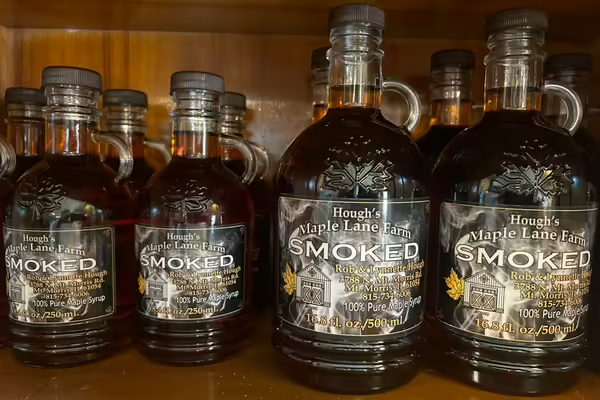
New this year, the Ogle County Extension Office at 421 W Pines Rd in Oregon will be open during the stroll. You will find an informational table, craft, and restrooms. Participating farms include Barnhart’s Stone Corner, BerryView Orchard, Dietrich Ranch, LLC, Happily Homegrown, Hinrichs Farm, Hough’s Maple Lane Farm, Jen’s Sunshine Farm, Orion Organics, Ponto Ranch, and Triple Creek Bison.
Both Farm Strolls are organized by University of Illinois Extension Master Gardeners in partnership with local producers and community organizations. Thank you to the Winnebago-Boone Farm Bureau for sponsoring the Boone County Farm Stroll, and Compeer Financial and Stillman Bank for sponsoring the Ogle County Farm Stroll. These events aim to strengthen connections between residents and the agricultural community while highlighting the importance of local food systems and diversified farming.
Directional signs will be posted at each stop to help visitors navigate. Each sign will display the farm host’s address along with a QR code that links directly to Google Maps for easy directions. For the safety of farm animals and visitors, please leave pets at home.
For questions about either event or reasonable accommodation requests, contact your local Extension office: Boone County Extension Office at 815-544-3710 or Ogle County Extension Office at 815-732-2191.
Stop by the office to grab a brochure, or go online at https://go.illinois.edu/2026BooneCountyFarmStrollBrochure or https://go.illinois.edu/2026OgleCountyFarmStrollBrochure.
University of Illinois Extension develops educational programs, extends knowledge, and builds partnerships to support people, communities, and their environments as part of the state's land-grant institution. Extension serves as the leading public outreach effort for University of Illinois Urbana-Champaign and the College of Agricultural, Consumer and Environmental Sciences in all 102 Illinois counties through a network of 27 multi-county units and over 500 staff statewide. Extension’s mission is responsive to eight strategic priorities — community, economy, environment, food and agriculture, health, partnerships, technology and discovery, and workforce excellence — that are served through five program areas — 4-H youth development, agriculture and agribusiness, community and economic development, health and community wellness, and natural resources, environment, and energy.