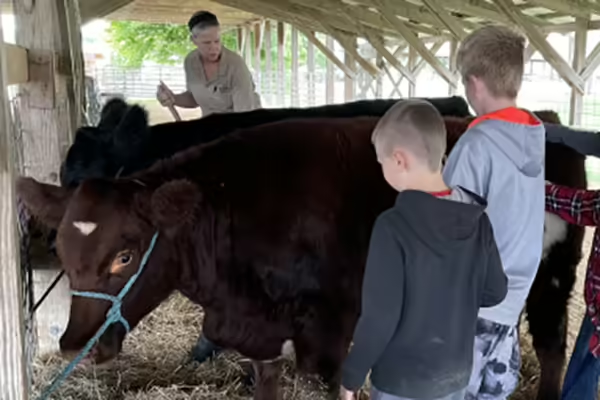
OREGON, Ill. — We all eat, but where exactly does the food come from? Youth throughout Ogle and Carroll counties discover the answer to that question through school, library, and park district programs provided by Ag in the Classroom.
You can help spread the knowledge by assisting at the Ogle County Fair. There will be a food stand benefitting Agriculture in the Classroom. Volunteers are needed to work in the food stand. Find a shift that works for you and sign up at https://go.illinois.edu/foodstand. You can also sign up or get any questions answered by contacting charbm@illinois.edu or 815-732-2191. Volunteers must be 16 years old. Time slots for volunteers are July 29: 12-3 pm, 3-6 pm and 6-9 pm; July 30: 11 am-2 pm, 2-5 pm, and 5-8 pm; July 31: 11 am-2 pm, 2-5 pm, and 5-8 pm; August 1: 11 am-2 pm, 2-5 pm, and 5-8 pm; and August 2: 11 am-2 pm and 2-5 pm.
Agriculture in the Classroom is a program that helps students gain a greater awareness of agriculture's role in the economy and society. Students learn that thousands of farm products are in the world around them—on their plate, in the clothes they wear, in the medicine that makes them well, and in earth-friendly fuels and plastics.
Ag in the Classroom is offered through the University of Illinois Extension-Ogle County in partnership with Ogle County Farm Bureau, Carroll County Farm Bureau, Ogle County Soil & Water, and Carroll County Soil & Water. For more information about the program, call the Ogle County Extension Office at (815) 732-2191.
University of Illinois Extension develops educational programs, extends knowledge, and builds partnerships to support people, communities, and their environments as part of the state's land-grant institution. Extension serves as the leading public outreach effort for University of Illinois Urbana-Champaign and the College of Agricultural, Consumer and Environmental Sciences in all 102 Illinois counties through a network of 27 multi-county units and over 500 staff statewide. Extension’s mission is responsive to eight strategic priorities — community, economy, environment, food and agriculture, health, partnerships, technology and discovery, and workforce excellence — that are served through five program areas — 4-H youth development, agriculture and agribusiness, community and economic development, health and community wellness, and natural resources, environment, and energy.