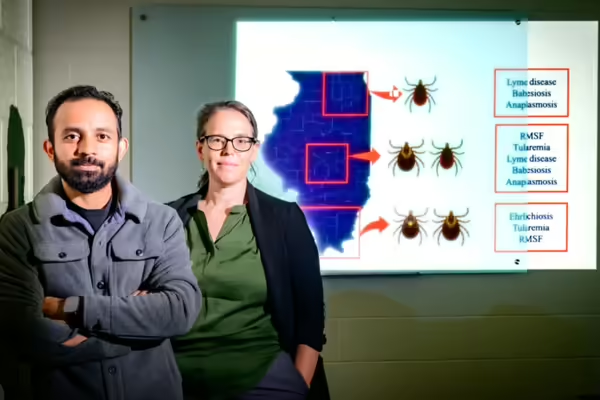
URBANA, Ill — A new study has reported a “dramatic growth” in the number of human cases of tick-borne disease between 2004 and 2022. The University of Illinois study also found that tick-borne diseases were reported in every month of the year and in every Illinois county, underscoring the importance of taking simple precautions when spending time outdoors.
"My big takeaway for the public is that we see tick-borne diseases 12 months out of the year and in every county in the state of Illinois," said the study’s lead author, Rebecca Smith, in a news release. Smith is a professor of pathobiology at University of Illinois Urbana-Champaign. "We have different tick-borne diseases in different places and different risks in different places, but every county, every month, there is a risk."
The study, which analyzed Illinois Department of Public Health data from 2004 through 2022, documented more than 6,400 reported cases of tick-borne diseases statewide. Researchers found that while the types of diseases and levels of risk vary across Illinois, no county is without risk. Reported cases have also increased over time.
The complete University of Illinois News Bureau story on the new research is available online.
The findings reinforce what University of Illinois Extension educators have been seeing as they answer an increasing number of questions from Illinois residents about ticks, tick-borne illnesses, and how to safely enjoy the outdoors.
"We’ve been getting a lot of questions from people who are rightfully concerned about things like alpha-gal syndrome, a condition that can, in certain individuals trigger a significant allergic reaction to red meat," said Nancy Kuhajda, Illinois Extension horticulture educator. "Our goal is to help people stay aware, not afraid. With the right information, there's no reason ticks should keep people from spending time outside."
Illinois Extension recently launched a comprehensive public education campaign to help Illinois residents better understand ticks and protect themselves while continuing to enjoy parks, trails, gardens, forests, and other outdoor spaces.
Research-based, easy-to-understand information on where ticks are commonly found, preventing tick bites, conducting tick checks, safely removing ticks, submitting ticks to local Extension offices for free identification, and recognizing common tick-borne diseases is available at go.illinois.edu/tick-info.
"Don’t be scared, just be prepared. There's a lot of information (and misinformation) circulating online," Kuhajda said. "We created these resources to give Illinois residents one place to find research-based answers and practical guidance they can trust."
In addition to the public feature story, Illinois Extension has developed a free Tick Education Toolkit for forest preserves, park districts, libraries, schools, municipalities, health departments, community organizations, and other groups interested in sharing trusted tick education.
Organizations interested in sharing tick education within their communities can download the free Tick Education Toolkit at go.illinois.edu/tick-toolkit.
For more information on Illinois Extension, visit extension.illinois.edu/.
SOURCES: Nancy Kuhajda, horticulture educator.
WRITER: Anthony Warmack, communications and marketing coordinator.
MEDIA ACCESS: Contact Anthony Warmack, warmacka@illinois.edu, to request specialist interviews on this topic. The image for this story may be downloaded for media use.
FEATURE IMAGE CAPTION: "Pathobiology professor Becky Smith, graduate student Abrar Hussain and their colleagues analyzed state data on tickborne diseases in humans and dogs. The study reveals hotspots of disease in various parts of the state. Photo by University of Illinois/Fred Zwicky"
University of Illinois Extension develops educational programs, extends knowledge, and builds partnerships to support people, communities, and their environments as part of the state's land-grant institution. Extension serves as the leading public outreach effort for University of Illinois Urbana-Champaign and the College of Agricultural, Consumer and Environmental Sciences in all 102 Illinois counties through a network of 27 multi-county units and over 500 staff statewide. Extension’s mission is responsive to eight strategic priorities — community, economy, environment, food and agriculture, health, partnerships, technology and discovery, and workforce excellence — that are served through five program areas — 4-H youth development, agriculture and agribusiness, community and economic development, health and community wellness, and natural resources, environment, and energy.