LEWISTOWN, Ill. — Healthy soils, cleaner water, and stronger farms, one field at a time – University of Illinois Extension and STAR, Saving Tomorrow’s Agriculture Resources, are working together to make it happen.
STAR was born out of a grassroots, farmer-driven movement in Champaign County to help guide agricultural producers in meeting conservation goals established to reduce soil and nutrient losses and address local water quality challenges. Designed as a simple, straightforward, easy-to-use tool, the STAR concept grew to include an implementation framework and was soon adapted and expanded into other Midwestern and Western states.
Developed for farmers, by farmers, the STAR Tool is a free conservation evaluation and guidance tool that generates a 1-5 STAR Rating at a field scale. Farmers are then encouraged to build a Conservation Innovation Plan for the next crop year to identify next steps in their conservation journey and explore the technical, educational, and financial opportunities available to help them implement practices. Producer data remains confidential and can only be shared with the producer’s explicit permission or as part of aggregated and anonymized results.
Extension is partnering with STAR by serving as a local resource for agronomic advice and conservation planning. Commercial Ag Educator Tara Heath is now a STAR Navigator for Fulton, Mason, McDonough, Peoria, and Tazewell counties. She will assist producers with completing assessments, interpreting results, and connecting them to technical and financial resources.
Tara shares, “I’m excited to help farmers take practical steps toward improving soil health and water quality. STAR makes it easy to see where you’re doing well and where small changes can make a big difference.”
In September of 2025, the Illinois Department of Agriculture officially designated the STAR Tool as the standard soil health assessment for all state-funded conservation practices. The STAR Tool will play a central role in supporting key programs, like Partners-for-Conservation Cost-Share and the Illinois Healthy Soils Initiative.
“Involving Tara has been a green flag for STAR conservation efforts across the state,” said Natalie Kerr, Illinois STAR Coordinator. “It’s important for farmers to speak with local experts, and historically STAR has worked with Soil and Water Conservation Districts to provide that relationship-based support. Having additional partners like Illinois Extension come on board to serve farmers as STAR Navigators makes our conservation program delivery stronger. Illinois has millions of acres of agricultural land, so when it comes to local technical assistance, the more the merrier!”
Participation is growing. For the 2024 crop year, 16 producers from Fulton, Mason, McDonough, Peoria, and Tazewell counties had a total of 2,060 acres in 61 fields, and achieved an average STAR score of 3.48. These numbers reflect a strong local commitment to sustainable farming practices.
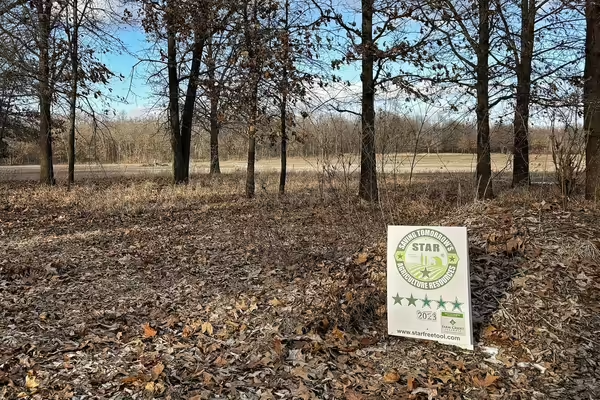
STAR field signs are available for participants, showcasing their conservation efforts to the community. The program also helps connect conservation-minded landowners with producers who share similar goals, fostering collaboration for healthier soils and cleaner water across Illinois.
Photo caption: Tara Heath, commercial ag educator, recently became a STAR Navigator for Mason, McDonough, Peoria, and Tazewell counties. The STAR tool is a free online conservation assessment for farmers. Individual fields receive a 1-5 STAR rating based on crop rotation, tillage, and nutrient management. This Mason County farm received a 5-STAR rating.
University of Illinois Extension develops educational programs, extends knowledge, and builds partnerships to support people, communities, and their environments as part of the state's land-grant institution. Extension serves as the leading public outreach effort for University of Illinois Urbana-Champaign and the College of Agricultural, Consumer and Environmental Sciences in all 102 Illinois counties through a network of 27 multi-county units and over 700 staff statewide. Extension’s mission is responsive to eight strategic priorities — community, economy, environment, food and agriculture, health, partnerships, technology and discovery, and workforce excellence — that are served through six program areas — 4-H youth development, agriculture and agribusiness, community and economic development, family and consumer science, integrated health disparities, and natural resources, environment, and energy.