Disclaimer - The following is meant only for educational purposes and not to be construed as legal or tax advice.
PEORIA, Ill. - Thinking about retiring from farming? Maybe you are brainstorming how the operation will transition when you are gone due to illness, injury, or death. Managing a farm in a fast-paced, changing environment can be overwhelming. Being able to adapt quickly while making good decisions takes experience and a willingness to take on managed risk. A farm family needs to examine the situation and carefully weigh its available options.
Selecting the Correct People
Choosing the right people for specific jobs is vital. Having the skills and personality to run a multi-million-dollar company is not something everyone is suited for. A lack of transition planning during unexpected retirements or life changes can leave heirs unprepared to manage the property. The reasons for a lack of preparation can vary, from fear to a lack of time to an unwillingness to look at a future without you in control of your farm. Human emotions can cloud your thinking, and then your decisions could upset someone within the family.
There is an old oil filter commercial that ends with the phrase, “You can pay me now or pay me later,” referencing the inevitability of car engine damage if you don't maintain your car with the best oil filter. The catchy commercial applies in principle to making tough decisions about your farm’s future. Many owners want to put off what needs to be done to keep peace, but this can sacrifice the long-term good of the farm and family. I have heard farm owners say that they will just let the kids fight it out themselves. If left to their own, your heirs may do just that: fight it out, leaving relationships damaged and the farm at risk.
Create a Good Job Description
A well-crafted job description is an excellent starting point for analyzing how the farm will operate during the transition. And it’s a great place to begin the discussions with your family. The job will require the following six basic duties:
- Field operations
- Technology use, including AI
- Agronomy and crop management
- Logistics and grain handling
- Maintenance and construction
- Business management, grain marketing, risk management, and compliance
The above-mentioned outline will get the task rolling for a much more detailed job description.
A Sole Proprietor, Family Partnership, or Family Corporation
In business terms, a farm is a multimillion-dollar business operation. This business is likely a sole proprietorship, a family partnership, or a family corporation, run by a single farmer or a family that operates like a board of directors. Farm leadership titles depend on operation size and enterprise diversity.
Having the right people in place to continue the farm under new family management is vital to the farm's future success. The biggest question to answer for now is, “Do you have the correct people in place to do the job to weather future storms?” Although many family members could manage the farm well in good times, they may falter when severe challenges arise. With the right preparation, the next generation can turn these challenges into opportunities for growth.
Training Your Heirs
Your adult child will need opportunities to grow by being given progressively more decision-making responsibilities. It is emotionally hard for parents—even experienced farmers—to allow this. Your heir must have experience and be allowed to have both successes and failures before taking over the farm. Seeing how well your heir performs in independent decision-making as they learn is a good indicator of where training and more guidance are needed.
Looking Outside the Family
Hiring seasonal workers around the farm is common for farm operations. However, aging farm operators are finding that their heirs aren’t always interested in the business side of operations or in taking on another duty. Some feel comfortable with mechanics or fieldwork but not with selling grain, paying bills, or negotiating leases. Hiring an overall business manager is becoming more common among farm operations with sufficient revenue to absorb the significant labor costs involved.
Hiring outside labor as a manager for your farm operation comes with challenges. Typically, an heir's final authority and hiring privileges can create tension with a hired business operations manager. Even though your heirs might not want business management duties, they should still learn basic business analysis so they can understand the reason behind certain decisions or suggestions.
Training on the Job, in the classroom, and Other Approaches
Managing a farm will become increasingly complex, as will the competitive marketplace. Having the correct people in place to run the farm when you are no longer in control is imperative. On-the-job training is a great way to learn the family farm business. However, for the farm to flourish and keep pace with rapid change, additional training can begin with reading articles and listening to podcasts. Make sure your heirs and hired managers have the proper education, training, and experience to transition the farm business into the future. Academic and practical training equip your heirs to handle rapid industry changes before they enter the field. Extension courses, offering both Certified Crop Advisor credits and non-credit learning, provide valuable opportunities to build skills for future success. Properly preparing your heirs to operate your farm is a powerful way to show you care.
Kevin Brooks is a Farm Management Educator with the University of Illinois Extension in Fulton, Mason, Peoria, and Tazewell counties. Kevin's email address is kwbrooks@illinois.edu
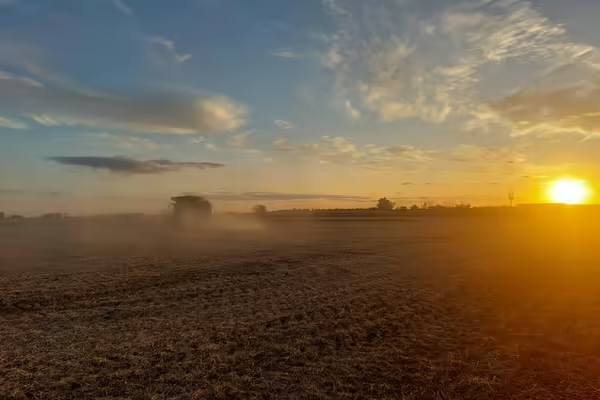
PHOTO CAPTION: Passing the torch: New family leaders prepare the farm for its bright future. (Photo by Kevin Brooks)
University of Illinois Extension develops educational programs, extends knowledge, and builds partnerships to support people, communities, and their environments as part of the state's land-grant institution. Extension serves as the leading public outreach effort for University of Illinois Urbana-Champaign and the College of Agricultural, Consumer and Environmental Sciences in all 102 Illinois counties through a network of 27 multi-county units and over 500 staff statewide. Extension’s mission is responsive to eight strategic priorities — community, economy, environment, food and agriculture, health, partnerships, technology and discovery, and workforce excellence — that are served through five program areas — 4-H youth development, agriculture and agribusiness, community and economic development, health and community wellness, and natural resources, environment, and energy.