Disclaimer - The following is meant only for educational purposes and not to be construed as legal or tax advice.
PEORIA, Ill. - In the past decade, more attention has been given to estate planning for family farm businesses, as the average age of commercial farmers in Illinois is 60-plus, and most landowners are 65 and older. Farmers do not own the majority of farmland in the state; individuals, not corporate interests, own it. Studies show that fewer than 50% of farm families have an estate plan to manage succession and property transfer upon the owner's death or incapacitation. Furthermore, even fewer -- less than 20% -- have a written plan communicated to their heirs. This article is designed to help farm families develop a basic understanding of their estate tax situation and why they should take steps to put a plan in place. The farmer or landowner should seek advice from a tax/legal professional.
Estate Planning is a Financial Decision
As the farming industry in Illinois struggles with profitability, the lack of an effective estate plan may be the single biggest negative financial decision for farm families. It could have a profound effect on the family after the death of the farmer or farmland owner, both financially and emotionally. However, there are planning tools to help guide families along the path to creating a solid estate plan. The hardest parts of building an estate plan are: 1) getting started and 2) finishing.
Having worked professionally as a farm trust officer, I can’t tell every family exactly what the perfect estate plan looks like, but I have a seasoned eye for identifying a bad plan. Careful planning and difficult family conversations can prevent most pitfalls. Ultimately, you are in control; only you understand your family well enough to make the right decisions. Unfortunately, many of the estate plans I have reviewed over the years are poor. As the statistics show, most farm families are unable to overcome the difficulties of planning and either don’t plan at all or put together a poorly done plan that will cost the family a lot of money and permanently damage relationships. Most families want a good plan but fail to start, finish, or put one together, leaving the family vulnerable. This article and the following articles will help families create a solid estate plan.
The Illinois Department of Revenue may be Your Biggest Financial Problem.
A sound farm estate/succession plan is one of the biggest financial tools you can use to keep the family farm operating for generations. Illinois has an estate tax that can be a significant burden on the family. Still, much of that burden can be reduced through effective planning by the owners, including the use of the $4 million exemption. Currently, an Illinois estate valued at $4,000,000 owes no estate tax to the state, but many Illinois farms are worth more than this exempted level. Once the estate exceeds $4,000,000, the entire estate could be taxed, starting with the first dollar. A $5 million estate could owe $285,714 under the current state tax law, which taxes an estate of 5 million at close to 6%. The estate tax rate in Illinois graduates to 16% at $10.04 million. At present, there is a discussion in the state legislature to increase the exemption.
A husband and wife can effectively double the value of the exemption if estate planning tools are implemented in their strategy to lower the tax burden. One does not need to know the actual tools, as you can rely on your tax professional. The Illinois estate tax is not portable between spouses, making it a strict use-it-or-lose-it scenario that requires a legal tax strategy to be put in place before the first spouse passes away. Estate planning tools available to owners include AB trusts, QTIP trusts, or gifting. It would be beneficial to familiarize yourself with these tools and strategies before meeting with your tax advisor. Having a trusted tax professional by your side is vital to ensuring accuracy and maximizing your financial well-being.
Owning Property Out-of-State or as a Non-Illinois Resident
As an Illinois resident, the owner needs to contact a tax advisor to fully understand the complexity of the owner's real or intangible assets, including any property owned outside Illinois. Non-resident Illinois farm owners need to consult their tax professional as well. When meeting with your tax advisor, have a prepared list of all property, including that owned out of state, whether intangible (not physical in form) or real (such as land).
Federal Estate Taxes
The federal government also levies an estate tax, but the exemptions are high enough that many farm families can avoid paying it. The exemption for a single person is currently $15 million, which doubles to $30 million for a married couple. This exemption is portable between spouses, but you must file the correct form with the IRS within a specified time frame. Many farm families in Illinois will not owe federal estate taxes under current rules, but some will.
Tax Avoidance is Only a Part of the Problem
Avoiding estate taxes is only part of the problem when you don't have a solid estate plan in place. A solid estate plan can preserve future family relationships by being proactive in planning estate transfers. Your goal should be to put your family in the best possible position for future generations, in terms of relationships and finances. Future articles in the Farm Estate Planning Series will focus on family relationships during and after the creation and implementation of an estate plan.
Kevin Brooks is a Farm Management Extension Educator with the University of Illinois Extension, based at the Peoria office. His email address is kwbrooks@illinois.edu
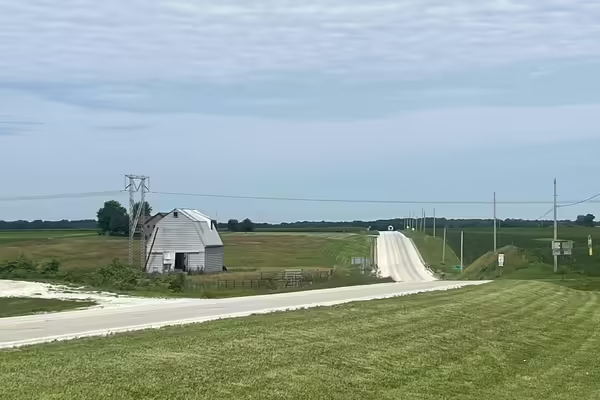
PHOTO CAPTION: Proactive farm estate and succession planning ensures agricultural legacies survive across generations.
University of Illinois Extension develops educational programs, extends knowledge, and builds partnerships to support people, communities, and their environments as part of the state's land-grant institution. Extension serves as the leading public outreach effort for University of Illinois Urbana-Champaign and the College of Agricultural, Consumer and Environmental Sciences in all 102 Illinois counties through a network of 27 multi-county units and over 500 staff statewide. Extension’s mission is responsive to eight strategic priorities — community, economy, environment, food and agriculture, health, partnerships, technology and discovery, and workforce excellence — that are served through five program areas — 4-H youth development, agriculture and agribusiness, community and economic development, health and community wellness, and natural resources, environment, and energy.