
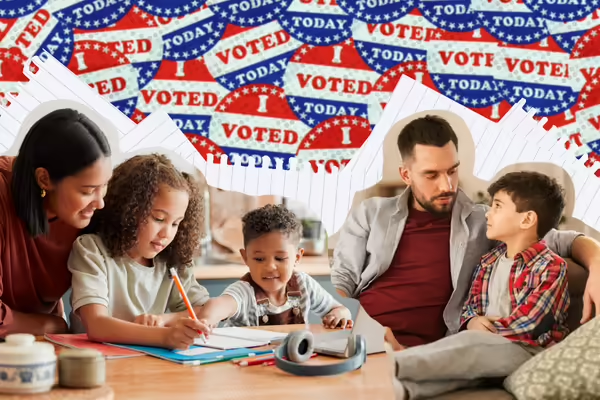
URBANA, Ill. — Youth may be too young to vote, but they are not too young to have questions about elections and politics. From campaign ads to conversations at school and around the dinner table, Election Day can spark curiosity, learning opportunities, and sometimes concern. University of Illinois Extension offers resources to help parents and educators navigate those conversations while supporting their young people’s well-being.
“Many parents find conversations about politics uncomfortable because they feel like they need to have all the answers before they talk to their kids. That’s not the case,” said Emilia Elabed, Illinois Extension youth development educator. “Start by asking young people what they’ve heard and how they’re feeling. Then listen and make room for questions. Young people know more than we may realize. They’ve seen the news, the yard signs, and heard conversations from classmates at school. Having a trusted adult to help them filter this information in a safe and supportive environment is crucial.”
According to Elabed, these conversations are also crucial for helping young people learn to navigate disagreements respectfully and process information accurately. Parents and educators can model that by listening and helping their children check the accuracy of information, and showing them how to express their views while remaining open to others.
“We live in an era of constant information overload,” said Elabed. “There is so much information coming at our young people all the time. Our role as trusted adults is to help them build the skills and confidence to form their own opinions, rather than make decisions for them. That’s part of helping youth become Beyond Ready to navigate the world around them.”
To help parents and educators navigate this challenging climate, University of Illinois Extension has a variety of resources available.
Resources to help youth navigate election conversations
Help youth evaluate information and explore their role
- How to evaluate sources (U of I University Library) — A framework to help youth and adults examine information, consider its purpose, and evaluate its credibility.
- Recognizing misinformation and disinformation (U of I Counseling Center) — Practical questions and resources for checking claims, investigating sources, and recognizing how emotions can influence reactions to information.
- Exploring civic engagement (Illinois 4-H) — Activities and conversation starters to help youth learn about their communities and find ways to participate before they are eligible to vote.
Keeping the conversation open and supportive
- Communicating with children (Illinois Extension) — Guidance for asking children what they see in the news, listening to their perspectives, and keeping conversations going.
- Terrific Teachable Moments for families (Illinois Extension) — An app with more than 150 short activities supporting social and emotional learning across different ages.
Recognizing stress and support well-being
- Supporting youth mental health (Illinois Extension) — Practical ways to build trusting relationships, create supportive spaces, and recognize when youth may need additional help.
- Helping teens deal with stress (Illinois Extension) — Tips for recognizing stress, listening to teens, and supporting them through difficult feelings.
Supporting the adults who support youth
Taking care of the well-being of adults who care for youth matters, too. These resources can help parents, caregivers, and other trusted adults manage stress and strengthen communication.
- Strong Couples Project (Illinois Extension) — Strong adult relationships can help create supportive home environments where young people feel safe discussing difficult topics and asking questions. Strong Couples is a free online relationship education program for qualifying couples, with self-paced lessons and coaching to strengthen communication, connection, and problem-solving.
- Tips for managing sociopolitical stress (U of I Counseling Center) — Practical strategies for managing news and social media intake, setting boundaries around political conversations, and making time for self-care.
- Building blocks of resilience (U of I Family Resiliency Center) — Resources on mindful parenting and building resilience in families.
Building Beyond Ready youth beyond Election Day
As election conversations continue in homes, schools, and communities, trusted adults can help youth build the skills needed to navigate an increasingly complex information landscape.
“Every election season offers an opportunity to teach skills that extend far beyond politics,” said Emilia Elabed. “By helping young people ask questions, evaluate information, and understand different perspectives, we are building the confidence and critical-thinking skills they need to participate thoughtfully in their communities and the world around them. Those are the kinds of skills that help youth become Beyond Ready for whatever opportunities and challenges lie ahead.”
For more information about 4-H in your community, visit 4h.extension.illinois.edu/join-4-h.
SOURCE: Emilia Elabed, 4-H youth development educator.
WRITER: Anthony Warmack, communications and marketing coordinator.
EDITOR: Brooke Katcher, 4-H recruitment and engagement coordinator.
MEDIA ACCESS: Cover image and cutline can be downloaded for media use.
INTERVIEWS: Contact Anthony Warmack, warmacka@illinois.edu to request specialist interviews about this topic.
ABOUT ILLINOIS 4-H: Illinois 4-H is the flagship youth development program of University of Illinois Extension, administered through the College of Agricultural, Consumer and Environmental Sciences. Through hands-on learning and life-changing experiences, Illinois 4-H prepares youth to be Beyond Ready — ready for college, career, military service, entrepreneurship, and more. Young people build confidence, leadership, and resilience as they explore interests from agriculture to computer science. Independent research and national surveys confirm the powerful outcomes of 4-H: participants are 40% more likely to pursue a college degree, twice as likely to obtain technical training, and two times more likely to serve in the military. With a legacy of cultivating leaders, Illinois 4-H continues to grow the next generation who are equipped to thrive in life and work today and beyond.
University of Illinois Extension develops educational programs, extends knowledge, and builds partnerships to support people, communities, and their environments as part of the state's land-grant institution. Extension serves as the leading public outreach effort for University of Illinois Urbana-Champaign and the College of Agricultural, Consumer and Environmental Sciences in all 102 Illinois counties through a network of 27 multi-county units and over 500 staff statewide. Extension’s mission is responsive to eight strategic priorities — community, economy, environment, food and agriculture, health, partnerships, technology and discovery, and workforce excellence — that are served through five program areas — 4-H youth development, agriculture and agribusiness, community and economic development, health and community wellness, and natural resources, environment, and energy.