Note: This article is not to be construed as legal advice. Consult with your legal advisor before entering tile agreements.
Improving farm drainage tiles in Illinois can be very challenging because most farmland is owned by absentee landowners rather than by the farmer. Owners sometimes do not understand the problems caused by failing older drain tile systems. Once a landowner agrees to improve field drainage, a tile system may be limited because there is no good outlet for draining water from the farm. A good outlet is a vital component of any farm drainage project.
The purpose of this article is to present the steps taken by a group of landowners working together to provide a high-quality tile drain outlet for their land. Some farms benefit from a bordering drainage ditch, an adequately large district tile main running through the farm, or a cooperative neighbor who grants the owner access to install a tile main across their land leading to a drainage ditch.
Farm Field Outlets are Vitally Important
Some farmers cannot drain extra water because they lack a proper outlet, leaving them with limited options. Farm landowners can use the Illinois Drainage Code to uphold their rights to add tile on a neighbor’s property, but this could involve legal battles in court. Even if a landowner secures a legal remedy to tile across a neighbor, future repairs and possible acreage added to the tile could overload a system not designed to handle increased flow. Once legal action is required, neighborly relationships will likely deteriorate further. For more information, see: 70 ILCS 605/ Illinois Drainage Code or an older article available at: farmdoc.illinois.edu/assets/legal/pdf/drainage_law.pdf.
Failing Tile Mains
The Subject Farm in the case study had several medium-sized tile mains that carried water eastward from three neighboring farms located to the west. The tile drain main was old, undersized, and in poor condition, and ran under a major railroad line. Blowouts from excess water pressure were recurring, requiring frequent and extensive repairs. The older drainage system, connected to the existing tile mains on the subject farm, was severely backlogged due to excessive water loads on the tile mains. In very wet years, yields on the Subject Farm were very low.
Neighbors Asked for Cooperation
The neighboring owners approached the Subject Farm owner to improve the tile mains, but the Subject Farm owners were not interested in making drainage improvements. Neighbor relationships were strained, in part due to a lack of cooperation in improving drainage. The assumption was that the tile main would be left to deteriorate indefinitely.
Yields Suffered
As yields on the Subject Farm diminished, the owners eventually sought to improve drainage and had plans drawn up to replace the system with a single new 1.1-mile tile main. The neighbor farms, also suffering from poor drainage due to the condition of the tile main, were approached by the Subject Farm owner. One of the neighboring farms (Farm A) had been pattern tiled. During wet conditions, water from Farm A rose to the surface in the road ditch, reducing tile efficiency, so the farm owner immediately jumped at the proposal. Farm B soon followed as the new owner understood the benefits of tile and a good tile main outlet.
Cooperation at Last
With the proposed new tile main, each farm added to the water load, and the size and expense of the new system. The third neighbor initially agreed to join the project but later changed their mind due to decades of strained relations. Farm A had the most significant financial responsibility for the project outlined in the proposal.
The new tile main project bid came in at over $225,000. Each farm would pay a prorated rate toward the project based on the volume of water moved and the total distance to the drainage ditch. The central drain was sized based on ultimate field drainage requirements, allowing for future pattern tiling. The tile contractor reduced the total costs to the landowners by bypassing the railroad track, saving over $100,000. There were legal issues involving the railroad in this proposed change, which resulted in a favorable court decision.
The Subject Farm owner decided to avoid costly repairs to the old system by paying for the non-cooperating farms’ share of the project. Without this, the Subject Farm owner legally needed to keep the old system functioning. Making this decision was difficult, as adding the 3rd farm to the system would increase the tile main's maximum diameter from 21 inches to 24 inches, thereby increasing the installation cost. Initially, the tenant farmer agreed to pay some of the landowner’s expenses, but the farmer lost his lease upon the landowner's death, and the estate sold the farm.
A Financial Success
The cost of the new outlet was under $250/acre on the affected acres with poor drainage. The owners had this cost recovered in two years due to increased yields. The group paying for the system agreed to share the costs of future repairs.
Kevin Brooks is a University of Illinois Extension Educator in Havana, Illinois, and can be contacted at kwbrooks@illinois.edu or at extension.illinois.edu/blogs/farm-coach.
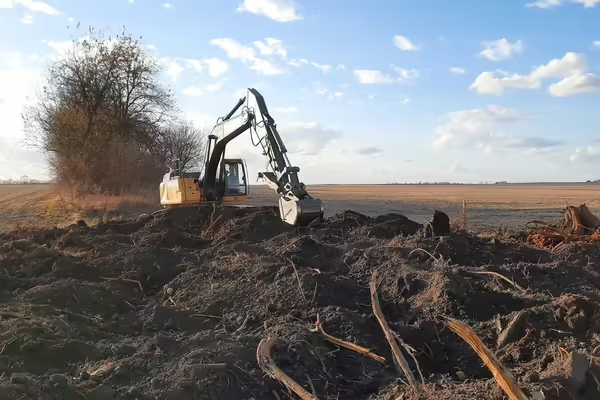
PHOTO CAPTION: An excavator clears tree roots for a farm drain tile. (Photo by Kevin Brooks)
University of Illinois Extension develops educational programs, extends knowledge, and builds partnerships to support people, communities, and their environments as part of the state's land-grant institution. Extension serves as the leading public outreach effort for University of Illinois Urbana-Champaign and the College of Agricultural, Consumer and Environmental Sciences in all 102 Illinois counties through a network of 27 multi-county units and over 700 staff statewide. Extension’s mission is responsive to eight strategic priorities — community, economy, environment, food and agriculture, health, partnerships, technology and discovery, and workforce excellence — that are served through five program areas — 4-H youth development, agriculture and agribusiness, community and economic development, health and community wellness, and natural resources, environment, and energy.