This article is not to be construed as legal advice. Consult with your legal advisor before entering tile agreements.
HAVANA, Ill. - Installing the necessary drainage tile on your farm often requires a tile main to direct water through an underground drain tile system and then through a neighbor’s property to reach a drainage ditch. Old tile mains can be miles long, crossing many neighboring farms. The cost of securing a good tile main from your farm to the outlet can be prohibitive, depending on distance, neighborly cooperation, and other hurdles. Uncooperative neighbors can be a major challenge, and railroads and highways can pose complex barriers.
Tile mains were commonly laid or bored under railroads and highways. Tile mains under railroads date back a very long time, while the age of tiles under highways can depend on when the Illinois Department of Transportation last reconstructed the road. Tile mains under interstates typically date back to the construction in the 1960s. Decades of heavy traffic can compromise the structural integrity of these tiles, and many structures have failed or experienced reduced flow due to damage.
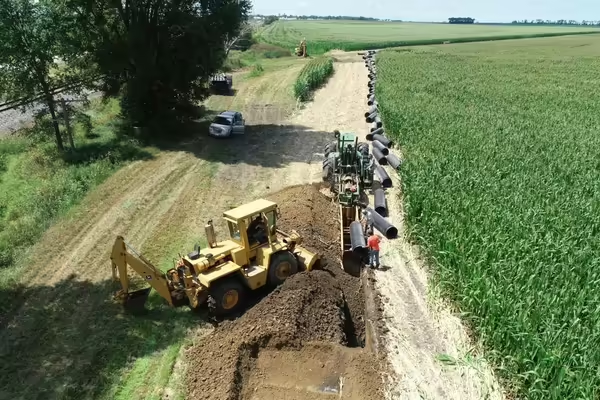
The purpose of this article is to provide an example of how a group of neighboring landowners cooperated to complete a 1.1-mile-long tile main. The small group was able to overcome significant barriers. This example demonstrates a cooperative approach to addressing water challenges legally, rather than acting as a direct blueprint.
Landowners Solve a Railroad Dilemma
The tiles on the project farm needed to be replaced by the owners to achieve good crop yields. The old system drained under a major railroad and a state highway before dumping water into a large district drainage ditch. Obtaining permission to bore under the highway from the Illinois Department of Transportation (IDOT) was straightforward using proper district office protocols. The railroad, however, posed significant challenges.
There were tile blockages in tiles on the railroad right-of-way. Root-clogged clay tiles restricted drainage flow, and the railroad engineer was uncooperative about repairing them. He opposed removing the trees, as they serve as a critical barrier to prevent snowmobiles from using the right-of-way. The drainage tiles that channeled water beneath the tracks did not function properly due to decades of heavy rail traffic. The railroad official firmly warned the contractor not to trespass on the railroad right-of-way, including for inspections of existing tile mains.
Checking the Court Records
The railroad managing engineer for this section of track pointed out that there was only one legally recorded tile easement under the railroad, and that the farm was using an illegal tile at another location. The owners were aware of at least two tiles going under the railroad. Court records date the tiling under the tracks to the 1930s.
The contractor drew revised plans to divert the water so it would run under the railroad at one location, due to cost and the railroad's refusal to allow a second location. The local drainage district and IDOT agreed to the plan. The project stakeholders hired a civil engineer, who dismissed the increased water volume from the closed second main as inconsequential.
To complete the project, the railroad demanded that the tracks be closed during construction under the tracks, which required compensation for a flagger to stop trains and a loss of revenue. The estimated cost to replace the tile under the rails was $125,000. The railroad also demanded a partial property-line survey to ensure tile contractors did not trespass on the railroad right-of-way.
Redirecting the Tile
The owners discussed exploring alternatives with the tile contractor. A new rerouted plan involved running the tile main alongside the railroad track to the drainage ditch, dumping the water upstream of the railroad bridge. This redirection would avoid boring the tile under the railroad track and would significantly reduce installation costs. Redirecting natural water flow required approval from IDOT, the railroad company, and the local drainage district.
The plan, when completed, would reroute the water dumping 2,000 feet upstream from the original outlet. The calculated amount of water entering the drainage ditch before flowing under the bridge would be negligible compared to the bridge's overall flow capacity, even during high water. The railroad engineer rejected the proposal, objecting to an increase in water flow under the railroad bridge.
During this time, the farmer and contractor noticed a railroad tie collapsing into a railroad culvert. The landowners contacted the railroad police, and the railroad made emergency repairs to the tracks, preventing a derailment. The railroad thanked the contractor for this warning, and the new railroad managing engineer was noticeably more agreeable.
A Favorable Court Decision
No railroad officials attended the court hearing. The owners obtained a favorable court order to proceed with the project, routing the tile main on the subject property near the railroad right-of-way to the ditch. To reach the ditch, the owners secured permission to cross 700 feet of an uninvolved neighbor's property. As friendly neighbors, the group agreed to allow this neighbor to run a drainage tile to the tile main on that property. The project was a success, measured by significant increases in corn yields on the farms involved.
Tile drains across multiple farms can create complex relationships among neighbors. In this case study, the landowner's persistence and professional behavior contributed to the successful installation of a cooperative tile main.
Kevin Brooks is a University of Illinois Extension educator in Havana, Illinois, and can be contacted at kwbrooks@illinois.edu or at extension.illinois.edu/blogs/farm-coach.
University of Illinois Extension develops educational programs, extends knowledge, and builds partnerships to support people, communities, and their environments as part of the state's land-grant institution. Extension serves as the leading public outreach effort for University of Illinois Urbana-Champaign and the College of Agricultural, Consumer and Environmental Sciences in all 102 Illinois counties through a network of 27 multi-county units and over 500 staff statewide. Extension’s mission is responsive to eight strategic priorities — community, economy, environment, food and agriculture, health, partnerships, technology and discovery, and workforce excellence — that are served through five program areas — 4-H youth development, agriculture and agribusiness, community and economic development, health and community wellness, and natural resources, environment, and energy.