This article is not to be construed as legal advice. Consult with your legal advisor before entering tile agreements.
HAVANA, Ill. - Contractors design modern farm drainage-tile installations to last for many decades. Some older systems are approaching and exceeding 100 years old. Hiring an experienced, reputable farm tile installation contractor is essential to the longevity of the system.
What Landowners Need to Know About Repairs
Some contractors use lower-quality tile components, which may fail more quickly. Interviewing multiple contractors and asking detailed questions will help to educate the landowner on tile quality. Prioritize contractor-grade materials made with virgin resin for longevity. Lower-quality plastics made from recycled materials are likely to be less durable due to weak spots. Problems may not show up for years.
Good Tile Joints are Essential
Most installation contractors do an excellent job, but mistakes can compromise the physical integrity of the tile project. If there are going to be issues, problems often appear at joints where a smaller-diameter tile joins a larger one, allowing sediment to enter the joint and clog the system. Properly securing tiles is difficult under rushed conditions, without on-site oversight, or when bonding different materials, such as modern plastic to old clay. Confirm if your contractor will be present during the installation.
Fabric is sometimes used at joints to prevent sediment from flowing into the tile through the joint while allowing water to seep through. Occasionally, a contractor might cover a mistake at the joint with fabric to save time, but this is rare, and fabric should not be used as a cover-up for an error.
Proper Gradient Must be Precise
The slope (grade) of the tile is vitally important. A tile plow or trencher needs to be highly accurate, using GPS-level precision. An improperly graded tile can slow water flow, diminish efficiency, or allow sediments to settle. An insufficient grade will slow water flow, thereby subjecting crop roots to poor growing conditions. Some landowners hire farmers with backhoes to replace sections of tile, but this can make gradient control difficult, creating trenches that cause tiles to lie unevenly, slowing water flow, and wasting money.
Deflection on Large Tiles
Deflection, in layperson's terms, is how well the tile maintains near-perfect roundness under the weight of soil and equipment running over it. A large tile can become unround, especially when the system has curves, and the trench is wider than the tile. Contractors can fill the gap between the tile and the trench with permeable gravel to keep the tile from flattening.
Standpipes and Inlet Structures
Standpipes are vertical, perforated pipes that allow water to get into the farm tile system from the surface. These structures are installed in fields by contractors to prevent ponding caused by slow water percolation and to allow water to flow more quickly into the drainage tile. Standpipes can also serve as breathers, which enhance water flow through the system. Your farm lease agreement should require the farmer to repair standpipes damaged by equipment and keep the holes free of crop residue. A damaged standpipe might require extensive excavation. Vegetative filter areas can help limit pollutants from entering the system.
System Overloading
The tile contractor should properly size farm drainage systems during the project's design phase. Under-sizing systems to save on installation costs can lead to damage. Installing a smaller tile main to the outlet to save money can lead to more expensive repairs should the field system be expanded in the future. Larger tiles, 12 inches and up, with dual walls are smooth inside and can increase flow. Dual-walled tile is more costly but allows more water to flow through. Make sure your drainage tile can handle the extra water before letting a neighbor connect to it.
Trees, Brush, and Heavy Equipment
Trees, including hedgerows, can damage field tiles and make coexistence difficult. Roots can grow beyond the tree canopy and can find their way into the slits/openings in the tile system. An outlet tile to another field with a tree line can prevent your tile system from functioning, and the tile may need to be removed. For more on hedgerows, see: /news-releases/getting-dust-settle-stay-illinois-farmland.
Maintenance Legal Agreements
Mutual (cooperating neighbors) farm tile mains often involve sharing installation costs across multiple farms. A farm near the tile outlet carries more water than the part of the tile main at the head. Installation costs are higher near the outlet, as are repair costs due to the tile's larger size to accommodate the increased volume. What starts at the head of the main may be eight inches in size to over thirty inches at the outlet.
Thus, it makes sense to prorate the farm tile main repair costs based on the volume and distance of water moved at the location where the repair is needed, thereby making each owner's repair expense different. The cooperating landowners should agree before the project installation begins. The signed maintenance and repair agreement should be drafted by an attorney and recorded with the county clerk's office.
The landowners should also work out a legal agreement with a neighbor when installing a tile that runs through the neighboring farm, if the owner is not paying for or participating in the project. If the neighboring landowner waives rights to use or maintain this tile, the resulting agreement must be filed with the county clerk by legal counsel. Recording the agreements will help prevent future disagreements.
Kevin Brooks is a University of Illinois Extension Educator in Havana, Illinois. As a farm manager and licensed real estate managing broker, Kevin has worked with many landowners on farm drainage and can be contacted at kwbrooks@illinois.edu or at /blogs/farm-coach.
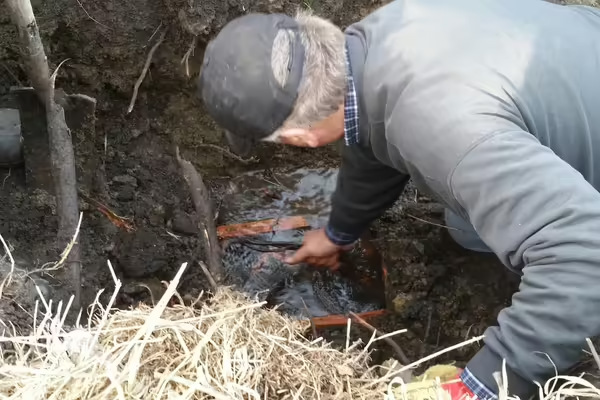
PHOTO CAPTION: A farmer investigates a broken tile. (Photo by Kevin Brooks)
University of Illinois Extension develops educational programs, extends knowledge, and builds partnerships to support people, communities, and their environments as part of the state's land-grant institution. Extension serves as the leading public outreach effort for University of Illinois Urbana-Champaign and the College of Agricultural, Consumer and Environmental Sciences in all 102 Illinois counties through a network of 27 multi-county units and over 500 staff statewide. Extension’s mission is responsive to eight strategic priorities — community, economy, environment, food and agriculture, health, partnerships, technology and discovery, and workforce excellence — that are served through five program areas — 4-H youth development, agriculture and agribusiness, community and economic development, health and community wellness, and natural resources, environment, and energy.