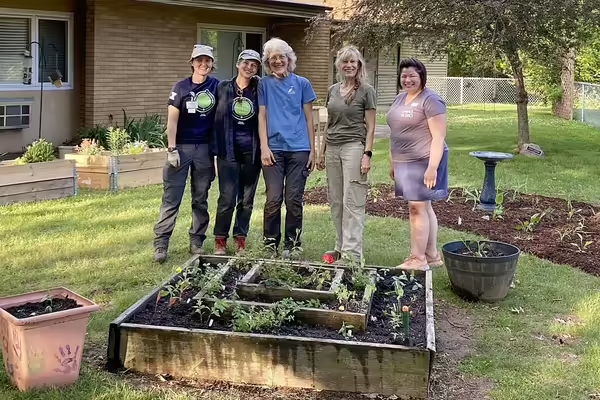
PEKIN, Ill. - When Hallmark House physical therapist and University of Illinois Extension Master Gardener Vic Harting looked at the outdoor spaces surrounding the nursing home, she saw more than landscaping. She saw an opportunity to create meaningful moments of connection for individuals who often have limited access to nature. With support from other Extension Master Gardeners, Vic has transformed the grounds into a series of therapeutic garden spaces designed to meet residents’ physical and emotional needs.
In the past two years, three distinct garden areas were installed: a wheelchair-accessible sensory garden, a native plant bed, and most recently, a songbird garden designed specifically for residents who can only view the outdoors from their windows. These additions have quickly become central to daily life at Hallmark House. They offer residents and staff a restorative environment that supports healing and community.
The gardens have had a meaningful impact on resident engagement and mood. “We’ve had some very depressed individuals, one patient in particular who was seen exploring the sensory garden often. Many staff told me that was the first time they ever saw him smile since being at Hallmark,” Vic noted.
Residents also engage with the garden in hands-on ways. Fresh cherry tomatoes have become a favorite treat, with mobile residents picking their own and others receiving them as a snack or during meals. Vic plans to expand the “taste” section of the sensory garden with more tomatoes and basil due to their popularity.
The gardens have unexpectedly become a valued space for staff as well. Employees take breaks in the gazebo overlooking the gardens, using the shaded area as a place to decompress. Even routine tasks have shifted in tone. “This is the path a lot of staff walk to take trash to the dumpster. I tend to notice them walking slower and enjoying the flowers and fresh air,” stated Vic. The activities department uses the outdoor space for “patio time” and tea parties, with more outdoor programming expected as the gardens continue to develop.
The garden project has inspired improvements to Hallmark House. The gazebo has been repainted, additional outdoor furniture has been added, and the facility planted a memorial redbud tree on Arbor Day in honor of former Director of Rehab Dawn Wagner. “Starting the garden has kickstarted some other outdoor improvements,” Vic shared. “The redbud was planted because it shows off Dawn’s favorite color purple.” These enhancements demonstrate how the garden has become a catalyst for beautification and community healing.
Hallmark House hopes to improve and replant window beds, paint and refresh the raised beds, create a hands-on horticulture club for residents, and restore the front-yard pond, once home to koi fish for watching. These next steps will deepen resident engagement and strengthen the therapeutic value of the outdoor environment.
Photo caption - Hallmark House physical therapist and Master Gardener Vic Harting has led the installation of sensory, native, and songbird gardens on the nursing home campus. These accessible outdoor spaces have sparked broader beautification efforts throughout the facility. Photo by Ainsley Olsen, Illinois Extension horticulture program coordinator.
University of Illinois Extension develops educational programs, extends knowledge, and builds partnerships to support people, communities, and their environments as part of the state's land-grant institution. Extension serves as the leading public outreach effort for University of Illinois Urbana-Champaign and the College of Agricultural, Consumer and Environmental Sciences in all 102 Illinois counties through a network of 27 multi-county units and over 500 staff statewide. Extension’s mission is responsive to eight strategic priorities — community, economy, environment, food and agriculture, health, partnerships, technology and discovery, and workforce excellence — that are served through five program areas — 4-H youth development, agriculture and agribusiness, community and economic development, health and community wellness, and natural resources, environment, and energy.