LEWISTOWN, Ill. - Every tree has a story to tell, you just need the right tools to read it. Those stories are written in tree rings, hidden in their height, and tucked away in details most of us walk right past.
During Forestry Skills 101: Using Forestry Tools, 13 participants plus four Extension staff got to step into the boots of a forester for the afternoon at Rice Lake, near Canton. Led by Karen Weigelt, University of Illinois Extension ag and natural resources program coordinator, the workshop gave attendees the chance to learn the same tools and techniques Karen used throughout her career in forestry. With stories from the field, hands-on practice, and plenty of questions along the way, participants discovered that measuring a tree is about much more than numbers. It's about understanding the life it's lived and the forest around it.
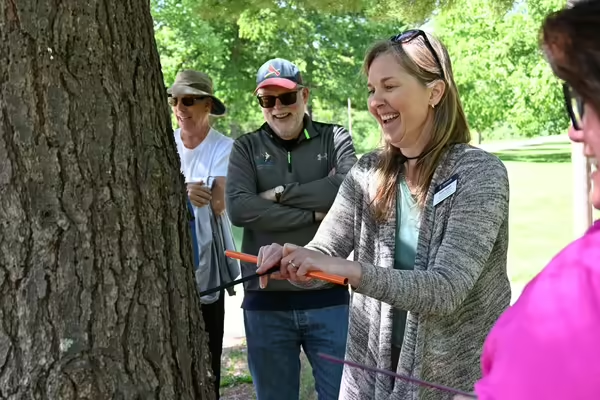
Participants learned how to measure tree height with a clinometer, measure tree diameter, and use an increment borer to pull a small core sample from a white pine. By counting the annual growth rings, they could determine the tree's age, identify years of rapid or slow growth, and learn how weather and environmental conditions leave their mark over time. (Don't worry, the tree survived the experience.) Karen also explained how these tools help foresters assess forest health, estimate timber resources, and make informed woodland management decisions.
“We had a mix of Master Gardeners, Master Naturalists, Extension staff, and the general public attend the workshop,” noted Brittany Chambers, natural resources program coordinator. “Some of them will use the skills to help make informed decisions about their own property, and others will utilize these skills in their volunteer roles at partner sites.”
Recently, Master Naturalists worked alongside Karen to get all the necessary data on a tree in Spring Creek Nature Preserve in East Peoria. The elm tree was nominated for the Illinois Big Tree Registry. While it was not the largest elm in the state, it was deemed a “Tree of Significance”.
“When we think of forestry skills, our Master Naturalists come to mind first, but the skills benefit Master Gardeners as well,” Brittany commented. “You can use the same tools and lessons to evaluate trees and bushes in your home landscape, too. They are especially handy for judging the tree or bush’s health or if it is in the best location.”
The Forestry Workshop included a special tour of a portion of Banner Marsh that requires special permission to explore. As the group hiked between the marsh and the forest's edge, Karen pointed out different tree species, shared what makes a forest ecosystem thrive, and helped participants see the woods through the eyes of a forester. Attendees left with new skills, a fresh perspective, and the tools to start reading the stories written in the forests and landscapes around them.
Photo caption
Extension program coordinator Karen Weigelt taught a Forestry Skills workshop at Rice Lake near Canton. Taking a core sample of a tree was one of the hands-on lessons the 13 participants experienced.
University of Illinois Extension develops educational programs, extends knowledge, and builds partnerships to support people, communities, and their environments as part of the state's land-grant institution. Extension serves as the leading public outreach effort for University of Illinois Urbana-Champaign and the College of Agricultural, Consumer and Environmental Sciences in all 102 Illinois counties through a network of 27 multi-county units and over 500 staff statewide. Extension’s mission is responsive to eight strategic priorities — community, economy, environment, food and agriculture, health, partnerships, technology and discovery, and workforce excellence — that are served through five program areas — 4-H youth development, agriculture and agribusiness, community and economic development, health and community wellness, and natural resources, environment, and energy.