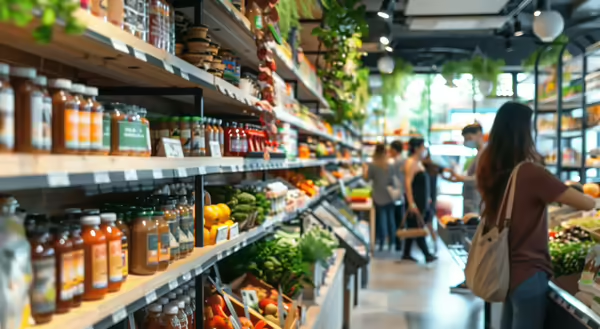
Want to know a secret? Your local, independent grocer loves you. Truly. They love your hometown, your traditions, your Friday-night ballgames, and the neighbors they’ve served for years. Despite what some may assume, their love for the community is much greater than their love for profit. Because in reality, very little profit exists in the rural grocery biz.
Most people imagine local business owners earning comfortable margins, but the reality for grocers is stark: the average independently owned grocery store earns a net profit of only 1% to 3%. Compare that with furniture stores, which earn 4% to 8%, electronics retailers, at 2% to 5%, or clothing shops, at 4% to 10%.
Your local grocer works longer hours for a lower return than almost any other retailer — early mornings unloading trucks, late nights balancing the books, and, more often than ever, mopping floors or stocking shelves themselves. They do it because they believe your town deserves access to fresh, quality food close to home.
During Illinois Extension listening sessions held across the state in 2024, grocers consistently described their deep sense of responsibility to their communities. They sponsor youth sports, buy yearbook ads, support local fund-raisers, and donate to food drives — not because it boosts sales, but because it’s who they are. They are rooted, present, and personally invested in their neighbors' well-being.
Yet, many grocers quietly admit that this love often feels unreturned.
They see longtime customers shifting loyalty to bigger chains that offer online ordering, curbside pickup, and delivery services that small stores simply cannot afford to match. They watch the schools, churches, and non-profits they’ve supported for decades buy cases of supplies from bulk clubs. And it hurts when local leaders celebrate the arrival of a new dollar store across the street — complete with tax incentives — while their own store struggles to keep the lights on.
In many towns, the decline is gradual but unmistakable. Younger generations treat the local store as a quick stop rather than a primary grocery provider. Average basket sizes shrink while utility bills, labor costs, and wholesale prices surge. Meanwhile, large chains enjoy enormous purchasing power and control their own distribution pipelines, allowing them to offer lower prices that small grocers simply cannot match.
The result? Rural communities are losing independent grocery stores at an alarming rate. Some call it a natural evolution of the marketplace, but the consequences can be devastating to small towns. When the local grocer closes, the town loses more than a store — it loses access to fresh food, a major employer, a civic partner, and a central hub of community life. In many places, that closure marks the beginning of a slow decline that is often difficult, and sometimes impossible, to reverse.
Your local grocer loves you. They have shown it through decades of service, sacrifice, and community support. The question now is simple: Will we show that love back?
Choosing to shop local — more often, more intentionally — isn’t just about supporting a business. It’s about safeguarding the health, resilience, and future of our hometowns. Your grocer has been there for your community. Let’s make sure our community is there for them.
About the Author
John Shadowens is a University of Illinois Extension Educator in Community and Economic Development and is the former president and CEO of Spero Family Services in Mount Vernon, Illinois. He has spent three decades in regional leadership and community development for a variety of issues throughout Southern Illinois. Currently, he specializes in developing food security solutions in rural food deserts. He develops and cultivates partnerships among communities and independent grocers to help them sustain or create grocery enterprises.
John has a Bachelor's in Psychology from Southeast Missouri State University and a Master's in Public Administration from Southern Illinois University Carbondale, and is certified as a Rural Grocery Specialist. John has consulted with dozens of organizations and presented to thousands, advocating for changes in our traditional approaches to working with young people and rural food insecurity.
To reach John, write to him at johnms@illinois.edu or call him at (618) 833-6363.