What makes a town feel like home? One key indicator of a strong, resilient community is placemaking. The Project for Public Spaces defines placemaking as “the collaborative process by which we can shape our public realm in order to maximize shared value.” In simple terms, it’s when residents and local leaders work together to creatively use public spaces for social benefit.
While many cities already rely on volunteers to support festivals and fundraisers, placemaking goes further. It is purposeful, centering on art, culture, and the revitalization of neglected spaces. Its goal is to foster a sense of belonging, pride, and shared ownership among people from all walks of life.
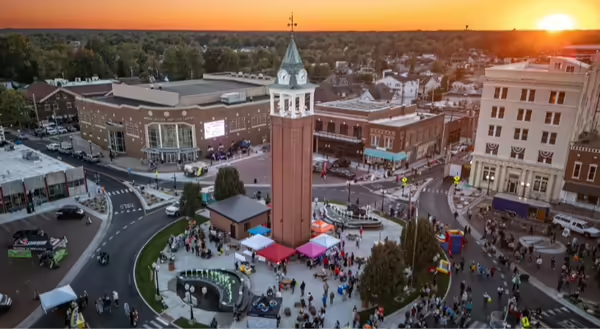
A powerful example can be found in Marion, Illinois. Just a decade ago, Marion’s downtown square was lined with empty, aging buildings as years of commercial growth gradually shifted toward the interstate on the west side of town. That began to change in 2019, when businessman Mike Absher was elected mayor and prioritized downtown revitalization. Within five years, storefronts were occupied, and the town square had been completely transformed with fountains, landscaped areas, music, and even a winter skating rink. Mayor Absher emphasized that the square was to be the people’s plaza, a public space for everyone, and implemented an open-use policy for events.
In 2022, the nonprofit Marion Connects was formed with a mission to boost civic pride, social engagement, and awareness of the city’s assets. The group launched a “Third Thursday” event series in April 2023, starting with a bubble dance party for kids. It quickly became a monthly community tradition, featuring salsa and line dancing, a back-to-school bash, fairy-tale-themed celebrations, and even a pirate party complete with a full-size ship on the plaza.
Since then, other groups have used the space for temporary art displays, car shows, historical walks, pop-up markets, and a summer concert series. Local churches, businesses, and downtown merchants now partner to sponsor activities and keep the area open late with special offerings. Every event has been free and family-friendly, drawing hundreds of participants and fostering a renewed sense of community in Marion. The city continues to grow economically, but placemaking is helping ensure that residents grow with it.
Communities of all sizes can follow a similar path. From large-scale projects like New York City’s Bryant Park revitalization to smaller efforts like the Riverwalk in Cape Girardeau, Missouri, the most powerful resource is always the people who call a place home. Research shows that placemaking boosts local economies, strengthens identity, encourages civic engagement, increases property values, and builds meaningful social connections.
How can your community begin? Start by identifying your unique local assets — rivers, hills, heritage, cultural traditions, or architectural character. Build your efforts around co-creation so residents can help design murals, markets, parades, and talent showcases. Start small with pilot events, pop-ups, or seasonal programs. If you lack a formal public plaza, consider underused spaces such as empty lots, courthouse lawns, or small parks.
Placemaking strengthens communities by engaging people directly in shaping the places they share. It’s a win-win — supporting economic vitality while deepening the sense of belonging that turns a town into a true community.
About the Author:
John Shadowens is a University of Illinois Extension educator in community and economic development and the former president and CEO of Spero Family Services in Mount Vernon, Illinois. He has spent three decades in regional leadership and community development, addressing a range of issues throughout Southern Illinois. Currently, he specializes in developing food security solutions for rural food deserts. He builds partnerships among communities and independent grocers to help them sustain or create grocery enterprises.
John holds a bachelor’s in psychology from Southeast Missouri State University and a master’s in public administration from Southern Illinois University Carbondale. He is also certified as a rural grocery specialist. John has consulted with dozens of organizations and presented to thousands, advocating for changes to our traditional approaches to working with young people and addressing rural food insecurity.
To reach John, email him at johnms@illinois.edu or call him at 618-833-6363.
Photo Credit: Jared Long, Southern Illinois Cinema