Many rural and small-town communities are encouraged to think about tourism in terms of branding, promotion, and attracting more visitors. Those things matter, but they are not always the best place to begin. In many communities, the more useful first question is simpler: What should visitor activity actually do for the people who already live here?
That question is at the center of “Home First”, a new University of Illinois Extension facilitation curriculum designed to help communities take a more grounded, resident-first look at tourism, outdoor recreation, and visitor development. Home First begins with the idea that tourism is not only about visitors. It is also about local identity, public spaces, small businesses, outdoor assets, community pride, volunteer capacity, stewardship, and quality of life. In other words, visitor activity is already connected to many aspects of community life, whether or not a place has formally named itself a destination.
Rather than starting with logos, slogans, or growth targets, Home First helps communities begin with observation. Where are visitors, events, outdoor recreation, seasonal use, or pass-through traffic already affecting the community? Where does that activity support residents? Where does it create strain? What is worth protecting, strengthening, or restoring before more promotion takes place? The goal is not to produce a heavy master plan or a branding package. It is to help communities clarify priorities, identify realistic next steps, and keep visitor strategies useful to the place over time.
Why Home First?
Tourism conversations often begin with visibility: How do we get more people here? How do we market ourselves better? How do we turn local assets into a stronger visitor economy? Those questions are not wrong, but they can move too quickly past the local conditions that determine whether tourism will benefit a community.
Home First slows the conversation enough to ask:
- What is already happening here?
- What matters in this place?
- What should be strengthened before more promotion?
- Where is the community ready, and where is it stretched?
- What would still matter on an ordinary weekday, even if no visitor surge arrived?
That shift matters because visitor development works best when it strengthens the place people already call home. For some communities, that may mean better connecting outdoor recreation assets to downtown businesses. For others, it may mean improving wayfinding, supporting locally owned businesses, easing the burden on volunteers, strengthening stewardship of parks and trails, or creating more meaningful ways for young people to envision a future in their community.
What the Curriculum Includes
Home First is a flexible facilitation process. It can be used as a half-day introductory workshop, a full-day working session, a three-part community series, or a longer six-session process, depending on local readiness and capacity. The curriculum includes six modules:
1. Tourism starts at home: Map where tourism, visitor activity, and outdoor recreation already intersect with daily community life.
2. What home first means: Define what tourism should strengthen for residents before focusing on growth or visibility.
3. Local identity, story, and what should be strengthened: Identify the stories, places, values, and everyday realities worth protecting or restoring.
4. Community-centered tourism audit: Assess strengths, gaps, readiness, and strain in a structured, resident-first way.
5. From insight to community-shaped opportunity: Identify two or three realistic actions that align with local values, capacity, and community benefit.
6. Stewardship, learning, and keeping visitors useful to the place: Define what success looks like over time and create a simple way to revisit progress.
The process yields practical outputs that communities can use, including a tourism/community systems map, a Home First purpose statement, a local identity and restoration inventory, a community-centered tourism audit, a short action plan, and a stewardship and evaluation framework.
Outdoor recreation as community infrastructure
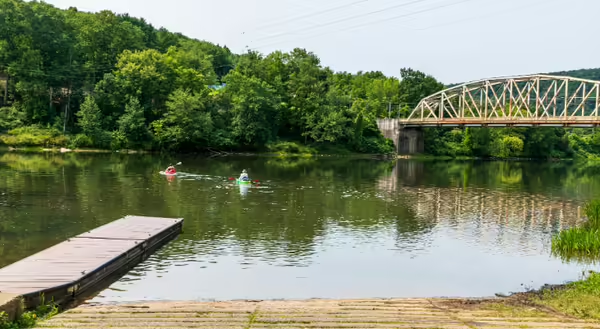
One important part of Home First is recognizing that outdoor recreation assets are not only visitor draws. Trails, rivers, lakes, parks, campgrounds, public lands, and natural areas are also community infrastructure.
They contribute to public health, local identity, youth connection to place, stewardship, and long-term community resilience. The outdoor recreation companion to Home First helps communities ask where recreation use supports residents, where it creates strain, and what actions would improve resident use and the visitor experience simultaneously.
That distinction is important. A river, trail, or park does not become a strong community asset simply because visitors use it, but rather when residents can access, care for, connect to, and see it as part of local life.
Measuring success differently
Home First is not designed to measure success solely by visitor counts. Instead, it asks a broader question: Is visitor activity helping to strengthen the place over time?
That may show up in stronger coordination among local partners, clearer resident-first priorities, visible improvements in stewardship and maintenance, better access to public spaces, more realistic follow-through, stronger support for locally owned businesses, or greater resident use of downtowns, parks, trails, and gathering spaces.
In this way, Home First treats tourism and outdoor recreation as part of community development rather than as a separate promotional effort.
Who Home First is for
Home First is designed for rural, small-town, and regional communities where visitor activity is already present, emerging, or being reconsidered as part of broader community development. It can support local governments, county leaders, economic development organizations, Main Street groups, chambers, tourism partners, park and conservation partners, heritage organizations, Extension educators, and cross-sector community teams.
It works best when a community is willing to convene a representative group, talk honestly about local conditions, and identify realistic next steps rather than jump immediately into marketing or promotion.
Bringing the conversation home
At its core, Home First is about helping communities make clearer choices. It does not ask communities to reject tourism. It asks them to define what tourism should be responsible for. It does not assume every place needs more visitors. It asks what kind of visitor activity would strengthen local life. And it does not begin with the question, “How do we get people to come here?”
It begins with: “How do we make sure this place is stronger, healthier, and better supported for the people who already call it home?”
Interested in bringing Home First to your community? Contact your local Community and Economic Development Extension educator or Katie Dudley, Regional Community and Economic Development Specialist, at kdudley@illinois.edu or 618-954-8257.
About the Author
Dr. Katie Dudley is an Extension Community and Economic Development Specialist who leads regional and statewide initiatives focused on rural tourism, outdoor recreation economies, and community resilience. Originally from Carrollton, Illinois, Dudley holds a PhD in Parks, Recreation, and Tourism Management from Clemson University. Her work focuses on developing and managing thriving communities, ecosystems, and tourism systems that support both residents and visitors. Her work helps rural communities design strategies that strengthen local ownership, workforce pathways, and long-term economic and civic capacity.