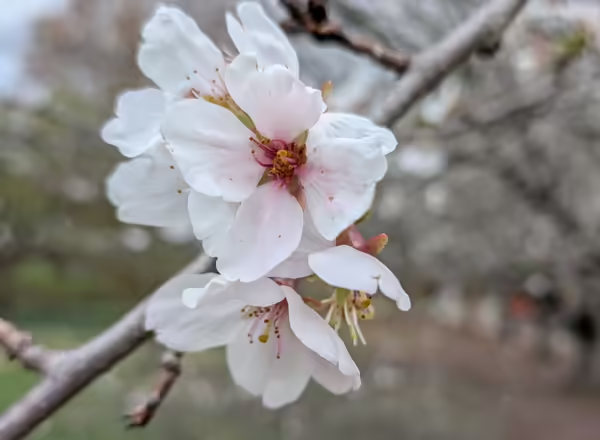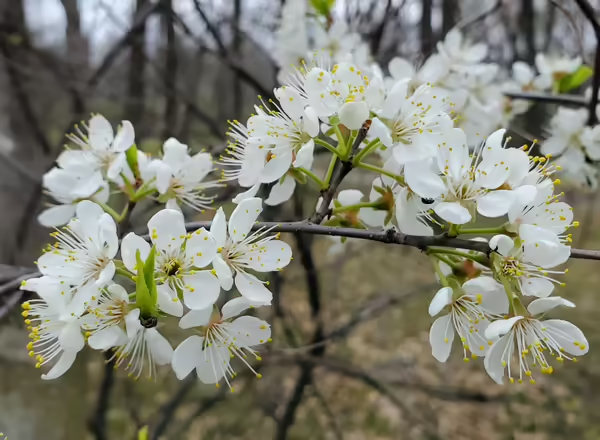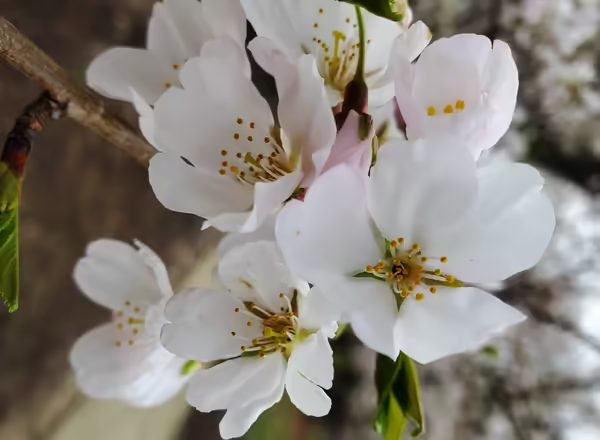
In early April, cherry blooms were in full bloom at the Illinois Arboretum, and I joined a large crowd of admirers for this spectacular display on a Friday afternoon. Each year, many seek this wonderful awakening, attracting students and community members of all ages to observe the signs of spring in the serene setting.
The ritual of taking in the cherry trees is not unique to our arboretum and has been a long-time tradition around the globe, originating in Japanese culture as early as the 8th century. In the US, the most notable cherry blossom bloom is likely in our nation’s capital, where cherry trees line the Potomac waterfront, drawing over one million visitors a year. The original cherry trees in Washington, D.C. were a gift from Japan in 1912, which has perpetuated this ancient tradition in the US, gaining popularity every year.
Observing phenology
The annual observation and appreciation of cherry blossoms is one way that modern-day humans observe phenology, defined as the annual timing of natural processes such as cherry blooms or insect emergences. However, our species has been observing these natural occurrences for eons.
Long before ancient humans began the culture-based observation of cherry blossoms, knowledge of phenology was a key to survival. It was important to understand and predict when a particular fruit might ripen, or when vital game populations might migrate.
While humans may intentionally coordinate with phenological events through learned behaviors, other species have long co-evolutionary histories that have resulted in uniquely timed occurrences. Many pollinators’ lifecycles are timed with the appearance of flowers that are vital to their food supply. In turn, plant reproductive cycles are also dependent on the co-relationship to ensure pollination occurs and viable seeds are produced to perpetuate plant populations. Ecologically, there are many more of these examples, which all serve to illustrate the incredible connectedness in the natural world.
Researching changes
Today, researchers around the globe are continuing to monitor and study phenology, with changes in these annual events emerging as some of the most striking signs of our warming climate.
A 2023 research paper made the most of cherry blossom data over the ages, using 1,200 years of information to compare historic bloom timing to the timing in recent decades. Using the extensive dataset in Kyoto, Japan, and other sites around the globe, researchers found that cherry trees have been flowering earlier in the last several decades compared to the past thousand years. Specifically, in Washington, D.C., cherry trees are blooming nearly a week earlier each spring, on average.
It is important to understand that every spring is different, and dates will always vary with regard to bloom times. However, a measure of heat accumulation, communicated as “degree days,” does reliably predict bloom time independent of calendar date. The 2023 paper and many others take into account heat accumulation by assessing temperature data along with calendar dates. Simply put, heat accumulation each spring is being accelerated by climate change to trigger earlier bloom times and a longer growing season.
Phenological events in the insect world are also experiencing changes with our warming climate. Life events such as spring emergence, migration timing, and the transition to overwintering life stages are happening later in many populations.
Weather data here in the US indicates that the growing season is getting longer by about two weeks in most locations. Since many insects produce multiple generations per year, a longer growing season can result in additional generations each year. While this may be good for hungry predators, it may be detrimental to crops affected by additional pest generations.
Mismatched phenology
For millennia, insect and plant phenology have coincided in the natural world, but a growing body of research is assessing this synchrony and finding that climate change may be throwing things off. A 2023 paper reviewed 34 years of insect and plant data from across Europe to assess changes in the phenology. Results from this research indicate that spring phenology in plants is advancing four times faster than insects, creating a dangerous mismatch.
While plants have been found to more consistently respond to warming, insects are another story. Their complex life cycles are responding differently, and the growing mismatch has a potential cascading effect across the complex food web on this planet.
An earlier spring may sound wonderful during an April cold snap or when protecting sensitive plants from risk of late frosts, but this changing phenology may have far-reaching impacts in the natural world. New research in this area is continually being published around the globe, providing important findings to watch as climate change unfolds in future decades.
References
Forrest, JK. 2016. Complex response of insect phenology to climate change. Current Opinion in Insect Science. 17, 49-54.
Huang, Y and C. Wu. 2023. Climate change has desynchronized insect and vegetation phonologies across Europe. 10.1101/2023.12.11.571152.
Hsu, HW et al. 2023. Variable warming effects on flowering phenology of cherry trees across a latitudinal gradient in Japan. Agriculture and Forest Meteorology. 339, 109571.
Lang, W et al. 2024. Phenological divergence between plants and animals under climate change. Nature, Ecology & Evolution. 9, 261-272.