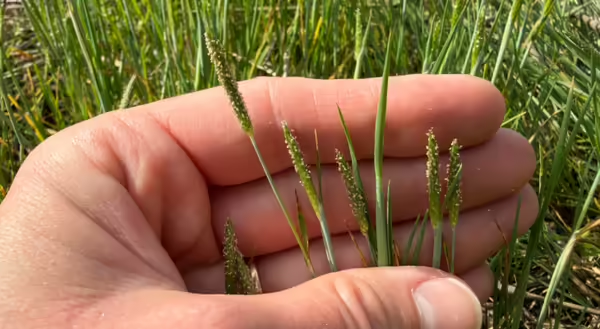
I recently received an inquiry from a farmer to identify an unknown grass he found on his property. This led me to a grass I’ve never identified before, but I had seen for years along the interstate and never knew what it was! Let’s take a look at Carolina Foxtail, Alopecurus carolinianus, which looks like a miniature Timothy Grass.
A different foxtail
Carolina Foxtail, also called Annual Foxtail, isn’t the same as the other foxtails we’ve covered in the blog before, like Giant Foxtail and Yellow Foxtail. While those foxtails are in the Setaria genus, are summer annuals, and have bristles around their spikelets, this foxtail is in the Alopecurus genus, is a winter annual, and doesn’t have bristles.
This grass stays between 1 to 2 feet tall and emerges in the spring. It is native, but is typically considered a weed – it prefers to grow in wet soils.
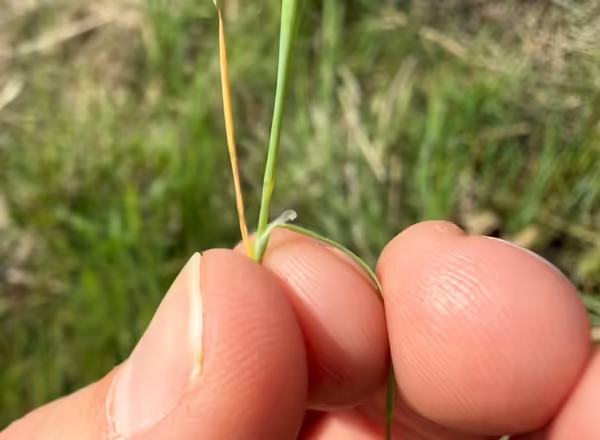
Carolina Foxtail has gray-green leaves and a white membranous ligule, just like Timothy.
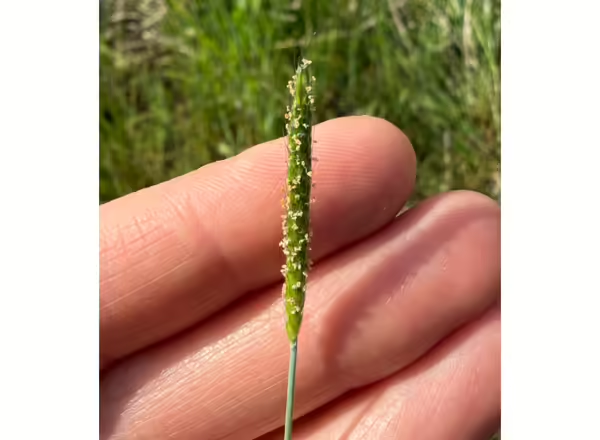
When it blooms in spring, it has a spike inflorescence that is a dense collection of spikelets. The spikelets have awns, but the awns are soft and give the spike a hairy appearance.
Telling it apart from Timothy
Carolina Foxtail is a smaller grass overall and blooms earlier than Timothy. The spikes also look different, with longer, softer awns on Carolina Foxtail spikelets compared to short, stiff awns on Timothy Grass.
Have you seen Carolina Foxtail before?
Thank you for reading! Need a refresher on grass identification terms, like ligule and spikelet? Check out this blog post!
About Grasses at a Glance
Never miss a new post! Subscribe to our email list to get updates each time a new post is available.
Give us feedback! How helpful was this information (click one): Very helpful | Somewhat helpful | Not very helpful
ABOUT THE AUTHOR: Erin Garrett is a Natural Resources, Environment, and Energy Educator for University of Illinois Extension serving Alexander, Johnson, Massac, Pulaski, and Union counties. Erin develops and delivers high impact programming to adults and youth to help them develop an appreciation for natural resources and to empower them to make small changes to positively impact the environment. Erin’s programming focuses on why homeowners should consider choosing native plants, how to support native pollinators, how to identify grasses, how to identify and manage invasive species, and developing an appreciation for prairie ecosystems.