Join us for a series of webinars focusing on the benefits of nature to our health and well-being.
2020 has been an unusual year for us all. The COVID-19 pandemic has challenged many of us in ways not previously challenged but it has also brought about opportunities and upsides. One of the silver linings of the pandemic is that there has been a national increase in the use of outdoor spaces and people connecting with nature. As winter approaches the Midwest, we want to continue to encourage people to commune with nature as a form of self-care, source of wellness and comfort while facing life's challenges.
The Bi-State Conservation Action Network has brought together experts who will share their research on the benefits of nature to our health and well-being. This series will be sure to inspire you to bundle up and head outdoors this winter and you will see that it just might be what the doctor prescribes.
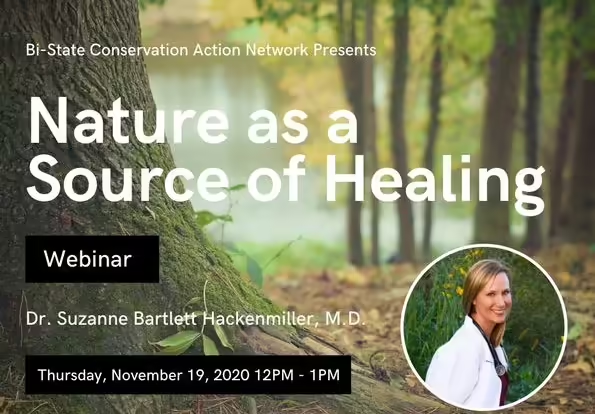
Nature as a Source of Healing, Noon - 1 PM, November 19
The first in the series is titled Nature as a Source of Healing led by Suzanne Bartlett Hackenmiller, MD, FACOG, ABoIM, Iowa’s first fellowship-trained and board certified medical doctor in integrative medicine She has a passion for integrative medicine and nature therapy and is a published author on the subject.
Join us to hear more about her personal experience with nature as a source of healing and her professional advice for us all so that we might be able to tap into the healing power of nature.
Access her website here: https://integrativeinitiative.com/
Access her recent book “The Outdoor Adventurer’s Guide to Forest Bathing” here:
Additional Programs in the Series 2021:
How Does Landscapes Design Impact Health & Well-being Noon - 1 PM, January 7, 2021
William Sullivan, PhD, Professor and Wadsworth Head of Landscape Architecture at University of Illinois has examined this question by measuring the impact of urban design on a person’s ability to recover from stressful experiences, the influence that views from high school classrooms have on a student’s capacity to learn, and the effect that urban green spaces have one’s physical activity, mental health, and relationships with others. In these studies, he assessed people’s hormones, heart rates, brain waves, psychological states, and ability to pay attention. He has found that regular contact with urban green infrastructure—places with trees, grass, rain gardens, and the like—has profound, positive impacts for individuals and communities. These urban green spaces need not be large or pristine to convey a variety of broad-ranging out-comes. They must, however, be easily accessible from a person’s home or workplace. Dr. Sullivan has shared his findings with scientists, designers, planners, and policymakers in an effort to create healthier communities where people can thrive.
Children & Nature, Noon - 1 PM, January 14, 2021
Andrea Faber Taylor, PhD is a Teaching Assistant Professor in the Department of Crop Sciences at the University of Illinois, Urbana-Champaign. Her research examines child development in the context of nature and greenspaces to support healthy functioning and future stewardship of the earth. She is advancing our understanding of the importance of nature experiences in human development. She teaches a course on this topic and courses about sustainable home gardening, small fruits, and herbaceous perennials with an emphasis on planting design to support pollinators and other beneficial species.
Bi-State Conservation Action Network Sponsors for this event include: University of Illinois Extension, Trees Forever, US Fish and Wildlife Service, Niabi Zoo, City of Davenport, Nahant Marsh Education Center, Girl Scouts of Eastern Iowa and Western Illinois, Rock Island Soil and Water Conservation District, Scott County Integrated Roadside Vegetation Management
|
Support for this series is provided, in part, by a grant to the Rock Island County Extension & 4-H Education Foundation from the Quad Cities Disaster Recovery Fund |
Related Events
 ECIMN Presents: Wildlife Rehabilitation