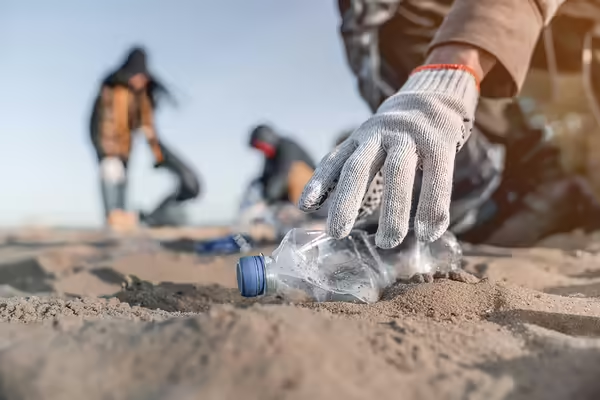
URBANA, Ill. — The ubiquitous plastic beverage bottle makes up about half of plastic waste collected for recycling in the U.S. Most recycled plastic is processed domestically, but a portion is traded overseas. A new study from the University of Illinois Urbana-Champaign draws on citizen science data to investigate how the global plastic waste trade contributes to litter along coastlines and waterways in importing countries.
“There has been a lot of news coverage about the plastic waste trade. The concern is that exporting waste to another country creates opportunities for that waste to escape into the environment during transportation and storage. We wanted to see if plastic waste imports lead to higher amounts of plastic litter found in coastal areas,” said Becca Taylor, assistant professor in the Department of Agricultural and Consumer Economics, part of the College of Agricultural, Consumer and Environmental Sciences at U. of I.
Plastic waste is an internationally traded commodity, which can be recycled into reusable materials, whereas plastic litter is the pollution that results from untreated waste.
“Overall, we find that a 10% increase in the amount of plastic waste a country imports is associated with a 0.6% increase in the amount of littered plastic bottles collected from coastal areas,” she said.
While only about 2% of plastic waste is traded globally, it is a substantial amount considering the huge growth in plastic production over the past 30 years. International trade of plastic waste reached its peak in 2014 with 16 million metric tons (about 35 billion pounds). Furthermore, the waste trade moves primarily from the global North to the global South, leading to concerns about “pollution havens,” where countries with low environmental regulations and inefficient waste management systems are more likely to attract polluting industries.
Read the full article from College of ACES.
University of Illinois Extension develops educational programs, extends knowledge, and builds partnerships to support people, communities, and their environments as part of the state's land-grant institution. Extension serves as the leading public outreach effort for University of Illinois Urbana-Champaign and the College of Agricultural, Consumer and Environmental Sciences in all 102 Illinois counties through a network of 27 multi-county units and over 700 staff statewide. Extension’s mission is responsive to eight strategic priorities — community, economy, environment, food and agriculture, health, partnerships, technology and discovery, and workforce excellence — that are served through six program areas — 4-H youth development, agriculture and agribusiness, community and economic development, family and consumer science, integrated health disparities, and natural resources, environment, and energy.