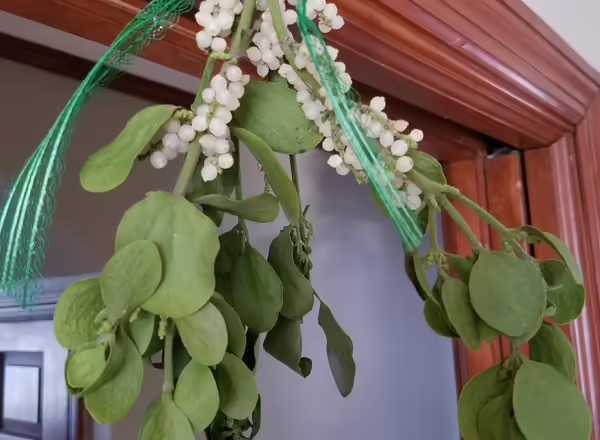
Mistletoe is a mysterious holiday plant that many of us may not understand much about other than the fact that you may be at risk of getting kissed if you stand underneath a sprig of it. However, this plant has a very interesting lifestyle, as well as a fascinating history of human interaction. Have you considered where this plant exists in nature or how it came to be the ubiquitous holiday plant we know today?
The Meaning of Mistletoe
The root meaning of the word “mistletoe” is an ode to human misunderstanding. If you break it apart, it’s derived from a combination of the Anglo-Saxon words for “dung” (mistel) and “twig” (tan). This name came from the ancient belief that bird droppings created new mistletoe plants. It is true that bird droppings play a partial role, but it wasn’t until sometime in the 16th century that botanists uncovered the fact that birds ate mistletoe berries first, then the seeds were spread by the droppings.
Mistletoe and Human History
Mistletoe was first used by humans for medicinal purposes long before its current holiday associations. The Ancient Greeks and Romans had a variety of uses for this plant, with Hippocrates being the first noted practitioner around 400BC. It's believed uses were wide-ranging, from treatments for spleen disorders or epilepsy to Pliny the Elder’s (23-79 AD) application as a cure-all for any poisoning. Ironically, modern science has characterized many mistletoe species as toxic to humans, although some recent research has explored the controversial use of European mistletoe (Viscum album) as an advanced cancer therapy.
Around the 1st century AD, Celtic Druids were the first to romanticize mistletoe. In wonder of its amazing ability to bloom in the dead of winter, they came to view it as a symbol of vitality, prescribing it to both humans and animals to restore fertility. Norse mythology furthered its romanticism with Frigg, the goddess of love, vowing to plant a kiss on all those who passed beneath mistletoe.
Throughout the Middle Ages, mistletoe’s association with fertility continued to spread, and it became widely associated with holiday celebrations. However, actual human kissing did not emerge until 18th-century England, when the custom allowed men to steal a kiss from any woman caught standing under the mistletoe. Refusal was viewed as bad luck for the year to come.
As westward European expansion brought colonists to North America, they found a new and very similar mistletoe species in the new world to perpetuate their old world traditions, which have flourished into to the modern day.
Mistletoe the Plant
Worldwide, there are over 1,400 species associated with the common name mistletoe, due to their similar lifecycle and growth habits, which all reside within the order Santales. Their distribution centers on tropical and subtropical regions around the globe, although some do extend their range into more temperate climates.
Around 12 species of mistletoe occur in North America, all within the genus Phoradendron. Given their relative lack of cold hardiness, all occur in warmer latitudes, south of a line from New York to Oregon. In Illinois, we have one native species, American mistletoe (Phoradendron serotinum), which occurs in our southern counties. I’ve found specimens as far north as Randolph County but have not found this plant in central IL.
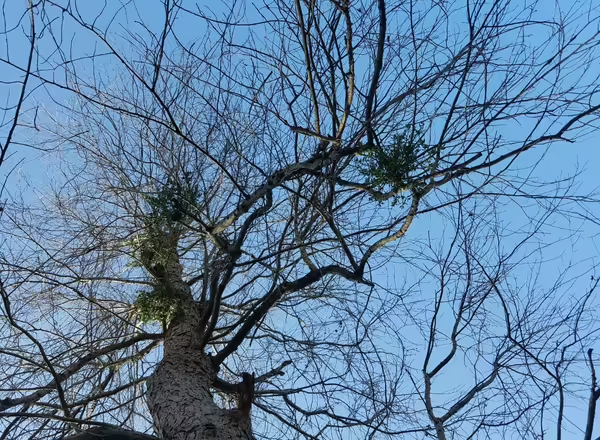
American mistletoe is considered a hemi-parasitic shrub that is evergreen, keeping its leaves year-round. It’s “hemi” (meaning half) parasitic because it is capable of photosynthesis, generating a portion of its own energy. Some carbohydrates, nutrients, and water are acquired from its host through a complicated plant structure called a haustorium, which is formed where root-like structures fuse to the tissue of the host plant.
It typically flowers in late fall (September and October), although some sources note even later bloom time during winter. Flowers are followed by clusters of waxy white berries that are covered in a sticky substance, which is toxic to humans but relished by birds. The unassuming avian counterparts spread berries they ingest through droppings while depositing others, which stick to beaks and feet, onto limbs as they move about the tree canopy.
American mistletoe is by far the most prevalent mistletoe species on our continent, infecting over 100 species of hardwood trees across its range. Its distribution spans the eastern US from Florida to Texas and as far north as a line from New Jersey to Illinois.
In a recent trip across Kentucky, the evergreen American mistletoe was easily seen from both interstates and state highways. The next time you travel south, be on the lookout for this interesting hemiparasite.
References
Mansky PJ et al. 2013. NCCAM/NCI Phase I study of mistletoe extract and gemcitabine in patients with advanced solid tumors. Evidence-Based Complementary and Alternative Medicine. 2013:964592.
National Cancer Institute. Mistletoe extracts (PDQ®)–patient version. Accessed at cancer.gov/about-cancer/treatment/cam/patient/mistletoe-pdq on December 17, 2025.
National Institutes of Health. European Mistletoe. Accessed at nccih.nih.gov/health/european-mistletoe on December 17, 2025.
Paller CJ et al. 2023. Phase I Trial of Intravenous Mistletoe Extract in Advanced Cancer. Cancer Research Communications. 3(2) 338-346.