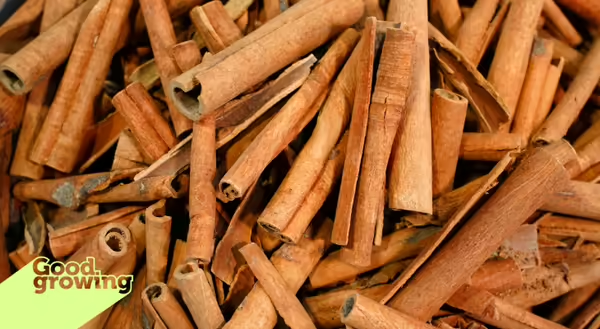
While we use them year-round, spices often take center stage during the holidays. From bread and pies to cookies and drinks, spices provide many holiday foods with their distinct and memorable flavors. One of the most popular spices around the holidays (and year-round) is cinnamon.
A spice with ancient roots
Cinnamon has been used for thousands of years. The ancient Egyptians used it in their embalming practices, and it was highly prized by the ancient Chinese, Greeks, and Romans. Cinnamon was also a popular spice used both culinarily and medicinally in the Medieval and Middle Ages in Europe. The demand for cinnamon and other spices led to the Age of Exploration as Europeans sought faster trade routes to Asia.
Where does cinnamon come from?
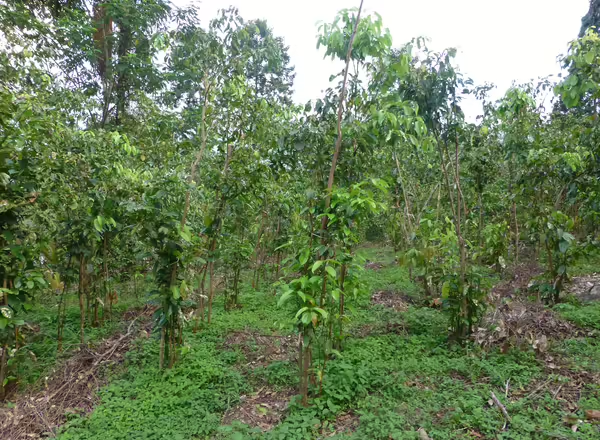
Cinnamon comes from the inner bark of several different trees in the Cinnamomum genus. These tropical evergreen trees are native to Asia and can grow up to 30–50 feet tall. Four countries, China, Vietnam, Indonesia, and Sri Lanka, produce 98% of the world's cinnamon.
Growing, harvesting, and processing cinnamon
In commercial production, trees are grown for several years and are then cut back to the ground, a process known as coppicing. This stimulates the growth of new, vigorous shoots, which are easier to harvest. Because they are coppiced, cultivated cinnamon is a shrub-like plant that grows to be about 6–8 feet tall. Plants are usually harvested every two to three years.
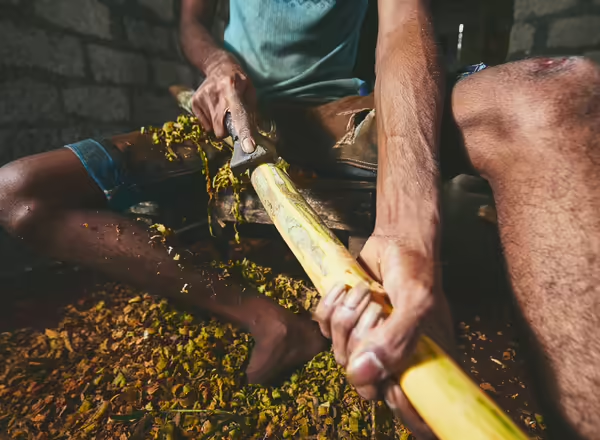
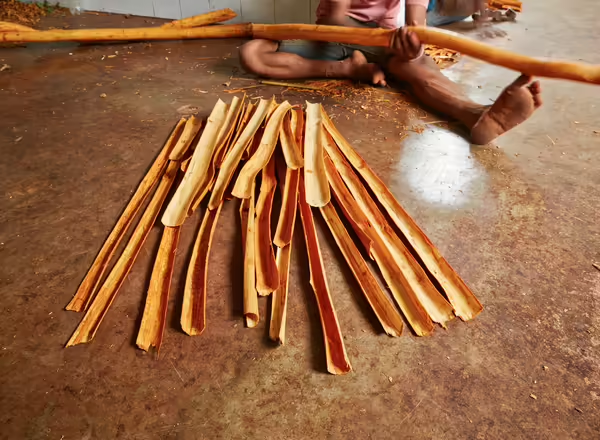
The harvesting process is highly labor-intensive. Workers cut branches, scrape off the outer bark, and peel away the delicate inner bark (what we use). These strips are then dried, during which they curl into quills or cinnamon sticks.
The quills are sorted by quality: long, unbroken pieces are sold as cinnamon sticks, while smaller or damaged pieces are ground into powder.
Types of cinnamon
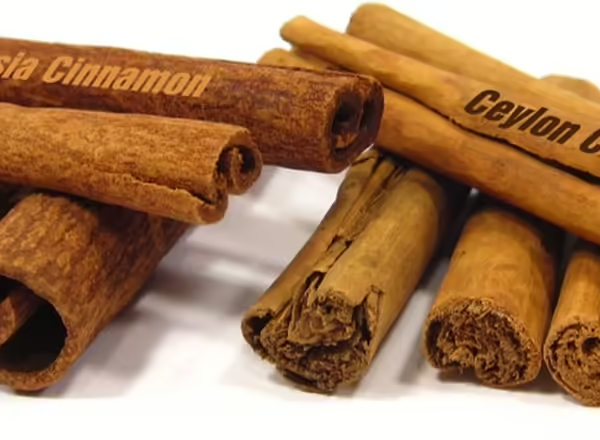
There are about 250 species in the cinnamon genus, but only a handful are used for culinary purposes. Cinnamomum verum, or Ceylon cinnamon, has a delicate, sweet flavor and is often described as having citrusy and woody notes. The quills of Ceylon cinnamon are composed of several thin layers and can be easily ground into a powder. Unfortunately, it will lose much of its flavor when cooked.
If that doesn’t sound like the cinnamon you buy, that's probably because most of the cinnamon sold in the United States comes from Cinnamomum cassia. Cassia cinnamon has a bold, intense flavor, making it a common choice for cooking. It produces thick, hard quills that cannot be easily ground. Cassia cinnamon is often darker and coarser in texture than Ceylon cinnamon.
Growing cinnamon at home
While they can’t be grown outdoors, cinnamon can be grown as a houseplant in Illinois. Plants should be grown in a well-drained, slightly acidic potting mix and placed in full sun to partial shade. Since they are tropical, plants should be given warm (above 60°F), humid (ideally 50% or higher, but they can tolerate lower) conditions.
Good Growing Fact of the Week: In much of the world, Ceylon cinnamon is considered ‘true’ cinnamon, while cassia cinnamon is referred to as cassia.
Want to learn more about cinnamon and other ‘holiday’ spices? Check out the Spice up your holiday with these holiday spices Good Growing Podcast episode!
Photos:
Cinnamon trees in production - Ji-Elle, CC BY-SA 3.0, https://commons.wikimedia.org/w/index.php?curid=24614878
Removing outer bark – Chalabala, Adobe Stock
Inner bark removed – Chalabala, Adobe Stock
Drying cinnamon - Chalabala, Adobe Stock
Cassia and cinnamon comparison – "Cassia_and_Ceylon_Cinnamon" (CC BY-SA 2.0) by Cinnamon Vogue, https://flic.kr/p/d5xGg5
Want to get notified when new Good Growing posts are available? SIGN ME UP!
Give us feedback! How helpful was this information (click one): Very helpful | Somewhat helpful | Not very helpful
Meet the Author
Ken Johnson is a Horticulture Educator with University of Illinois Extension, serving Calhoun, Cass, Greene, Morgan, and Scott counties since 2013. Ken provides horticulture programming with an emphasis on fruit and vegetable production, pest management, and beneficial insects. Through his programming, he aims to increase backyard food production and foster a greater appreciation of insects.