By Bob Streitmatter, Botanical Garden Manager at Peoria Park District
Spring is a wonderful time to be in a garden, as it comes to life…bright foliage and flowers seem to be everywhere. Walking through the garden almost becomes a celebration, as you spot Spring Beauty, Dutchman’s Breeches, Bluebells or Trillium. Defined as spring ephemerals, they welcome the arrival of spring. They emerge and bloom in early spring, when the sun is shining through the leafless canopy. After they have finished blooming, the foliage dies back, and the plants are dormant until the following spring. You may be tempted to fill the empty spot, but it's best not to disturb them and use perennials and shrubs to cover their absence. I use ephemerals as an underplanting for perennials (i.e. Fern, Daylily, Hosta, Solomon’s Seal) and shrubs (i.e. Lilac, Viburnum, Hydrangea or Forsythia). Ephemerals certainly bring interest to the spring garden, but they are also a much-needed source of pollen and nectar for early pollinators.
Parts of my old garden were blanketed with a carpet of Snowdrops, Squill, Spring Beauty and Bluebells that bloomed sequentially; they were used as an underplanting for a hosta border, blooming long before the hosta emerged. When we moved hosta to the new garden, we were fortunate to bring a bit of this underplanting with the transplanted hosta. And these clusters are now starting to colonize.
Some spring favorites
Spring Beauty Claytonia virginica
The dainty Spring Beauty Claytonia virginica has white flowers that carry pink veins or stripes; overall you often see a soft pink cast in the flowers. Part of the amaryllis family, you can see the relationship with the fleshy, linear foliage, 3-4” in length. The flowers are held just above the foliage on 4-6” stems. By early to mid-summer, after seed formation, the flower stem and leaves disappear without a trace till spring. The seed will spread to form colonies and the seedlings will emerge the following spring as tiny leaves, rarely flowering this first year. If you have hosta, you need Spring Beauty, it’s a wonderful underplanting for hosta or a shade border. Native to the rich bottomlands of the Midwest, they are meant for the woodland garden, keeping company with ginger, bloodroot, and Virginia blue bells.
Dutchman’s Breeches Dicentra cucullaria
Dutchman’s Breeches Dicentra cucullaria is small, reaching 9-12” in height. Blooming in the spring, it has small white flowers shaped like knickers hung upside down. The foliage is gray, green and delicately divided, almost fern-like. In rich soils and partial shade-full shade, it will naturalize and form colonies, making it perfect for underplanting hosta; or scattering through a woodland garden.
Virginia Bluebells Mertensia virginica
Virginia Bluebells Mertensia virginica, known for colonizing moist bottomland, emerge with their floppy leaves in early spring. They have nodding clusters of small, fragrant blue flowers in spring; buds and young flowers are pink, maturing to a soft, lavender blue. Great for underplanting shade or woodland perennials, it is especially well suited as an underplanting for shrubs and shrub borders. Since it self-seeds, forming beautiful colonies, the passing foliage will quietly melt away after the shrubs are in full leaf.
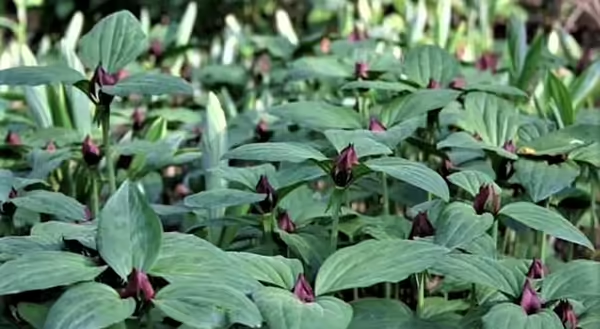
Prairie Trillium Trillium recurvatum
Prairie Trillium Trillium recurvatum emerges in May; it has deep burgundy flowers, resting atop a cluster of three leaves, dappled with light and dark green. It prefers rich, moist soil in a woodland setting; work well-rotted compost or manure into the soil for best results. A classic spring-blooming wildflower, it looks amazing when massed or naturalized in a woodland garden. It looks especially good with its native companions like woodland phlox, ginger, bloodroot and fern.
On the first day of spring, I dig my fingers deep into the soft earth.
I can feel its energy, and my spirits soar.
Helen Hayes