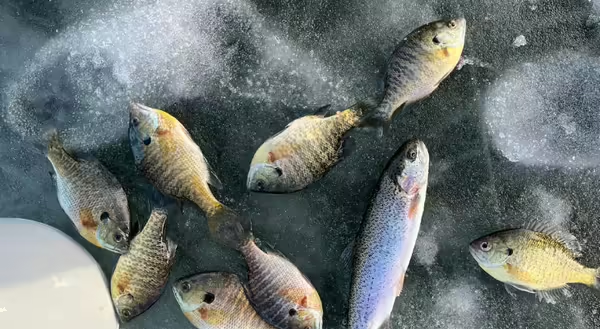
Winter’s cold snap brings a range of human reactions. For the select few who celebrate the chance to ice fish, these sub-freezing days are a welcome invitation outdoors.
Standing on the surface of a frozen lake, deciding where to drill a six-inch hole, then fishing vertically through that tiny opening in hopes of pulling up a very cold fish may sound odd to many people. Yet when you understand the science behind the natural resources involved, the odds of success – and the wonder of the experience – grow considerably.
Fish are cold-blooded, meaning their body temperature matches the water around them. In winter, their metabolism slows, so they don’t need to feed often, but they still need to eat. Most species spend the season near the bottom, especially around underwater structures such as points, humps, rocky outcrops, or submerged trees.
But the real marvel here isn’t the fish – it’s the water itself. Water (H₂O) is one of our planet’s most extraordinary substances. It exists naturally as vapor, liquid, and solid, and its physical behavior is nothing short of miraculous.
Water reaches its maximum density at 39.2°F. As it cools below that point, the molecules begin forming stable hydrogen bonds that arrange themselves into an open, hexagonal pattern – the beautiful crystalline structure we see in ice. This structure takes up more space, making ice less dense than liquid water, so it floats.
That single property is one of the reasons life on Earth exists at all. If ice were denser than liquid water, lakes and oceans would freeze from the bottom up, trapping and killing aquatic life. Instead, floating ice forms an insulating layer, protecting the liquid water – and the fish – beneath it.
So did this scientific marvel arise by accident, or is it part of a grand design? As the ice fisherman stands safely on a thick sheet of frozen water above 24 feet of liquid life below, the question naturally comes to mind. Pondering how he got here himself, at least this fisherman feels thankful for being a warm-blooded 98.6 degrees, and knowing the cold-blooded fish he pursues is searching to maximize its own warmth near the bottom of this lake at 39.2.
ABOUT THE AUTHOR: Curt Sinclair is the 4-H Youth Development Extension Specialist for Shooting Sports and Environmental Education. He received his B.S. in Forestry from Southern Illinois University in Carbondale in 1982 and his Master's in Recreation Resource Administration from North Carolina State University in 1988.