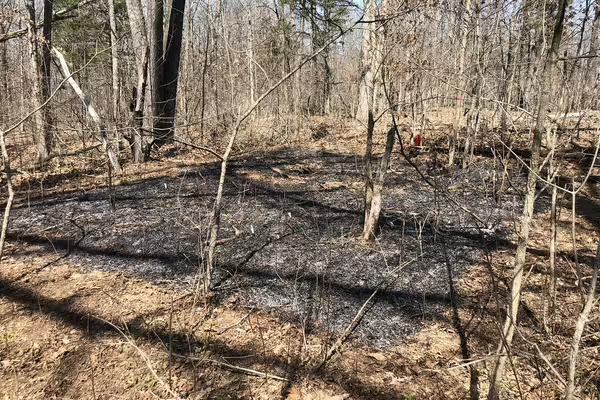
URBANA, Ill. — As winter comes to a close, many people look forward to warmer temperatures and spring blooms, but for land managers working to preserve or restore oak-dominated forests, it is prescribed burn season. Fire brings more light into forests, which is crucial for young oak tree growth, but many land managers are concerned about how non-native plants affect fire intensity and young tree survival rates. A new University of Illinois Urbana-Champaign study found that conducting more prescribed burns in forests with invasive grasses creates conditions that benefit young oak trees.
Professor Jennifer M. Fraterrigo studies how ecosystems respond to environmental change, from fire to disease, and said that land managers in southern Illinois, working with large forest plots, brought their concerns about fire and grass invasion affecting oak regeneration to her team.
“This was a real problem for land managers. Prescribed fire is the most effective tool they have to manage large areas. If fire is having this unexpected, potentially adverse effect, it would be difficult for them to achieve their management objectives,” said Fraterrigo, a researcher in the Department of Natural Resources and Environmental Sciences, part of the College of Agricultural, Consumer and Environmental Sciences at U. of I.
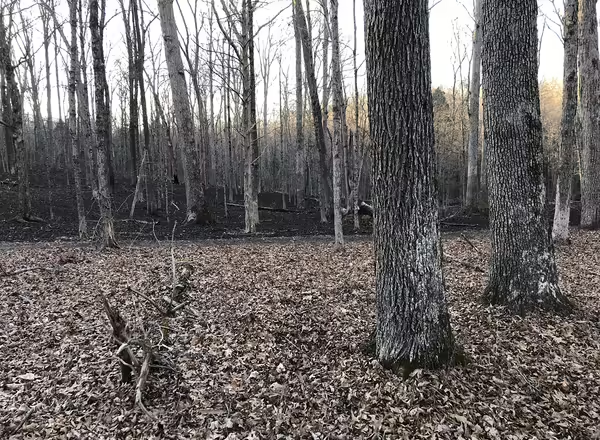
Illinois’ native oak-hickory forests have adapted to survive fires and benefit from controlled burns that remove woody debris from the understory and create canopy gaps for more sunlight to reach the forest floor. This allows acorns to germinate and grow into future forests. However, the introduction of non-native grasses into forest ecosystems has led to uncertainty about the behavior and effects of fire.
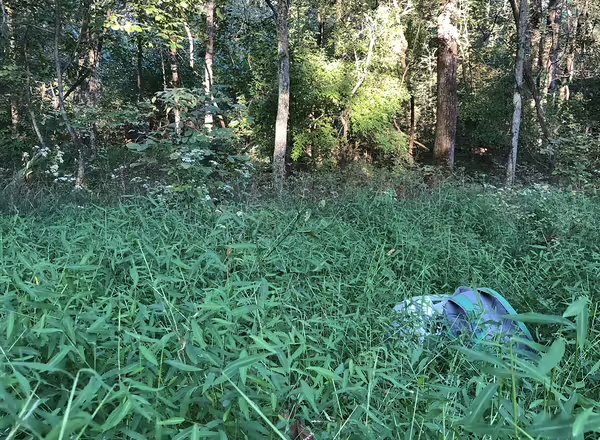
Invasive grasses, such as Microstegium vimineum, commonly known as stiltgrass, can cover the forest floor and prevent native plants from growing. Stiltgrass can also respond well to prescribed burns and add to the fuel load, leading to hotter and longer fires that can, in turn, create conditions for more invasive plants to thrive and harm native plants.
To better understand how repeated prescribed fires in Midwestern oak-hickory forests affected invasive species, forests, and oak regeneration, the researchers applied controlled burns in plots with young oak trees in the Shawnee National Forest in southern Illinois. They found that frequent fires increased light in the forest understory and reduced fire intensity. Almost twice as many young oak trees survived and resprouted in plots that had been burnt more often as those with a single burn. Stiltgrass cover also decreased with more frequent fires.
“A lot of research has previously focused on the effects of one or two burns,” Fraterrigo said. “This study demonstrates that we need a lot of fire for a long period of time to achieve the results that we want.”
Co-author Dan Marshalla, at the time an NRES graduate student, led much of the data collection and analysis. “Our findings of the benefits of repeated fire for oak regeneration should boost the confidence of land managers who want to use prescribed fire to promote oaks but are wary about the presence of stiltgrass,” he said, adding that further research is needed to understand the effect of repeated fire throughout stiltgrass's life cycle.
As part of the study, University of Illinois foresters assisted with the controlled burns and collecting data. The Extension forestry program works with forest landowners to increase their management skills and address challenges, including invasive species. “The study supports the use of prescribed fire as a management practice for forests in Illinois, especially as a means to promote oak regeneration,” said Forestry Extension and Research Specialist Chris Evans, who supported the field research. “The most interesting aspect was how repeated fire seemed to mitigate some of the negative impacts of stiltgrass.”
The paper, “Increased fire occurrence benefits early oak regeneration in temperate deciduous forests in part by disrupting an invasive grass-fire feedback,” is published in the Journal of Applied Ecology [DOI: 10.1111/1365-2664.70279].
This research was made possible in part by Hatch funding from USDA’s National Institute of Food and Agriculture and the U.S. Forest Service.
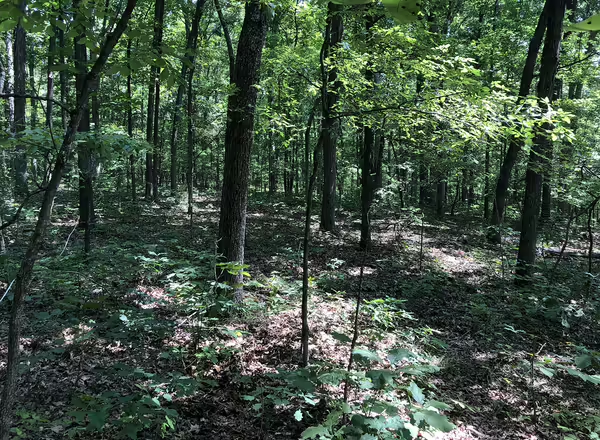
Photos provided by Dan Marshalla and Jennifer M. Fraterrigo. Top: A forested research study plot in southern Illinois after it was burned in late winter. The researchers found that conducting more prescribed burns in forests with invasive grasses creates conditions that benefit young oak trees.
University of Illinois Extension develops educational programs, extends knowledge, and builds partnerships to support people, communities, and their environments as part of the state's land-grant institution. Extension serves as the leading public outreach effort for University of Illinois Urbana-Champaign and the College of Agricultural, Consumer and Environmental Sciences in all 102 Illinois counties through a network of 27 multi-county units and over 500 staff statewide. Extension’s mission is responsive to eight strategic priorities — community, economy, environment, food and agriculture, health, partnerships, technology and discovery, and workforce excellence — that are served through five program areas — 4-H youth development, agriculture and agribusiness, community and economic development, health and community wellness, and natural resources, environment, and energy.