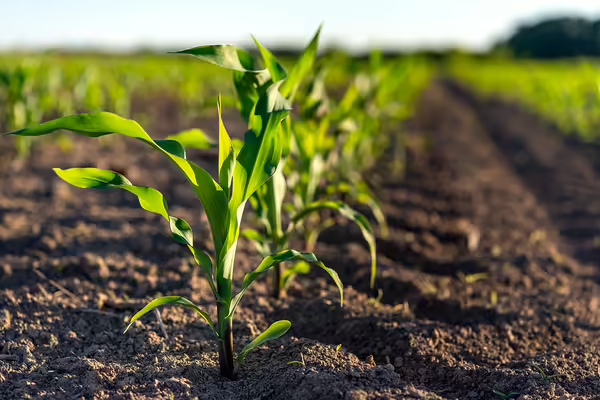
URBANA, Ill. — Corn bred with genes from wild relatives can reshape soil microbial communities and reduce nitrogen loss — with no yield reduction — according to new research from the University of Illinois Urbana-Champaign. The advancement marks the first time corn’s genetic makeup has been linked with inhibition of nitrifying and denitrifying bacteria, the microbes responsible for turning fertilizer nitrogen into forms that pollute water and contribute to climate change.
“We're already showing reductions in nitrification of up to 50% in field and greenhouse trials, which is awesome,” said the study’s senior author, Angela Kent, professor in the Department of Natural Resources and Environmental Sciences, part of the College of Agricultural, Consumer and Environmental Sciences at Illinois. “We grow 97.3 million acres of corn in the U.S. every year. If we were able to introduce that trait and reduce nitrification by 50% across that whole acreage, that would have huge impacts.”
Multiple groups of soil microbes use nitrogen as an energy source, but two of those groups are wildly overrepresented in modern agricultural soils, and both contribute to fertility loss. Nitrifying bacteria turn ammonium from organic matter or fertilizer into nitrate, a form of nitrogen that readily flows through soil to pollute waterways. Denitrifying bacteria convert nitrate into gaseous forms. Often, denitrifiers produce harmless dinitrogen gas, but when soil oxygen is abundant or soil carbon is limited — not uncommon conditions in conventional agriculture — denitrifiers produce nitrous oxide, a potent greenhouse gas.
The researchers say the Green Revolution and exclusive selection for aboveground traits in corn — ignoring traits related to the roots and rhizosphere, the microbe-rich zone surrounding roots — changed the crop’s relationship with the soil and created ideal conditions for nitrifiers and denitrifiers.
Read the full article from College of ACES.
University of Illinois Extension develops educational programs, extends knowledge, and builds partnerships to support people, communities, and their environments as part of the state's land-grant institution. Extension serves as the leading public outreach effort for University of Illinois Urbana-Champaign and the College of Agricultural, Consumer and Environmental Sciences in all 102 Illinois counties through a network of 27 multi-county units and over 700 staff statewide. Extension’s mission is responsive to eight strategic priorities — community, economy, environment, food and agriculture, health, partnerships, technology and discovery, and workforce excellence — that are served through five program areas — 4-H youth development, agriculture and agribusiness, community and economic development, health and community wellness, and natural resources, environment, and energy.