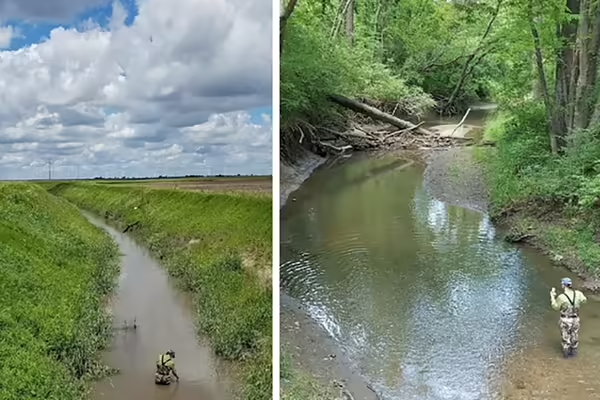
Farmers plant or preserve riparian buffers for various reasons, such as improving water quality, controlling erosion, or maintaining hunting habitat. Now, a new study from the University of Illinois Urbana-Champaign underscores the benefits of riparian buffers to terrestrial biodiversity, finding that for every 10% increase in forest cover, an additional species is present.
“We found raccoon and common snapping turtle DNA all over the place,” said senior study author Eric Larson, associate professor in the Department of Natural Resources and Environmental Sciences (NRES), part of the College of Agricultural, Consumer and Environmental Sciences at Illinois. “But the fact that we found bobcats and big brown bats with our sampling method was exciting, and shows just how much is going on in those riparian buffers.”
The sampling method Larson is referring to — environmental DNA metabarcoding — is one he and fellow ecologists have leaned into in recent decades to detect rare or hard-to-capture species. By extracting DNA fragments from water, soil, snow, or even air, scientists can reconstruct the animals that have traipsed, swam, or flown nearby.
When Larson and Olivia Reves, the study’s first author, decided to study biodiversity in riparian buffers, they already knew the benefits of tree cover for aquatic organisms. For example, shade from overhanging trees protects the water from thermal extremes and creates more favorable fish habitat. But less was known about the benefits of riparian buffers to terrestrial animals in agricultural areas.
To fill this gap, Reves and Larson used eDNA metabarcoding to identify terrestrial species from water adjacent to agricultural land across 47 sites in Central Illinois, varying in forest cover.
“This monitoring tool has been overlooked to identify the benefits of agricultural conservation actions like riparian buffers for terrestrial biodiversity,” said Reves, who recently completed her master’s degree with Larson.
Read the full article from College of ACES.
University of Illinois Extension develops educational programs, extends knowledge, and builds partnerships to support people, communities, and their environments as part of the state's land-grant institution. Extension serves as the leading public outreach effort for University of Illinois Urbana-Champaign and the College of Agricultural, Consumer and Environmental Sciences in all 102 Illinois counties through a network of 27 multi-county units and over 700 staff statewide. Extension’s mission is responsive to eight strategic priorities — community, economy, environment, food and agriculture, health, partnerships, technology and discovery, and workforce excellence — that are served through six program areas — 4-H youth development, agriculture and agribusiness, community and economic development, family and consumer science, integrated health disparities, and natural resources, environment, and energy.