Resources:
- Invasive Carp Regional Coordinator Committee
- Managing Invasive Carp from the U.S. Fish and Wildlife Service
- Invasive Carp Canada
- Non-indigenous Aquatics Database: Silver Carp, Bighead Carp, Grass Carp, Black Carp
Questions? We'd love to hear from you!
Abigail Garofalo aeg9@illinois.edu, Erin Garrett emedvecz@illinois.edu, Amy Lefringhouse heberlei@illinois.edu
Welcome to another episode of the Everyday Environment Podcast where we explore the environment we see every day. I'm your host, Amy Lefringhouse.
Abigail: 00:14And I'm your cohost, Abigail Garofalo.
Amy: 00:17And today, we have got a guest with us from the Illinois Natural History Survey. Mr. Steve Butler is with us. He's a research biologist at the Kaskaskia biological station. Welcome, Steve. Thanks for being here.
Amy: 00:34Hello. We're glad to have you. We're gonna we're gonna dive into get it? We're gonna dive into the aquatics realm here for this episode, and we're gonna talk a lot about invasive carp. So Steve's done a lot of work on invasive carp throughout his career.
Amy: 00:53And again, you come from the Kask Kaskaskia Biological Station, which I think I looked it up and it looks to be near Sullivan, Illinois. Is that right?
Steven: 01:01Yeah. The Kaskaskia Station is right at the point where the Kaskaskia River flows into Lake Shelbyville in Moultrie County. So it sits right there at the junction of the river in the lake. It was started right around the time that they filled Lake Shelbyville when they finished the dam and filled Lake Shelbyville. Okay.
Steven: 01:21So its purpose was initially just to study, you know, the fisheries of Lake Shelbyville, but our kind of our, you know, field of study has expanded quite a bit since that point in time, and now we work basically all over the state of Illinois.
Amy: 01:35Okay. So tell tell us how like, tell us what you specifically do there at the station or statewide, and, like, how you kinda came into the work of looking at, you know, invasive carp.
Steven: 01:50Yeah. I've worked on a lot of different projects over the years, but these days, my primary, you know, job is to, work with invasive carp and particularly on the Illinois River. That really picked up around 2010. That's when we realized that the invasive carp were basically knocking on the door of Lake Michigan. There were a number of individuals that were caught in Lake Calumet on the Southeast Side Of Chicago, that year, and that raised all the alarm bells. And, you know, really spurred a lot of, funding to come through to to work on trying to keep those fish out of out of the Great Lakes.
Amy: 02:35Do you do other stuff too there? I mean, outside of invasive carp work?
Steven: 02:39Yeah. Over the years, I have. I've worked on some dam removal projects. I've worked on a number of fish telemetry projects, so we're, radio tracking studies.
Amy: 02:48Mhmm.
Steven: 02:50I've helped out with other odds and ends for some sport fish research over the years, but my big thing these days is that, you know, the invasive carp is yeah, there's a lot of work to be done with in the invasive carp world.
Abigail: 03:03Yeah. So speaking of those invasive carp, anybody who's, you know, spent time on Illinois or the Mississippi River or even people have seen like these videos online, if you're not personally familiar with this experience of a fish suddenly jumping out into their boats. What's actually going on there, and why do these fish behave this way when we're talking about these carp?
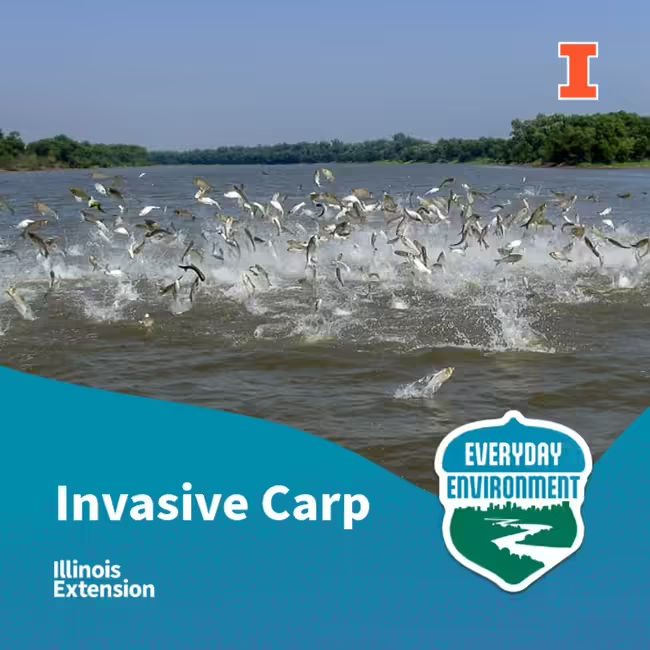
Steven: 03:25Yeah. So when you see all the videos on YouTube of the jumping carp, which are awesome, but, what you're seeing is, primarily silver carp. They're the ones that jump, and I have no idea why. I could speculate on that. And I've also heard some anecdotes that they don't actually do that back in their native range in China.
Steven: 03:50I don't know how true if that's entirely true or not, but the ones here in the Mississippi Basin definitely jump. And they're responding to, like, any sort of stay out sound or stimulus that startles them. It'll cause, like, big pods of them to all jump out of the water all at once. So you'll be driving a boat down the river, and all of a sudden, you've got a thousand fish, you know, going in going airborne all around you. Yeah.
Steven: 04:15And they'll hit you. They'll, you know, jump in the boat, slime everything in the boat, make a real mess, and it's quite the spectacle. And, yeah, you get a few breezes out of it driving your if you drive your boat too quickly up and down the river.
Amy: 04:29Yeah. And these are not little fish.
Steven: 04:32No. Some of them, you know, twenty, thirty pounds or more. So, yeah, they they'll leave a mark.
Abigail: 04:37Amy, have you ever been hit?
Amy: 04:40Yep. I worked at the Illinois River Biological Station. So we were up and down the Illinois River, and we would take out like, we would take trash can lids out with us as, like, these, like, armor when we were going down, and we always felt like it was, like, a certain RPM that we were going on the boat, like, that would really, really make them, you know, jump and be around. We didn't mean, when we were doing it, you the faster you went, seems like the either we didn't see them jump or we were already past them. I don't know.
Amy: 05:13Again, this is just my experiences several years ago, but, we would have, like, you know, shields. We would use these trash can lids as like shields in case they were jumping out at us. And then we've taken Master Naturalists, when we had our Master Naturalists conference, you know, last year in Macomb, we went out on the Mississippi and those master naturalists got to be slimed several times on that river ride too, so yeah, pretty crazy stuff. I also remember we had grass carp in this lake that I used to live around when I was a little kid, and we'd go fishing out on this lake with my dad, and there was one time where we, it was, I just remember, like in my brain, we had this grass carp get into our boat one time. So I've had lots of, like, crazy carp stories, I guess, over my life.
Steven: 06:07Yeah. The grass carp aren't as prolific jumpers as the silver carp are, but one of the biggest hits I ever took, I had a grass carp hit me right under the chin, and I was just laying on the bottom of the boat seeing stars for about five minutes.
Amy: 06:19Oh, jeez. So Man. So we kind of dove right in. I say dive again because I guess I just love that pun, but we're talking about different invasive carp. and Steve's already said silver carp.
Amy: 06:36We've talked about grass carp, but people often hear, like, Asian carp, and, like, it's just one fish species. So can you walk us through the different types of carp, and then why each one of these might be might be creating different challenges?
Steven: 06:55Yeah. So we when we talk about invasive carp or we used to use the term Asian carp, we're talking about four different fish species. So the the jumpy ones, those are the silver carp, and they're related to most closely related to bighead carp, which is another common one that we have in our rivers now. And both of those are filter feeders, so they have these filtering apparatus, in their gills. Their gill rakers are, big head carp have these comb like gill rakers, and silver carp, the gill rakers are actually fused into this, like, sponge like sort of apparatus.
Steven: 07:35And they're very, very effective at filtering particles out of the water column. So they just swim around with their mouths open, filtering out plankton. That's problematic because, we have a lot of you know, some of our native planktivores, they're directly competing with those. So our native gizzard shad, our big mouth buffalo, and our paddlefish, few other things. Yeah.
Steven: 08:00The big head and silver carp are directly competing with those. Additionally, the young of nearly all fish, initially, after they hatch out of the egg, they're consuming zooplankton as a food source. So we're you know, we have some concerns that they're gonna impact recruitment of, you know, young of almost any types of fish. Mhmm. Then there's grass carp, which we've talked about.
Steven: 08:27So grass carp primarily consume aquatic vegetation. They'll eat they'll switch to filamentous algae sometimes. They'll also eat some, you know, few bugs and, you know, some other odd animal matter as well, but their big thing is they consume plant matter. So they're really, really effective at removing vegetation from, you know, our waterways, which is why they were initially stocked in a lot of places to begin with to control aquatic vegetation. You can still and you can still get, these days, triploid grass carp for stocking in, you know, farm ponds or, a lot of a agencies stock triploid grass carp.
Steven: 09:04Those are sterile, so they're those ones aren't gonna reproduce. Unfortunately, there's a lot of diploid grass carp that do reproduce that are out there now, and they will have a big impact on wetlands or just anywhere where you we would like aquatic vegetation to be growing. And then finally, there's black carp. They are molluscivores, so they will consume snails and mussels, which is extremely problematic because a very large percentage of our native snails and mussels in North America are already imperiled. So now we have this, you know, predator you know, molt muscle predator that we brought into the system that is just an added threat to all our already endangered snail and mussel species.
Amy: 09:52Black carp wasn't on our radar however many years ago that was when I was here. I feel like that's I mean, I don't know. Probably on your maybe on, like, biologist or scientist's radar a lot earlier than when I was in college, but I just heard I just heard of black carp, like, just the last few years.
Steven: 10:10Yeah. Black carp are the newest ones that are really starting their their expansion phase right now. Mhmm. Grass carp initially got out sometime in the, like, sixties to seventies, and then silver and big head carp roughly seventies to eighties, and black carp didn't really get out into the wild until sometime in the nineties, probably. Although there's some commercial fishermen down in Louisiana that we think were catching black carp back sometime in the nineties, so they might have already been in the system even earlier than that.
Steven: 10:43We just weren't aware of it yet. They're one of the harder ones to to sample because they live deep down on the river bottom. So they're not as easily, you know, captured with a lot of our standard fisheries gear. So
Amy: 10:55Sure.
Steven: 10:56They're they're harder to detect, but they're definitely out there now.
Abigail: 11:01So this is a little off book, but like aquatic invasives, lot of people think of, like when we talk invasives, I'm sure a lot of our listeners are like plant people, terrestrial people. When we talk about carp and introduction to the system and when they first came into the system, what's like the main method of introduction in which we're seeing these carp come to our waterways?
Steven: 11:25So that's a long story. So going all the way back to the 1960's, remember the, like, Silent Spring was published, what, in '62, '63? So all of a sudden, we were looking for alternatives to spraying, you know, pesticides everywhere. So the idea of, like, biological control agents became, you know, really, you know, like, big idea. Mhmm.
Steven: 11:48So we brought grass carp were initially brought in, like I said, for controlling aquatic vegetation. That was facilitated by US Fish and Wildlife Service, a lot of state agencies, a lot of universities spread grass carp around for you know, as biological control for ins and, you know, as an alternative to spraying herbicides for controlling aquatic vegetation. Sure. And, you know, they were they got out, you know, probably, you know, all the back in the seventies, they were already pretty well established in the Mississippi Basin. Mhmm.
Steven: 12:23Big head and silver carp were brought in primarily for aquaculture purposes. Again, they were, you know, there was some help from, US Fish and Wildlife Service. Arkansas Game and Fish Commission, really facilitated their introduction, and, the, aquaculture industry in, Arkansas and Mississippi was big on bringing those fish in. Because they're such good filters, they really help, as like a biological filtration agent in aquaculture ponds.
Amy: 12:52Mhmm.
Steven: 12:53So these are, you know, like, if you buy catfish from the store, it probably came from aquaculture, somewhere in the, you know, Mississippi Delta region in Arkansas or Mississippi. So introducing, you know, big hand silver carpet in this pond is really good for maintaining, for helping with water quality. Also produces, you know, like, an another fish that you could potentially market. So those fish were also they did a lot of work on introducing those fish into, say, like, sewage lagoons, again, for it's just like a biological filtration agent. Mhmm.
Steven: 13:29Black carp were primarily brought in again for aquaculture. In aquaculture, you know, you're you're raising a lot of fish in really, you know, high densities. Mhmm. So there's a lot of, you know, that fosters, you know, a lot of disease transmission parasites. One of the big parasites that affects, like, fish, especially when they're raised in high densities is, it's called yellow grub.
Steven: 13:52It's a trematode, and it has an intermediary host that's a snail. Mhmm. So, like, the idea is if you can control the snails in those ponds, you can, like, break that life cycle and reduce the, you know, the amount of yellow grub that's, you know, in that's infecting these fish that makes the the fillets from those fish unmarketable. So they brought in black carp as a control agent for those snails. Unfortunately, all these fish have gotten out, and now they're pretty widespread throughout the Mississippi Basin.
Abigail: 14:25So then earlier, we were talking about names of the fish too, and, you know, like Asian carp, we don't use that, we use invasive carp anymore. I've also heard a term thrown around called copi. So what is that?
Steven: 14:40Right. So we've gotten away from the term Asian carp because we became aware that some segment of our society, like, conflates, like, Asian carp and Asian people in, like, a negative connotation. So the the state of Minnesota, in particular, back in early two thousands, like, there I guess there was a lot of antagonism towards some of the Asian community in Minnesota, and they they wanted to get away from using the term Asian carp in an, you know, negative light, because it like, there I guess there was some some people in some people's head, and I would need a psychologist to explain this to me. They they mix those up in their head. And I don't understand how that works, but it's a thing.
Steven: 15:25Mhmm. So we're getting away from using the term Asian carp just because of those, you know, like, negative, like, racial connotations and, you know, preferring the term invasive carp. Copi is currently the brand name that they're we're trying to market it under just because the term carp itself has a negative connotation to a lie a lot of North Americans. You'd ask people, hey, you wanna eat some carp? And they say, no way.
Steven: 15:52So they you know, like, you go to a lot of restaurants and you order fish off the menu. What the name of the fish on the menu is not what the actual species of fish is. You know, we market a lot a lot of different types of fish under certain names just for marketing purposes. So the idea for Copi is like, you know, like a name that might be a little more appealing to, you know, people that, you know, looking to buy fish. And the the invasive carp are I'll I'll I'll you know, I'll argue they're way more palatable than our common carp that you would have which have been here since the eighteen seventies.
Steven: 16:30You know, they're they're mild white flaky meat, but unfortunately, they have the name carp attached to them. So people say, like, no. I don't wanna buy carp off a menu or, you know, if I see carp marketed in the freezer section in the store, they're less likely to buy that.
Amy: 16:46That's interesting just because I I guess I grew up in river towns, and like all that stuff was on our menus. Right? I mean, and fish on Fridays, and you know, that that was all. But But you know what? I've never I haven't paid attention.
Amy: 17:02I mean, when Copi, the term came out a few years ago, I'm not sure how many years ago, I was like, oh, okay. I I get understand the process, but I'm not sure, I haven't checked menus, you know, over here on our, you know, I live in Quincy, which is on the Mississippi River, and I feel like we just still continue, you know, we've got buffalo, we've got, you know, those things on our menus. I'm not sure if I've seen Copi on our menus over here.
Steven: 17:32Yeah. I don't know how widespread that is, the distribution of that is yet. They're trying to build those markets up. Sure. I know if you go to Taste of Chicago every year, they're serving Copi.
Steven: 17:43Mhmm. You know, like, they have they have chefs there preparing, you know, different types of Copi. Mhmm. So yeah. And you ever see, you know, Copi in a supermarket, you know, go in and give it a try.
Amy: 17:55Yeah. Yeah. I have heard positive reviews, like, from the state fair. I think they've they've had it at the state fair a few years.
Steven: 18:04Yeah. But the big thing is we're trying to increase demand for these fish. So because one of the big, you know, challenges we're running into is just the the price the price point of these fish, the incentive for commercial fishermen to go out and catch them. It's by itself, it's fairly low because they're competing with, you know, like, major commercial fisheries, you know, marine go commercial fisheries. So, yeah, we're trying to increase the demand, you know, and there's, like, marketing associated with that.
Steven: 18:32So just, yeah, just trying to increase the, you know, up the marketing distribution end of things.
Abigail: 18:38Sure. Interesting the the social science and economics kind of behind the challenge of invasives as well. Very cool.
Amy: 18:47Yep. We were talking about that just with my students in my class. I teach a wildlife management class, and we were just talking about just the complexity of any wildlife problem. There's we used a triangle of, like, ecology, economy, and culture. Culture, right?
Amy: 19:03There's always those kind of three systems, I guess if you will, with any wildlife management problem or issue that we have that you have to really consider, and then when you're creating a plan behind that, you have to consider, you know, all of those different systems when designing a solution. So here we're, you know, thinking of like a market, economy, we're thinking culture, like what will people eat, what's the name, you know, behind it. We're thinking obviously ecology and what's the effect of those on our on the ecology. Yeah, natural resource issues, wildlife issues always very highly complex. So we talked a little bit about, you know, we we noticed, oh my gosh, these are in Lake Calumet. We realized, you know, it's more, we've seen them in the rivers, it's maybe now more than a river issue and kind of turned to a Great Lakes concern. So, you know, why are scientists and managers paying such close attention to kind of that connection to the the Great Lakes?
Steven: 20:12Yeah. So back around 1900, they dug a canal that connects, you know, the Chicago River to the, you know, the the Des Plaines and the Illinois River. So the Chicago Sanitary Canal, now provides a direct water linkage between Lake Michigan and the Illinois River. And we knew for a while that the invasive carp were kinda creeping their way up the Illinois River towards Lake Michigan, and, you know, some scientists were already, you know, raising alarm bells, but it became, like, the basically, all the red flags got raised in there in 2010 when those fish got I think I can't remember if they were silver or big head carp. I'd have to look back, but, they were caught right there in Lake Calumet, which is only a stone's throw away, from Lake Michigan.
Steven: 21:00So that got everybody's attention, and that was a crazy year. It was all hands on deck. Everybody was up with throwing every sort of sampling gear they could into the water, like, all over the Chicago region that year. And that really spurred the formation of, basically, like, a regional coordinating committee. It's these days, it's called the invasive carp regional coordinating committee to kind of organize all the efforts among all the different, you know, state and federal and local agencies to make sure we're all on the same page to try to keep these fish from advancing any further towards, like, eight well, to make sure they're not in the Chicago waterways to begin with, or potentially challenging, their way through that part of the system to get into Lake Michigan.
Abigail: 21:44I, like, feel that frenzy, though, because it's, like, that's a big deal. Because all of the Great Lakes are connected in some way shape or form.
Steven: 21:53Yeah. And we've already I mean, the Great Lakes are very different from what they were historically. We have already introduced all sorts of invasive species into the Great Lakes. I mean, there's zebra, quagga mussels, there's alewives, there's mean, there's all sorts of thing, all sorts of invasive zooplankton. There it's it's crazy.
Steven: 22:12It's very different from what it historically was, and we just really do not wanna introduce any more invaders into that system if we can help it, particularly, you know, these filter feeding fish that might suppress, you know, plankton densities even further than the, you know, zebra and quagga mussels already have because the the Great Lakes support, you know, multibillion dollar fisheries. And so there's a risk there that, you know, if those are disrupted, you know, further that, you know, they could have major, you know, cultural and economic impacts.
Amy: 22:45Mhmm.
Abigail: 22:46The Great Lakes are really complicated too because the entry point is Illinois. Illinois the Illinois border of Lake Michigan is very small. There are other states that have, like like Michigan and and Wisconsin, like, have much larger borders of of Lake Michigan, and now it becomes a multistate challenge of working across these agencies.
Amy: 23:08So with that committee, so we've got where we the alarm was 2010, and it was like, my gosh, we need to get together. We formed this, you know, committee. Tell us more about, you know, we talked a little bit about COPY being like kind of one prong, I guess, of some of the solutions to this problem, but tell us more about just some of the other ways that everyone has come together to, you know, try to try to control it, try to keep it from going into Lake Michigan.
Steven: 23:40Yeah. So two really, you know, kind of related things. First is just preventing the fish from being able to move any further up the system. So one of the, you know, the biggest, you know, like, things that's going on with that is just there's an electric barrier on the Chicago Sanitary Canal there at Romeoville. Bunch of basically just steel cables that go under the, like, along the bed of the canal there, and they electrify the entire water column.
Steven: 24:09So that's a really unpleasant play place to be in the water.
Amy: 24:15Mhmm.
Steven: 24:15So they have a they have a whole series of those electric barriers in place now. So there's some redundancy built in when they gotta, you know, turn one or more off for maintenance. Mhmm. So that's like the last line of defense. Like, we don't want fish even reaching that point if we can help it, but if they do get to that point, hopefully, those electric barriers will prevent them from moving any further up.
Steven: 24:38Further downstream, the big thing is just harvesting as many of these fish as possible, just to reduce the propagule pressure that might be, you know, moving up towards that electric barrier. So there is, contracted commercial fishermen that are removing, you know, literally millions of pounds of these fish every year from the Upper Illinois River. And then there's a lot of other efforts just, you know, monitoring efforts, making sure we understand, you know, where they are, you know, their abundances in each of the navigation pools on the Illinois River, understand sort of the population demographics. And, there's a lot of other, control efforts looking at, it's like deterrent systems that we could possibly put in place at each of the lock and dams along the river to prevent you know, try to reduce the number of fish that are moving upstream at each of those choke points. So there there's, you know, pretty large effort among a lot of different agencies that try to just keep not only keep these fish removing upstream, but to reduce their numbers within the Illinois River itself.
Steven: 25:42Yeah. Ultimately, I mean, we obviously, we wanna keep these fish out of Lake Michigan, but, like, they're not going away within, you know, the Illinois or Mississippi River itself. So we do need to figure out how to at least manage them to, you know, some level where to mitigate some of their impacts within the rivers themselves.
Amy: 25:59Mhmm. I thought it was interesting. I saw a presentation. I think it was last year at the mass again, at the Master Naturalist Conference, but, Jim Lamer was talking about flooding too, and they had monitored, carp movement up and down the lock and dam systems. I feel like it was the Mississippi, but they talked about flooding too and how that can really exacerbate the movement up and down because those lock and dam systems can kind of like sometimes hold them back, but when flood events happen and they're opening these, you know, locks or the systems up, they're able to move around and they were seeing that in research and their monitoring efforts too.
Amy: 26:42So just the river systems are complex in itself too.
Steven: 26:49Yeah. And there's a lot of different types of dams that, you know, we built all up and down the Mississippi and Illinois River. There's not just one type of dam. Some the water flows over the top. Some of them some of them at high flows, they actually drop the dam down to the entire dam down to the riverbed.
Steven: 27:04It's called a Wicket Dam, and some of the dams on the Lower Illinois River are are that type of structure. Mhmm. So at hot during high water, there basically is no dam in those places. Yeah. And so and some dams, probably most of the fish are probably going through the lock chamber and at other dams, yeah, they're probably just going right over the top of the dam at high flows.
Steven: 27:23Mhmm. Mhmm. So it it depends on the, you know, specific structure.
Abigail: 27:27So we're so we're making all these efforts to control them. We want them we don't want them in Lake Michigan. We wanna manage them for their negative impacts in the the rivers and streams across Illinois. But what it like, we're we've been managing this for a long time. Right?
Abigail: 27:42Like, had this, like, warning in 2010, that was about sixteen years ago, and we've seen them for much longer. What makes them so difficult to control over the long term?
Steven: 27:53Well, for one thing, they their reproductive capacity is absolutely incredible. Individual female fish can produce hundreds of thousands to millions of eggs. So you get, you know, the right conditions in certain years, and you get, you know, massive spawns, and they just produce gazillions of offspring. So their ability to replenish themselves rather quickly is is really high. In addition to that, they're extremely mobile, so you might have a big spawn year, say, the Mississippi, and a lot of those fish might then move into the Illinois or vice versa.
Steven: 28:29So even if you're controlling you know, doing a ton of effort in, you know, one river to control them, they might just move back in, you know, from a from some other source in, you know, the next year. That and there's just so many of them out there, you know, you can remove a million pounds of them, and, you know, in some some of the navigation pools, you're not only making so much of a dent.
Amy: 28:50Mhmm. Mhmm.
Abigail: 28:52Do they have any, like, predators?
Steven: 28:55In their native range, there's all sorts of predators, that could potentially even eat adult fish in their native range. There's a couple species of freshwater porpoises in the Yangtze River in China. Historically, they had some, predatory sturgeon and the Chinese paddlefish, which I can't remember if it's now extinct or not, but if it's not, it's on the way out. It is actually like a predator, unlike our North American paddlefish, which is a planktivore. But here in North America, once they reach adult sizes, there's really not much that's preying on them other than us.
Steven: 29:32At the small sizes, you know, any other every type of fish predator that's out there in the river will eat them. So all our native sport fish will eat the really tiny ones. Unfortunately, they grow so fast during the first year of life that they escape that window where they're vulnerable to, you know, our native predators pretty quickly.
Abigail: 29:51And there's so many. Yeah. Right?
Steven: 29:54Yeah. And the big spawn years, it is absolutely incredible how many little baby, you know, carp are swimming around out there. Yeah. They've become incredibly dense in those, you know, those big spawning years.
Amy: 30:06You know, you were talking about there's a lot of work to do with these. What's our what's our outlook, I guess, as scientists and biologists? Like, you know, are we just continuing to research and know and figure out the species and and trying to look for solutions? I mean, know, as a scientific community, you know, what's our kind of like next steps that we're looking at? And then I guess my second part of my question then is, like, as a boat owner or a fisherman or even a, like, consumer at the restaurant, like, are ways that we could do?
Amy: 30:39So I guess twofold there. Two two kind of levels of questioning there.
Steven: 30:44Yeah. From the manager or scientist standpoint, I mean, ultimately, we wanna be able to manage them down to some population level where, you know, we'll, at the very least, reduce their you know, the impacts they're having on the, you know, ecosystem to some, maybe not, you know, happy medium, but, you know, less than less than they currently are. Mhmm. And that's probably gonna be through some combination of, you know, barriers, you know, deterrent systems, harvest, probably some, you know, mechanisms we haven't even thought of yet.
Amy: 31:17Even know. Yeah. Yeah. Yeah.
Steven: 31:18But, but a lot of that you know, some of that's just understand standing their demographics and, you know, exactly how many of these things you do have to take out to really, you know, like, induce, you know, recruitment overfishing. And a lot of that's you know, the the harvest aspect of that is really driven by market demand like we were talking about earlier, just the price point of these fish. We've subsidized that to some extent just to, you know, incentivize the commercial fishers to, you know, catch more and more and more of these fish. And, you know, if we can develop, you know, enough of a marker for these things, hopefully, they can take enough of them out to, you know, really be, you know, putting a sustainable dent in their populations Mhmm. You know, in in the long term.
Amy: 32:03Sure.
Steven: 32:05You know, what all of the rest of us can do, a, you know, if you see Copi out there, you know, buy it. You know, help, you know, fuel the demand, you know, to, you know, remove more of these fish.
Amy: 32:17Mhmm.
Steven: 32:19Now, I mean, also, any one of us could go out on the river, and we're allowed to keep as many of these fish as we want. There's no no harvest limits, so, you know, go wild on there. You know, honestly, recreational, you know, fishers probably are not gonna harvest that many of these fish, but, you know, it's also not gonna hurt. So Mhmm. Mhmm.
Steven: 32:39You're we're yeah. We're probably not gonna remove as many, you know, enough on a large enough scale to, you know, make that big of a dent, not comparable to what the commercial fishers are gonna be able to do. But, you know, you can go out. You can in some places, you can snag the fish. You can bow fish for them.
Steven: 32:56I'm a big fan. I really like fly fishing for grass carp. That's a lot of fun. You get those hot days in the middle of the summer, and sometimes you'll see grass carp feeding on insects on the surface. And you can go out and, you know, you know, catch these twenty, thirty pound fish on dry flies with a fly rod.
Steven: 33:11That's awesome. Cool. Yeah. Yeah. But then the other big thing is just, like, don't help spread these fish any further.
Steven: 33:20So like we were talking about earlier, we don't wanna move any more of these fish around, and there's all sorts of means where that could happen through bait buckets. I mean, we know, like, oh, you know, there's a number of, you know, cases where, you know, various types of fish have been moved through bait bucket transfers. So I would, yeah, urge people not you know, if you catch your own bait, you know, using a seine or minnow traps, don't go and fish with that in another water body that doesn't have invasive carp in it, and then, you know, release your bait. Definitely, yeah. Definitely don't move any adult fish around for, you know, for sure.
Steven: 33:57That should go without saying. But Yeah. Also be careful where you if you buy fish, let's say, for your pond stocking, pay attention where you get those fish from. Like, the biggest thing would be, grass carp, you know, or stocked in a lot of ponds all over the country. Nowadays, most of the dealers that you're gonna buy grass carp from, those are gonna be certified triploid grass carp, so they are sterile.
Steven: 34:19They can't reproduce. But with that said, there are some dealers out there that aren't gonna follow the rules. So, definitely, if you're gonna buy grass carp, get that through, you know, your, local, like, extension service, or, I know a lot of, soil and water conservation districts will, do, your fish sales, you know, once or twice a year. Those are buying from, you know, reputable licensed dealers that have permits, and those are certified triploid fish. Bob's Fish Farm advertising them in paper flyers nailed to a telephone pole.
Steven: 34:55Maybe ask to see his paperwork before you get fish from him, and if he doesn't wanna show it to you, you know, walk away.
Amy: 35:00Mhmm. Mhmm.
Abigail: 35:01No offense to all the Bob's out there, but like Yeah.
Steven: 35:06Yeah. But those guys are out there. Yeah. Like, it's if you talk to some of the conservation officers, they deal they see some crazy stuff. You know, if there's a way to make money off of chipping fish, somebody sooner or later is gonna try it.
Amy: 35:16Mhmm. Mhmm.
Steven: 35:18Yeah. And don't go down to, like, the river and, you know, catch your own grass carp to stock your pond with because those fish down on the you know, out in our rivers, unfortunately, those are probably diploid fish. And Yeah. Yeah. We wanna keep these fish from getting into any new places.
Amy: 35:33Mhmm.
Steven: 35:34Oh, and I should mention black carp. We have a bounty on black carp now. So for every black carp you catch, you could get a $100.
Amy: 35:41Who's that through?
Steven: 35:42If you sir if you do a Google search for black carp bounty, it'll come right up. It's through Illinois DNR. Okay. Manages that. So Okay.
Steven: 35:52Yeah. If you want it I I have no idea how to actually fish for them. I haven't tried this yet. But Mhmm. People, you can catch them on rod and reel.
Steven: 35:59So if you wanna take a stab at it, you can get a $100 for every black herb you catch.
Amy: 36:04Oh, wow. That gives us some good kind of like tangible things that we can do as community members and as people who enjoy the outdoors. A few things that we can at least try on our end collectively to to help with this this major issue. But we thank you, Steve, so much for sharing everything that you have shared with us about invasive carp. Eat some Kopi, I guess, is one of the main takeaways from today's episode.
Amy: 36:37Thank you so much, Steve, for sharing.
Steven: 36:40You're welcome.
Amy: 36:42Well, like every episode, we end the episode sharing our everyday observations. This is where we highlight the mundane and normal of our environment that is actually really interesting. I'm gonna pick on you, Abigail, to go first. What's your everyday observation this time?
Abigail: 36:57Yeah. This will be released in May. So I'm just thinking about how, you know, the salting of the roads and all of that that's happening all the winter and time things like that. You actually need like a lot less salt than you think you do. A lot of our salt trucks aren't calibrated appropriately, or people just throw out like a ton of salt on their sidewalks, you really don't need that much.
Abigail: 37:23I can't remember what the exact ratio is, but there's like a coffee mug for like a certain number of sidewalk squares, and it's like
Amy: 37:30it's a lot less than I ever thought. Yeah.
Abigail: 37:33Yeah. And so and I live in a cul de sac, so I always think about how like there's way too much salt in our cul de sac because the salt truck has to like go around. One thing I love to kind of look out for in the spring, and I don't love to see it, but it's a really cool indicator of, like, how these things impact others, is you can see where places were over salted, especially in grassy areas and lawns and other places, because you see salt damage to, like, nothing grows there, because the soil is so salty. Mhmm. And so it's a really cool thing to keep an eye out for this spring as, you know, you're walking around like industrial areas, hospitals, businesses, things like that that like have kind of these automatic salters.
Abigail: 38:16Or even if you see that on your land, there's like over salting, you're like, why does nothing grow next to the sidewalk? Probably because there was salt there. So it's just kinda cool to look out, and I have like a couple of really cool pictures of that over the years too, where I find those, and it's just kind of a little, oh, I know why that doesn't grow there, and it's probably something that we can do something about.
Amy: 38:37So that's my everyday observation. Yeah, yeah. That is good. I was I did see, over the winter, an infographic that showed, you know, how little of salt we can use on our sidewalks and, you know, our front steps and things like that, and it was a lot less than I ever imagined. So, yeah, thanks for sharing, Abigail.
Amy: 39:01Steve, what about you? What's your everyday observation?
Steven: 39:03Well, let's see. I got a couple things I could talk about. Last weekend out at Fox Ridge State Park near Charleston, sitting out in the woods, and I saw not one, but two melanistic raccoons.
Amy: 39:17Woah.
Steven: 39:17So jet black raccoons, and I had to look this up, and it's pretty rare. And since I saw two of them, that's probably even rarer.
Amy: 39:26Yeah.
Steven: 39:26But they they were really cool looking just like not just dark, but, like, jet black. They're really cool animals. And then the other thing, back in December, I was down in Pope County, and, the first time I've ever actually seen flying squirrels.
Steven: 39:44know they're distributed, like, statewide in Illinois. They're, like, you know, they're all over the place, but people never see them because they're pretty small and they're nocturnal.
Abigail: 39:52Mhmm.
Steven: 39:53But just before dark one night, I was sitting out on, you know, in the National Forest land, and, yeah, all of sudden started seeing all these flying squirrels start, you know No. Climbing around all over the trees and saw a couple of them, yeah, do their gliding.
Amy: 40:06Really? Yeah. Did you have, like, lighting that you could see them, or could you just, like, when it was, like, just dusk, you could kind of see them gliding across?
Steven: 40:14Yeah. It was just before dusk, and it was it was clear. So, yeah, I could make them out, like, yeah, going between from tree to tree.
Amy: 40:21That's amazing.
Steven: 40:22Yeah. That was the first time I've ever seen those Yeah. Even though I've probably been around them of
Abigail: 40:28They're secretive too. Like, they're not like hanging out in land, like, neighbors yards and things like that. Like, they like forest ed areas.
Amy: 40:37Yeah, like heavy forest, yeah.
Abigail: 40:38Yeah. At night, and they're just they're just kinda like, squirrelly in the sense of, like, they don't like to hang around people.
Amy: 40:45I've never seen them I've never seen them in real life. I know that they had a big they had a research project for a long time at Kibbe Biological Station, which is Western's, bio station up in my area near Warsaw. But, I've never I was reading a book the other day called Winter World. It's like the how wildlife survive winter, and he the author writes about just kind of like the the winter survival of flying squirrels, I was thinking to myself, I wanna see one of those one day. So that's really cool.
Abigail: 41:16We all gotta go visit Erin.
Amy: 41:18Yeah. In down in Southern Illinois.
Abigail: 41:20Yeah. Exactly. Amy, what is your everyday observation?
Amy: 41:24Well, I know this is being released in May, so I'm gonna talk a little bit about spring ephemerals and woodland spring ephemerals. So I, in my backdrop, you can't see me, but I have Virginia bluebells behind me in my video here. But last spring I was able to see a dwarf larkspur, which isn't like super rare, but I saw it at a little park here outside of Quincy, and it was just a neat, you know, new species to see. At first, was like, is that tall bellflower? But it was like early in the spring, and I was like, that's not the same, and it wasn't that that tall, but it was growing just on the the kind of next near creek on kind of like a forested rocky hill area, is very typical of its habitat.
Amy: 42:16So dwarf larkspur, look it up. It's a beautiful little plant in the delphinium genus. So but yeah, it's one of our our natives here in Illinois that bloom in early spring. So cool. Challenge for to go find them to.
Abigail: 42:34Add it to my list.
Amy: 42:36Add it to your list. Well, thank you all for being here today. I really appreciated the conversation. This has been another episode on the Everyday Environment Podcast. Check us out next week where we are going to talk with Ashwarya Virabahu.
Amy: 42:51She's gonna talk to us about invasive golden oyster mushrooms.
Abigail: 42:59This podcast is University of Illinois Extension production, hosted and edited by Abigail Garofalo Erin Garrett and Amy Lefringhouse. Marketing and communications are by Emily Steele.