Resources mentioned:
Questions? We'd love to hear from you!
Abigail Garofalo aeg9@illinois.edu, Erin Garrett emedvecz@illinois.edu, Amy Lefringhouse heberlei@illinois.edu
Welcome to another episode of the Everyday Environment Podcast where we explore the environment we see every day. I'm your host, Amy Leffringhouse.
Abigail: 00:15And I'm your cohost Abigail Garofalo.
Amy: 00:18And today we have a guest with us. Her name is Dr. Maria Lemke and she is the director of conservation science with The Nature Conservancy. Welcome, Maria. Thank you so much.
Amy: 00:33Happy to be here. Well, thank you for being here. We really appreciate your time. Dr. Lemke is gonna talk to us about invasives and invasives management on the large scale.
Amy: 00:49So we've talked about a lot of different topics throughout this season, but we're going to talk about it kind of on the big landscape scale. And believe it or not, I've known Maria since I worked at Illinois River Biological Station way back in my grad school days. And now I visit Emiquon Preserve, which Maria's gonna talk to us a little bit about every year with my students at the community college that I teach at and also with my Master Naturalists. So to start us off, Maria, will you tell us a little about what you do with The Nature Conservancy and what you do there at Emiquon Preserve?
Maria: 01:37Sure. Well, I am a freshwater biologist by trade. Mhmm. And I have served as the director of conservation science for about six years now with Illinois Chapter. I did start at the Conservancy about almost twenty four years ago, actually.
Maria: 01:54So a lot of my early work, and still work I continue, works in agricultural landscapes. So I work with a lot of scientists and partners to understand how well different conservation practices work to mainly to reduce nutrient, nitrogen, and phosphorus losses from farm fields. Sure. And so we work with private landowners and our partners to install these practices, like small constructed wetlands, filter strips, cover crops, things like that. And then we measure how well they work at different scales, how well how well they work at the farm scale, how well do they work at a larger watershed scale.
Maria: 02:29And a lot of that works in the Mackinaw River, which is one of the tributaries to the Illinois River. And then downstream from the Mackinaw, a lot of my time also work I work with the Emiquon team, so at at our Emiquon Preserve. And so we lot of my role there is to help that team work with and coordinate developing the science and the monitoring framework around our floodplain restoration projects.
Maria: 02:57So these efforts help us understand, you know, is the restoration working? Is it progressing in the direction we want it to be, or are there potential encroachments of perhaps invasive species that we need to be concerned about and thinking about? So that's kind of, in a nutshell, of what I do. Yeah. Yeah.
Abigail: 03:20Very cool. I always joke that this should be like a semi career podcast for people to be like, what do I do in the natural world? Because there's so many cool options.
Abigail: 03:28Today, we're mainly talking about Emiquon as kind of like a a place based understanding of of, like, Illinois restoration and invasive species management. And so for listeners who may not be familiar with this major Midwest restoration success story, what makes this place so unique?
Maria: 03:49What makes it unique? Well, it has a unique history, for one. I'll kinda step back a little bit. It was prior to the 1920s or so. It was a one of the most highly productive floodplain systems along the Illinois River.
Maria: 04:10I don't know if you know, but the Illinois River is a relatively small river with a really big floodplain. And so it that had a lot of connections to the river. So it's a highly productive system and attracted all kinds of migratory birds and and supported all kinds of mussel species and fish, and it still does to a large extent. But in the early twenties, the site we now call The Nature Conservancy's Emiquon Preserve was drained and levied off from the river for agriculture, and then it was subsequently farmed for row crop agriculture for about eighty years.
Amy: 04:45And this is in this is near which towns? Like, I guess, towns along the Illinois River does Emiquon Preserve kind of butt up next to?
Maria: 04:55Good question. So, yes. Emiquon Preserve is located here in Central Illinois, right across the Illinois River from Havana
Amy: 05:04Okay.
Maria: 05:05Illinois. And it's it lies adjacent to the US Fish and Wildlife Service Emiquon National Wildlife Refuge. Mhmm. So sometimes, there's a confusion, whether it's Fish And Wildlife Land or Nature Conservancy Land, that they're adjacent to each other. Which is good.
Maria: 05:23Yeah. It's really it's excellent. Yes. And and across the river is Chautauqua National Wildlife Refuge. So really, one of the unique things about this complex, not just the Nature Conservancy's Emiquon Preserve section of it, but the whole complex.
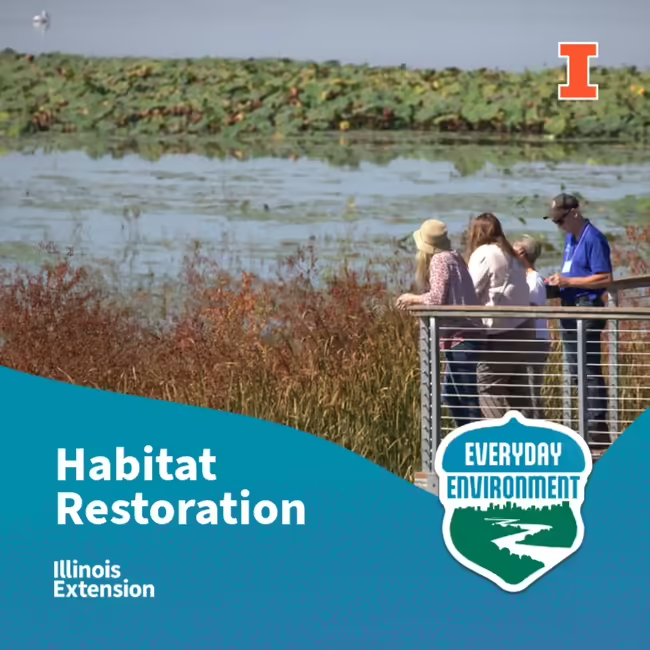
Maria: 05:40It's about, I would say, 14,000 acres of restored conservation land along the Illinois River. So it attracts hundreds of thousands of migratory waterfowl and supports, you know, huge diversity of resident, you know, aquatic species and plants and and other kinds of habitats. So I think that makes it really unique in that its size. Another thing about this wetland complex that's unique is it's designated as a a Ramsar wetland of international importance.
Maria: 06:14I think there's about 2,500 around the world of these Ramsar sites, and and really, you have to qualify. There's a lot of criteria to get there, including really diverse wildlife and supporting high quality habitats, and and serving a lot of functions. So this system is is really unique in that way as well.
Amy: 06:33Who qualifies that, Maria? Is it like, a a big agency, or is it like Yeah.
Maria: 06:40It's like Ramsar is a is a place I think it's in Iran. It started it's probably a committee or a council of four sorts. You have to apply for this designation. There's a lot of things that they look at, lot of criteria that are considered.
Amy: 06:56So it's really a globally, you know, recognized project and a globally recognized restoration effort.
Maria: 07:05It is. It's called the wetland of international importance. There's about 2,500 of these Ramsar sites around the world.
Maria: 07:13And there's several in Illinois. I think there's even one in Southern Illinois. So but as I recall, it had to do with different numbers of species, and ecosystem services, and that kind of thing.
Abigail: 07:25We can include the Ramsar site in our show notes. Yeah. There's a lot of really cool information. I just found the criterion. It's like, wetlands should be considered internationally important if it contains a representative rare or unique example of a natural or near natural wetland type found within appropriate biogeographical region.
Abigail: 07:45And then there's, like, different groups of criteria as well. So, like Mhmm. The site is supports vulnerable, endangered species, supports populations that maintain the biological diversity of a particular area. Critical stage in their life cycles is one which I think is really cool. It regularly supports 20,000 or more waterbirds.
Maria: 08:10Yes. And we have hundreds of thousands at times of waterbirds at Emiquon.
Abigail: 08:15Mhmm. Mhmm. So lots of very specific ones about, like, fish or water or birds and very, very cool.
Maria: 08:23Yeah. I'm pretty sure that Southern Illinois is a ramsar site too. Maybe the Cache.
Amy: 08:29Like the Cache. Yeah. Awesome. Yeah.
Maria: 08:33One of the unique things about our Emiquon Preserve, I believe, is that in 2016, we completed the construction of a water control system that is located between the river levee and the preserve. And prior to 2016, we couldn't manage the water in the site. It just kept filling up and getting deeper and deeper and and not really serving as that wetland that function of a of a shallow wetland habitat. And so once this water control system was completed, we can now manage the water between we can let river water in should we want that, or we can also let water out. And this kind of mimics that historic seasonal cycle of these floodplain systems where water would flood in in the spring and early summer, and then recede throughout the summer, creating those great habitats for fisheries.
Amy: 09:30Mhmm.
Maria: 09:31communities.
Abigail: 09:32For our audiences, why might there need to be this control system that exists for this this large wetland restoration project?
Maria: 09:43It's a great question. So I'll give you the example of Emiquon specifically. Basically, restoration began when we turned off the pumps, the pumps that kept that area dry for agriculture. So prior to restoration, you know, it is series of agricultural drainage ditches that were all connected, and they all drained into a main agricultural ditch that that ran to the levee, and then the water could be pumped out of the site to keep it dry. Otherwise, it would fill up with water.
Maria: 10:19So what Nature Conservancy did is just turned off those pumps in about 02/2007, and water started filling up the the site again. And interestingly enough, historically, that site was had two lakes, Flag Lake and Thompson Lake. And we had LiDAR conducted in advance, and those lakes are still there even though it'd been farmed for eighty years, and that's what filled up, and it really resembled historic maps of the site prior to being converted to agricultural land.
Amy: 10:51That's cool. Yeah.
Maria: 10:52Was really cool and really But after a few years, it kept getting the water just kept filling up, right, from rainwater and and some groundwater as well. And and pretty soon, it just turned into a big lake. We couldn't we couldn't we didn't we lost those marshy wetland habitats, and it was coming against the levee, and wave action was starting to degrade some of the levee. So we needed to be able to let water back out of there. And so and I'll mention here too, in 2013, you may recall we had a historic flood on the Illinois River, and water came over the levee from the south end.
Maria: 11:29So we had river water coming in over the levee, and this and it really filled up. So 2016, completion of that water control structure, we could let water back out of the sites. We could do some management, like repair some of the levees that had been damaged by some of that wave action, built a kind of a visitor use center, did a lot of things, but also recreated that wetland marsh habitat as well. That historically was there.
Abigail: 12:01Nice. Well, and if our listeners, if you have been a long time listener and you remember our water season, like, lot of this, like, increased water that we're seeing, the reason it was creating a lake and not just staying wetland, like, historically is because we've changed the hydrology permanently of Illinois. We're channelizing water directly into these streams instead of allowing these natural wetlands across all of Illinois River to exist. Is that kinda what is that right, Maria?
Maria: 12:31Yeah. The hydrology of the river system has definitely been changed over the years. Historically , we have some research that shows that the Illinois River would flood in the spring, you know, and summer's really low, and you might get a couple of floods in the winter. But you could pretty much predict that flood period. Now, it floods unpredictable anytime.
Maria: 12:58The, you know, the the river systems are very, very unpredictable at this point. Water levels can go up, they can go down. You can have flood anytime. So that has changed a lot, which is one reason we didn't just, you know, open up the levee to the river. It's not the same seasonal flood pulse that it used to have.
Maria: 13:19And so we need to be able to manage water coming in at the right time to you know, it's it's important for moist soil plants to grow to get that water at the right time. The waterfowl need water to eat they won't eat the seeds unless there's water on the plants, so you need that water for those migratory waterfowl. Of course, you need it for the fish. But also, you know, it's it's it's important to let water back into the river as well. Historically, I'll say again, the Illinois River is what's called a flood pulse system.
Maria: 13:54And so a flood pulse river, and that means because it had this great, huge floodplain around that surrounded it, that spring pulse the rains would fill up that floodplain area and create nursery habitat for riverine fishes. A lot of plants, aquatic plants, would grow, create habitat for all kinds of wildlife and insects and and food for for ducks and other other birds and other critters that eat plants. But and then when the water recedes back into the river, it brought in all kinds of nutrients and and algae and all kinds of things for the channel, for the riverine channel organisms to eat. So it was a real back and forth support system, and it's and it's a system. So it's not just the floodplain.
Maria: 14:43It's not just the river. It's the whole system. Mhmm. Mhmm.
Amy: 14:48So you had a kind of two stages. You stopped pumping, and then you connect then you constructed the water control structure and the water control system. So then we kinda connected back to the river. So you reintroduced, you know, some of that river water into the system and then also some river out to the channel. And obviously, that brought back, you know, really great habitat just like you were talking about.
Amy: 15:20But there were also some challenges that came with that. So what were some of the biggest questions or concerns that you guys had when you did that reconnection with the river?
Maria: 15:32Yeah. So I'll just step back a little bit to give it a little bit of context. But prior to ever turning off the pumps to restore the site, the Nature Conservancy convened what we call the Emiquon Science Advisory Council. And this consisted of scientists and natural area managers and all kinds of experts that met over a series of two or three years. And they looked into questions about how do you go about restoring floodplain that's been levied off from the river and farmed for eighty years?
Maria: 16:08And then how do you know if the restoration is working? And so some of the top concerns that that came with the idea of reconnecting the site back to the Illinois River included high nutrient and sediment loadings that might flow from the river into the preserve area, and also introducing non native fish species like carp that can be invasive at the site. And but like I mentioned earlier, we were coming at this restoration from that systems approach. And so that means that it wasn't just about restoring the floodplain. It was about that reconnection.
Maria: 16:45So we pretty much had to think about how do we restore the system approach, the connection with the river, yet manage for the potential risk of invasive species and sediment loadings coming into the site and such. So one of the critical outputs of that science advisory council was the development of this monitoring framework that we continue to use, And it provides real time data on things like a list of things. But they include abundances of native species and non native species, habitat quality, things like migratory waterfowl use, a lot of other ecological attributes of that site. And that really helps us then to gives us kind of that warning bell if if some there's something happening that we need to be aware of that in terms of the restoration or invasive species, we can get that kind of early warning sign.
Amy: 17:46Mhmm.
Maria: 17:47And you mentioned that you were to Illinois River Biological Station. They're a huge partner of ours, as is the Forbes Biological Station across the river. And they do a lot of the fish monitoring or waterfowl monitoring in Emiquon that that feeds into that that monitoring framework I just talked about.
Amy: 18:04It's funny. When we were there with my students this earlier this I guess it was in the fall semester, you know, that's one of the highlights is to take take a boat ride up to see the water control structure and see that construct see that structure there. That's the one that's the one place where Emiquon, you know, meets the river, and that is the you know, it looks not that great. You know, like, not that sexy. It's like, oh, yeah.
Amy: 18:29Cool. It's like, it's big, you know, industrial looking structure, but really, it's a, you know, big piece of of management, you know, in in that system. It was cool. I mean, you know, they you could tell that they were like, this is it. This is the place. And my students are like,
Maria: 18:48oh, hallway. Concrete, and a big levee, and has a crane on it. Yeah. Exactly. Exactly.
Maria: 18:58Yes. It is really cool, though, when we're actually letting water in or out, and you start managing that site, and to see the the water moving. Mostly, we've let water out of Emiquon, but it's and we've measured, you know, what type of what is Emiquon contributing back to the river? So we look at the algae and the zooplankton and the nutrients. And so that's it is it's it's pretty neat to see.
Maria: 19:23Well, with that one point too, you
Amy: 19:25can it's an easy way to monitor and measure that kind of thing. You're not having it's not ubiquitous where it's connected in all different places. You've got that one spot where you can get that data that's Exactly.
Maria: 19:38Exactly.
Abigail: 19:40And you said the system was built in 2016?
Maria: 19:44Correct.
Abigail: 19:45Okay. So I visited Emiquon in 2015. I was an undergrad, and we took a restoration class where we visited all these different restoration sites.
Abigail: 19:56And I remember them talking about, like, the plan, like, this system being built. So I'm, like, trying to bring my brain back. But one thing I do remember them saying is that in order to like clear out the wetland, they actually drained it first, like to get rid of all the invasive carp, essentially was one of the big problems, and then would refill it. Like that was like a piece that I remember. So I feel like I'm wondering, it sounds like invasives have become like a really big part of the story and a big part of wetlands in general because we're their connection to the river and how they interact with all these different elements.
Abigail: 20:29So why are restored flood Pains especially vulnerable to, like, invasive plants and fish and things like that?
Maria: 20:37Right. Yeah. I would say that any newly restored habitat creates space for not only native species, but non native species and invasive species to settle in and reproduce and and thrive. Mhmm. I think floodplains in particular there's a lot of sources for invasive species to enter in.
Maria: 21:01Aerial, you know, this wind dispersal of seeds. Mhmm. A lot of birds and wildlife freeing in seeds on their fur and their feathers. And then for floodplains, there's the river system. There's a lot of things that can come in, seeds and and other invasive species like carp and some other aquatic invasives that can come in from the river system.
Maria: 21:19And I mentioned that 2013 flood earlier that brought in silver carp, and they had carp. They came we saw them coming in over the levee, so it's it's gonna happen. I mean, it's it's inevitable. So you just have to acknowledge that it's it's gonna happen and develop management plans and practices to to reduce the potential negative effects of of these species when they do get in the system, when they do start increasing to a to a threshold that might start negatively impacting the restoration itself.
Amy: 21:55So, you know, a lot of our listeners might have their own yards, maybe their own farms, and their own maybe woodlots, wood you know, woodland areas, but this is like a whole different scale, managing invasives at a 6,000 acre site plus the, you know, the bigger complex. I'm assuming all all the agencies are looking bigger picture even than just Emiquon Preserve, but that sounds really daunting and really like, whoo. How would I ever where would you ever even start? So how did your advisory council, if you wanna call it that, science advisory council, you know, like, how did you decide, like, what species what invasive species you wanna, like, focus on and, like, what types of management tools to use? Like, where do you how do you take that first step?
Maria: 22:42Mhmm. Yeah. That's a really good question, and we have a an amazing stewardship team at Emiquon that they're on the site daily managing invasive species. A lot of the invasive species at the Emiquon Preserve are are plants, are invasive plant species. A lot of those are terrestrial, or maybe some of them are semi aquatic.
Maria: 23:02And so I did ask them about this. How do you how do you like, how do you know what to do? Where do you start? And how do you know you're making progress? And so they have a ranking system that they use to to prioritize what species they and to address first, like, are what takes the priority over other invasive species?
Maria: 23:29And that ranking system includes what are the most prolific seeders? Like, what what what invasive species put out the most seeds? How aggressive are they? Are they inhabiting what kind of habitat are they inhabiting? Is it really high quality habitat that we want to maintain, is it something that can wait?
Maria: 23:48We wanna make sure our highest quality habitat is conserved. They look at the extent and the potential impact of these invasives among other species, and so they rank them from highest to lowest. Some of these species, like some of the highest priority species include things like purple loosestrife, phragmites, Canada thistle . Some of those things are are some of the things that they really focus on. They use a lot you asked about how do you how do you even approach managing for these?
Maria: 24:20And they have a lot of different methods that they use. So one of them is hydrology. So if we can let water in and flood out a lot of the plant species, that's very helpful for certain species, not all of them. Prescribed fire is a huge management tool that's used, and again, that's just really knocks back certain species, but it might benefit others. So there's a balance there.
Maria: 24:44They also use a targeted chemical application as needed. And looking into maybe in the ability to use drones to find these species out there be you know, before before they get too aggressive or get too large of a population there, maybe even treat some of these species that are difficult to access, things like that. In terms of the aquatic species, you know, common carp is the main focus that we're we're focused on in terms of aquatic animal species at this point in terms of invasive species. And Abigail, you mentioned that early on. We we did, prior to restoration, drain the site down and removed a lot of the carp and a lot because a lot of those ditches were full of common carp, grass carp, even big goldfish.
Maria: 25:40I mean, all kinds of Mhmm. Carp were in there. And and and we roofed a lot of them, and that was very successful for a number of years. But that monitoring I talked about with the Illinois Department of Natural Resources monitor fish. Illinois River Biological Station monitors fish.
Maria: 25:57We started to see the numbers increasing in the past few years, and that concerned us in that we didn't have a good handle on we know they're increasing, but we didn't have a good handle on how many really were out there. Like, what is the are the numbers out there? What are the abundances, and what's the total biomass that's out there? How big are these fish, and how many are there? Now they are they recruiting every year?
Maria: 26:26Are they getting new recruitments spawning and recruiting successfully annually, or what is the pattern of that? So that's what we're trying to get a handle on now. We brought in some carp experts a year or so ago and talked to them, like, what do we need to be looking at? You know? What do we need to be measuring, and how do we do that?
Maria: 26:45And they gave us some really great advice on the main things we need to be looking at, that's what we're working on now, is trying to get that information.
Abigail: 26:53Well, that's I was kinda thinking about it. So, like, when you have when you're getting that information, okay, I know that, like, you know, we're seeing these in increased numbers, we're keeping an eye on them. At what point does it become, you know, like, we have this they're present to they're a problem?
Maria: 27:09Mhmm. Right. There's been a lot of research conducted and published that that look at what that threshold is when common carp become a problem. Mhmm. Because they're a problem in a lot of places.
Maria: 27:27Yeah. And not just in Emiquon. And so there's a certain threshold that considered the threshold of where they start having negative impacts on vegetation and other native species. It's a certain level of the biomass per area. Sure.
Maria: 27:46Something like 30 kilograms per hectare or something like that. But it's so that's why we're really interested in knowing, are are we getting close to that threshold or that we're starting to see problems? We've seen some declines in our aquatic vegetation and some water clarity problems in certain areas, but it's a big place. So that's what you know, one of the issues with common carp is, you may know, is that they they uproot aquatic plants as they're as they're feeding. And that not only negatively impacts the aquatic vegetation, but it increases the turbidity.
Maria: 28:23It decreases water clarity, which which is negatively impacts other plant species because their sun's not getting down to where they need it to go to grow. So there's it's, you know, it's kind of a water clarity, vegetation quality concern. And so that's what we're trying to understand is, are we reaching that threshold that all these researchers have kind of done all this research on to understand, you know, across different systems, kind of what that level is, give or take? Mhmm. And so that's what we're working on now.
Maria: 28:57This past summer, we worked with our partners to to to tag over 700 common carpet bus, 705 to be exact, with what's called PIT tags. And these are called passive integrated transponders. And these PIT tags, each pit tag on each common carp have a unique internal microchip. And that is activated when it goes when that fish runs past a special antenna array that so so when you pass the fish close to this antenna array, you can you actually can identify individual fish. Mhmm.
Maria: 29:40Which which fish? They all have a unique, you know, tag number. And so this is what we're working on now. So we tagged all these fish this summer, our team did. And then as the fish are being recaptured and removed from Emiquon over the winter and early spring, this will give us it's called a mark recapture study.
Maria: 30:02And what it does is it gives you really good estimates of the abundances of carp out there. Mhmm. You tagged this many fish, you recaptured this many fish, and there's there's an equation you put all this into. Yeah. But it gives you a really good number of estimate, anyway, of those abundances.
Maria: 30:21And that's really gonna we're hoping will give us that information if we're reaching that threshold that we need to take some more stringent approaches, I would say. But we have been working with commercial fishermen since 2020. And up to date, they have removed over 400,000 pounds of carp from Emiquon. It's not just common carp. It's this silver carp, and it's big head carp, but they're selectively fishing for carp.
Maria: 30:49They're not there's not a lot of bycatch, you know, of our native species and Mhmm. And such. So they are removing those carp. So I guess this is gonna help us understand. Is that good enough?
Maria: 30:58Are they gonna are we actually reducing the population, or do we need to think of something else to start start reducing the population? The other thing we're doing actually, these are scientists from the Illinois River Biological Station. They are getting data to better understand the age structure of the of the carp out there. Are they all 15 years old and there's no new ones? Or are they like I mentioned earlier, are they spawning and recruiting every year?
Maria: 31:30And so they're working on that to understand what is their recruitment Yeah. Cycle. And that was those are the two things that the carp experts that we talked to said you need to really understand at the site. So we're hoping to get some really good data in this spring and early summer and better understand, are we reaching that threshold
Amy: 31:50Sure. Or not. That's really cool. I teach a wildlife management class at the community college, and we talk about population tables, and we talk about mark and recapture studies, and we've never done it because my wildlife class is always in the spring, so but we've we've talked about doing, like, a mark recapture with little roly polys where you, like, you, like, paint them with nail polish, and then you, like, you put them out, and then you go back and find just to establish the abundance of this, like, roly poly population. So I'm, like, see?
Amy: 32:22This is These mini lessons that we were talking about in the classroom are, this is applied at this 6,000 acre site where we're thinking about, you know, what is the abundance, what is the population, and then what is the population table then? We know the reproductive reproduction tendencies of these fish. We know the biology of this fish, and so then we can kind of, like, use that data to figure out what we've got in there. So it's kinda cool to see it really in action, just these, again, like, mini lessons that I have in my class.
Maria: 32:56Yeah. Yeah. That's great. Nice to come out. We'll talk more about it with the class.
Maria: 33:01Yeah. Exactly. And it helps us kinda hone in too. It's a big area, so it it helps you start understanding, you know, what's happening in this big area.
Amy: 33:12Mhmm.
Maria: 33:13It's not just so dispersed out there. It's it's more you can get some real information and some real quantifiable data.
Amy: 33:21Are you looking more at just common carp than the other the other invasive carp that the that the the channel guys are looking, you know, the channel folks are looking at, you know, your black and your silver and your big head carp. Are you looking more at common carp then? Because they're that that uprooting kind of, like, churning species versus the others? Just curious.
Maria: 33:46Right now, in terms of management, yeah, that's fine. This is in terms of understanding their numbers and and their recruitment. Yeah. We're really focusing these efforts on common carp.
Maria: 34:00Mhmm. However, in terms of removing carp, the commercial fishermen, that is one of our methods to get silver and big head out as well. Sweet. We know they're there. Mhmm.
Maria: 34:10They're definitely in there. But according to the data that we have, those don't really reproduce in the backwater. So they're they're there, and they're growing. They're getting bigger, but they they need flowing water. Mhmm.
Maria: 34:26And so we're not as concerned about them increasing in numbers as we are of common carp who reproduce very well in these backwaters.
Amy: 34:35Mhmm. Mhmm.
Abigail: 34:36Well, you mentioned a couple of tools that you're using to manage these invasive species. You talked about, like, PIT tagging. At one point, you mentioned or maybe I'm just remembering from your blog, the drone technology, but, like, you know, there's also commercial harvest. You mentioned that. How do these newer approaches change what's possible for managing invasives in in Emiquon or generally.
Maria: 35:00Right. Yeah. so I'm not sure pit tagging and commercial, you know, removal of fishermen fishing is new. It's a great method. They're both really good methods to, I think, to manage systems at this scale, and to get the data maybe you need at this scale.
Maria: 35:24You can't just go saving them up and get them out. So Yeah. There's other things. The drone technology, you know, we're still I think there's a lot of potential to increase our efficiencies at, you know, treating some of these invasive plant species to streamline our, you know, the capacity of our staff. We don't have a huge stewardship staff, and this is So a big really probably helps prioritize where to work, but also how to work more effectively.
Maria: 35:57And maybe if, you know, that we can use drones to to to accurately find some of these invasive species before they get really prolific and big patches, you know, treat them early on. We can we do some future work out there? So that should be really interesting in the coming years to see how they increase our efficiencies and effectiveness.
Amy: 36:26Yeah. I'm thinking of, like, because it is a big, huge site, like, your stewardship team's kind of like, you know, you said you had criteria as to, like, what, like, where you were gonna what priorities they are giving to a lot of the terrestrial plant species, and, like, I picture them, like, gridding it all out, and, you know, like, mapping out where where do we have these kind of, like, really super unique habitat areas? Where are the populations of these plant species? And then just kind of, like, tackling those, you know, grids or squares, like, one at a time. Is that something that they kind of, like, do?
Amy: 37:05Do they are they map? Are they using maps? Are they, you know, probably with, and then mapping with drones makes it even more kinda cool and efficient, where you could kinda go to treat or find these populations? I don't know. I'm just like kinda thinking like, how would I approach this big picture, you know, project?
Maria: 37:24Yes. Yeah. So they do have some tools. I have a tool called field maps that they use, and this this, they put in, you know, where what acres were burned and where, and where they treat what was treated and where, and what they used. And so they that's a really effective tool used across all of our preserves.
Amy: 37:42Okay.
Maria: 37:43And not just in Emiquon. And the other thing I'll mention too is the Forbes Biological Station across the river for since restoration began, has been that just creating a vegetation map for us at Emiquon using aerial. So we've had aerial photography conducted, and then they create that into a digitized vegetation map. And so we can map the changes in different vegetation types in the in the well in the well in the floodplain portion of Emiquon as well.
Maria: 38:20So we can tell if, you know, we're getting, for instance, American Lotus. Early on, we didn't have hardly any, and we can see now it's just expanded into large parts of the of the of the floodplain area. So that might be something we need to consider that's starting to get a little invasive itself, even though it's not, you know, non native. But so there's a different ways, mapping, using mapping and aerial imagery and drone imagery and even satellite imagery that we're exploring to to be able to monitor changes in vegetation. And even, like I said, to identify maybe some of these invasive species that you wouldn't see otherwise.
Maria: 39:07Mhmm.
Amy: 39:08Yeah. You can't get out there, access, or just yeah.
Maria: 39:12Or it's hidden behind something else. You just don't see it until until it's a big patch of it or something. So kind of early detection. Mhmm. Yeah.
Abigail: 39:21So when we're thinking beyond Emiquon, what kind of lessons from this project do you hope other restoration efforts across the Midwest can learn when it comes to invasive species and long term management?
Maria: 39:35Yeah. So from my experience, we're all learning from each other. We're learning from different restoration sites as well, as well as communicating what we're learning in Emiquon to other restoration sites along the, you know, the river Mississippi River in the Midwest itself and and and beyond. One of the questions that we're working to better understand at The Nature Conservancy's Emiquon Preserve, but also at a smaller preserve called Merwin Preserve. It's Spunky Bottoms.
Maria: 40:08It's just downriver from Emiquon, also the Nature Conservancy site. Between these two sites, we're really we're really working to better understand how do you how do you restore these floodplains? How do you create high quality habitat and maintain high quality habitat that, you know, is connected to the river, provides this access for river and fishes to use as needed for nursery habitat and overwintering and backwater habitats. Knowing that you have you have common carp, you have invasive species, how do you balance maintaining high quality habitat, floodplain habitat, and managing invasive species. So we're hoping to learn a lot about this at Emiquon, but also learn about this in a different way at at our Spunky Bottom site, which will is a smaller site.
Maria: 41:06It'll probably be connected to the river more often so we can we can we can look at different management options and and try out these different ways to manage and really manage measure what's working and what's not Yeah. Then, you know, it's really important then, like I said, to to communicate what works and what doesn't work, you know, across these floodplain restoration efforts. Testing these different methods to prevent invasives from coming in in the first place, but then how do you manage them when they are there? And then how do you even one the things, you know, I talked about that monitoring framework is is really upfront develop. What is it you're gonna be measuring and monitoring to be able to assess not only if the invasive species are becoming a threat, you know, but also just how that restoration is working, and how do your management strategies how does it affect your aquatic plant community or your fish community, and how do you balance that out?
Maria: 42:11You know, there's certain needs that waterfowl need you know, drain it down for waterfowl feeding, but that fish may not really appreciate that. So how do you how do you balance that? You know? And and so that's kind of what we're hoping to learn and communicate to other wetland managers along the Illinois River, but also beyond just the Illinois River system.
Amy: 42:30Mhmm. Well, wonderful. I think that's all the questions that we have for you, Maria. I would encourage folks to visit Emiquon Preserve right outside of Havana. There, it is like I always call Havana and that surrounding area kind of a hotspot of if you're a naturalist or someone, there are lots of sites around there that you can see, you can make a time of it, you can go to Emiquon Preserve, you can go to Dixon Mounds Museum, which is right there, that's gonna be a plug for tourism, I guess, for the area.
Amy: 43:12But it's definitely if you're a naturalist, you've got that. You've got, you know, the Sandridge State Forest is not too far away. The Jake Wolf Fish Hatchery is not very far away. You've got Chautauqua National Wildlife Refuge right there. It's just a really neat place that has really, really neat projects in that area.
Amy: 43:37So visit Emiquon, spring migration, fall migration times. It's, like, amazing there. So yeah. cute.
Maria: 43:48I'd say if you like to birdwatch, that's it's that whole area is a perfect place to see all kinds of all kinds of quiet birds, but also prairie birds, all kinds of yeah. It's a great place to go.
Amy: 44:02Wonderful. Well, we thank you, Maria, for being with us today. We thank you for your time.
Maria: 44:07Thank you. I appreciate it.
Amy: 44:10Well, like every episode, we conclude our episodes with a segment called Everyday Observation, and this is where we highlight kind of the simple, normal things we see in our environment that is actually really interesting. So I'm gonna ask Abigail, can you share your everyday observation first?
Abigail: 44:32Yeah. So my everyday observation, keeping in mind that this will be released in May, is just, especially for up here for me, it's Northeastern Illinois, is just like the spring lawn flowers, which doesn't feel like the most pristine nature thing, and most of them are non native, and just kinda like "weeds", But I just love my lawn in the spring because it's just purple and yellow and just like, I don't know, just like really really lots of fun colors of things that, you know, I'm sure my neighbors are like, why is that growing there? But I think it looks beautiful, and I just like it takes my breath away just a little bit when I come up to it because it's just like my own little haven spot in my suburban neighborhood. So Yeah. So that's my everyday observation.
Amy: 45:22I agree. It's kinda like that time when you're don't wanna yet mow. Right? You're like, no. I don't wanna start mowing.
Amy: 45:31So you kind of let it go for a little bit. Sorry, neighbors, but you let it go for a little bit, and you get to see things that that go into bloom that maybe sometimes you might not be able to see if you start mowing super early.
Abigail: 45:47Yeah. And then and usually at that time too, it's like the only other flowers out there are like tulips and daffodils, which are beautiful too. But like these just feel, I don't know, fresh.
Amy: 45:58So Mhmm. Mhmm. Awesome. Thanks, Abigail. What about you, Maria? What do you have to share?
Maria: 46:05Well, I wasn't thinking about this being in May.
Amy: 46:10Sounds good
Maria: 46:11to hear. So I'll just a few weeks ago, and we were out with our Emiquon team on the water control structure. Again, this is between the levee and the preserve along the river, and we were up there pretty much all day. This was in January. And it's quite chilly, but it's also very sunny.
Maria: 46:30Really beautiful day to be outside. And it was just fun to see bald eagles flying around. A lot of lot of deer, they're real furry and fuzzy this time of year, and all over the levee, muskrat lodges in the shallow water there. This is a very beautiful day. More recently, the preserve is now covered in ice.
Maria: 46:55Like, it's solid ice out there, and so you can see tracks on the ice. The coyotes and foxes have crawled, and they they use it as a highway when it's frozen, and you can hear the ice booming. Yeah. This is really amazing. And right now, there's lots.
Maria: 47:09This won't be in May, but there's lots of snow geese. Not huge numbers of snow geese flying over, and so makes me optimistic about spring.
Amy: 47:20Oh, absolutely. That ice booming is wild. I was at actually, I drove by Spunky Bottoms the other day, because I had never been there. I I mean, I'd heard about it. I knew it's by Maradosha.
Amy: 47:30I don't live that, you know, far from there. And we somehow made our way down towards the river down these roads that are, you know, we're in the middle of nowhere. But we got down there close to the river, and it was like the ice was booming and making the and it was dark too, so it was like it was kinda eerie, but also, when he knew what it was going you know, you knew what was going on, it was really kind of a neat thing.
Maria: 47:56It is really neat. Yes. You just mentioned Spunky. I'll just mention that we're putting in a small control structure of Spunky too now. This should almost be done.
Maria: 48:06Okay. Yeah. Maybe your classes would like to see that at some
Amy: 48:10Yeah. That'd be really close to
Maria: 48:11Down Road.
Amy: 48:12Yeah. Very close to
Amy: 48:14Our school, so cool. Yeah. I recently read online somewhere about these two people that have walked every single street in Peoria, I think. I it's something it's some but they've walked every single street. So the other day I was in a small town that I live nearby.
Amy: 48:37It wasn't it's not the one that I grew up in, but I've spent a lot of time there. It was where our church was and where my parents grew up. And the other day, I we went around that town. We didn't walk it, but we were driving very slowly, and we were looking at different, like we were looking at the town in a whole different way. And I think that's what those people were when I was reading that article, they were talking about how they looked at Peoria in a completely different way when they were walking slowly every single street.
Amy: 49:08And it took them lots of years, but I was doing kind of the same thing in this hometown that I came from. And just looking at a town when you're when you're driving slowly or walking, you notice some of the natural features in a town that you never even paid attention to, like little creeks or streams or, you know, they might be like drainage areas or whatever. like a steep wooded area and these these houses were kind of like tucked in there, and then like old bridges that had gone over a stream that I'd never even, like, paid attention to because you're you're always going places. You're not paying attention to kind of, like, the natural features that are inside, you know, kind of almost like infrastructure inside of a town. So that was just kind of, like, my everyday observation is and a challenge, I guess, to everyone is, like, slow down and like pay attention to like some of those natural features that you have in Abigail, your suburban area.
Amy: 50:08There's probably like things that you you're like, oh my gosh. I didn't realize, you know, that this stream connects then goes through these neighborhoods and that's why it's called Curved Creek or, you know, whatever. There's like both history and kind of those natural features that were kind of, I don't know, blaring to me when I slowed down. So
Abigail: 50:29Yeah. It's like instead of nature being like the destination that you go to to a specific site, like, there's all these really cool natural spaces around you
Amy: 50:39that you can actually observe. Think they kinda like yeah. You just drive over the bridge real quick, and you don't even pay attention to, you know, what's underneath there. So my kid my kids and I have done some geocaching. We used to do geocaching a lot when they were younger on a day where we didn't have anything to do.
Amy: 50:57That gets you to places where you're like, oh, I didn't even know this, you know, stream was there, whatnot. So, anyway, that's my everyday observation.
Maria: 51:06Oh, that's very cool. Well,
Amy: 51:09thank you guys all. Again, thank you, Maria, for being here. This has been another episode on the Everyday Environment Podcast. Check us out next week. It'll be our last week in the invasive species season.
Amy: 51:21We are going to answer your questions all about invasives.
Abigail: 51:30This podcast is University of Illinois Extension production, hosted and edited by Abigail Garofalo Erin Garrett and Amy Lefringhouse. Marketing and communications are by Emily Steele.